
AI Maintenance Scheduling for Mining Equipment: Maximum Uptime, Minimum Cost
Mining equipment is capital-intensive and mission-critical. An autonomous haul truck costs $5-8M; a rope shovel costs $20M+; a dryer or mill can cost $10-15M. Every hour of unplanned downtime represents lost production and cascading impacts across the operation.
Yet equipment maintenance remains surprisingly inefficient at many mining operations. Traditional approaches divide maintenance into two categories: planned maintenance at fixed intervals (regardless of equipment condition), and reactive maintenance responding to failures after they occur. Neither approach is optimal.
Planned maintenance at fixed intervals wastes value by conducting maintenance when the equipment is still performing well, missing the opportunity to extend service intervals. Reactive maintenance creates unplanned downtime, cascading impacts on production, safety risks, and expensive emergency repairs.
Artificial intelligence transforms equipment maintenance by predicting failures before they occur. Sensors monitor equipment condition (vibration, temperature, pressure, fluid analysis), machine learning models predict remaining time before failure, and maintenance is scheduled proactively—just before failure occurs. This approach maximizes equipment uptime while minimizing maintenance cost.
For Australian mining companies, this translates to competitive advantage: fewer unplanned failures, longer intervals between maintenance, extended equipment life, and sustained high-utilization operations.
This guide explores how Australian miners are deploying AI to optimize maintenance scheduling.
The Equipment Maintenance Challenge
Understanding maintenance inefficiency reveals why AI becomes essential.
The Fixed Interval Problem
Traditional planned maintenance schedules maintenance at fixed intervals:
- Engine oil changes: Every 500 operating hours
- Filter replacement: Every 1000 operating hours
- Major overhauls: Every 10,000 operating hours
These intervals are conservative—designed to protect against worst-case usage patterns. However:
- Underutilization: Equipment running light duty wears slower. Why conduct $50K maintenance on equipment with 3000 hours of light duty remaining when 5000 hours could be safely run?
- Waste: Maintenance conducted on equipment still performing well wastes money
- Opportunity cost: Planned maintenance removes equipment from service when there’s no production benefit to doing so
For a fleet of 20 haul trucks at a typical mining operation, conservative maintenance intervals might cost $2M annually in unnecessary maintenance.
The Reactive Maintenance Problem
Many operations defer maintenance until equipment fails:
- Unplanned downtime: When equipment fails unexpectedly, it’s removed from service immediately, disrupting production
- Cascading impacts: Equipment failure often cascades. A haul truck breakdown removes a shovel operator waiting for the truck, slowing the shovel and cascading impacts across the mine
- Emergency repair costs: Reactive repairs are more expensive than planned repairs. Emergency maintenance conducted at night, on weekends, or with overtime costs 40-50% more than planned maintenance
- Increased failure risk: A bearing failure in a haul truck might damage the transmission, converting a $10K repair into a $100K+ major overhaul
- Safety risks: Equipment operating in failed condition creates safety risks for workers
For a mining operation with 5-10 unexpected equipment failures annually, total unplanned downtime and emergency repair costs might total $1-2M+ annually.
The Incomplete Information Problem
Traditional maintenance decisions lack real-time equipment condition data:
- Condition monitoring is limited: Most operations don’t have comprehensive equipment sensors. Maintenance decisions rely on operator reports (“truck is running rough”) rather than objective condition data
- Equipment aging is assumed: Age-based maintenance assumes that old equipment fails more often. However, well-maintained old equipment often outperforms poorly-maintained new equipment. Age isn’t a reliable failure predictor
- Failure patterns aren’t analyzed: Historical failure data isn’t systematically analyzed to identify which equipment characteristics predict failure
- Optimal maintenance intervals are unknown: What’s the optimal maintenance interval? Fixed interval schedules often guess rather than optimize
How AI Transforms Equipment Maintenance
Modern machine learning systems address maintenance challenges comprehensively.
Comprehensive Condition Monitoring
AI systems integrate data from multiple sources to assess equipment condition:
- Vibration monitoring: Vibration sensors on critical equipment (bearings, gearboxes, motors) detect abnormal vibration patterns indicating developing failures
- Temperature monitoring: Temperature sensors detect overheating indicating friction, bearing failure, or lubrication problems
- Pressure monitoring: Pressure sensors in hydraulic systems detect leakage or pump degradation
- Fluid analysis: Engine oil, hydraulic fluid, and coolant sampling detects contamination, wear particles, and chemical composition changes predicting failure
- Performance monitoring: Equipment performance metrics (fuel consumption, load handling, cycle times) indicate developing problems
- Usage tracking: Operating hours, utilization, duty profile (load intensity, ambient temperature) inform maintenance timing
Predictive Failure Analysis
AI models predict failure likelihood:
- Historical failure analysis: Machine learning models trained on historical failures identify which sensor patterns predict failure
- Remaining useful life (RUL) prediction: For each piece of equipment, AI predicts remaining useful life—how long until failure is likely
- Confidence intervals: AI provides not just predictions, but confidence levels. High confidence predictions are more actionable; low confidence predictions trigger additional monitoring
- Multiple failure modes: Equipment can fail in different ways. AI separately predicts different failure modes (bearing failure, transmission failure, electrical failure) enabling targeted prevention
Maintenance Scheduling Optimization
AI optimizes when maintenance should occur:
- Condition-based scheduling: Rather than fixed intervals, maintenance is scheduled based on predicted remaining useful life
- Production-aware scheduling: Maintenance is scheduled to minimize production impact, considering production demand, equipment utilization, and spare equipment availability
- Resource optimization: Maintenance is scheduled to optimize spare parts availability and maintenance crew utilization
- Cost optimization: AI balances maintenance cost vs. failure risk, recommending the most economical timing
Continuous Learning and Improvement
Unlike fixed maintenance intervals, AI improves continuously:
- Failure feedback: When equipment fails unexpectedly, the system learns what sensor patterns preceded failure
- Successful prevention: When predicted failures don’t materialize (because preventive maintenance was performed), the system learns that its prediction was accurate
- RUL recalibration: Over time, predicted remaining useful life becomes increasingly accurate as the system accumulates data
Implementing AI Maintenance Scheduling
Effective implementation follows a structured approach.
Phase 1: Equipment Baseline and Data Integration (Weeks 1-4)
Successful implementation requires comprehensive data:
- Equipment inventory: Comprehensive inventory of all critical equipment with specifications, age, maintenance history
- Sensor deployment: Install sensors on critical equipment. For a mining operation, typically 20-30 pieces of critical equipment (haul trucks, shovels, dozers, drills, crushers, mills)
- Historical failure data: Digitize failure history, maintenance records, and downtime events
- Current condition baseline: Take baseline sensor readings establishing current equipment condition
- Maintenance cost database: Document typical maintenance costs for different repair types (overhaul, component replacement, emergency repair)
Phase 2: AI Model Development (Weeks 4-12)
Data scientists develop predictive models:
- Feature engineering: Translate sensor data into features that predict failures (e.g., vibration patterns, rate of temperature change)
- Failure prediction models: Machine learning models linking sensor patterns to failure probability
- RUL prediction: Models predicting remaining useful life for different equipment types
- Maintenance cost modeling: Models linking condition metrics to expected maintenance cost
- Optimization models: Models balancing maintenance timing against production impact and cost
Phase 3: Operational Deployment (Weeks 12-16)
Deploy into maintenance workflow:
- Real-time monitoring dashboard: Operators and maintenance teams view equipment condition status, RUL predictions, and maintenance recommendations
- Alerts and scheduling: System automatically schedules maintenance when RUL predictions indicate imminent failure
- Integration with CMMS: Maintenance recommendations integrate with existing Computerized Maintenance Management Systems
- Training: Maintenance and operations teams learn to interpret AI recommendations and adjust schedules
- Quality control: Initial AI recommendations are reviewed by senior maintenance engineers
Phase 4: Continuous Improvement (Ongoing)
The most valuable phase is continuous learning:
- Failure tracking: When failures occur (expected or unexpected), detailed investigation documents what happened
- Model refinement: Regular retraining of prediction models with accumulated equipment history
- Interval optimization: Over time, optimal maintenance intervals evolve; the system learns these
- Equipment-specific learning: The system recognizes differences between individual pieces of equipment; trucks A and B might have different optimal intervals
Business Impact: Typical Results
Organizations implementing AI maintenance scheduling typically experience measurable improvement.
Uptime Improvement
- Before AI: Equipment availability 92-95% (accounting for planned and unplanned maintenance)
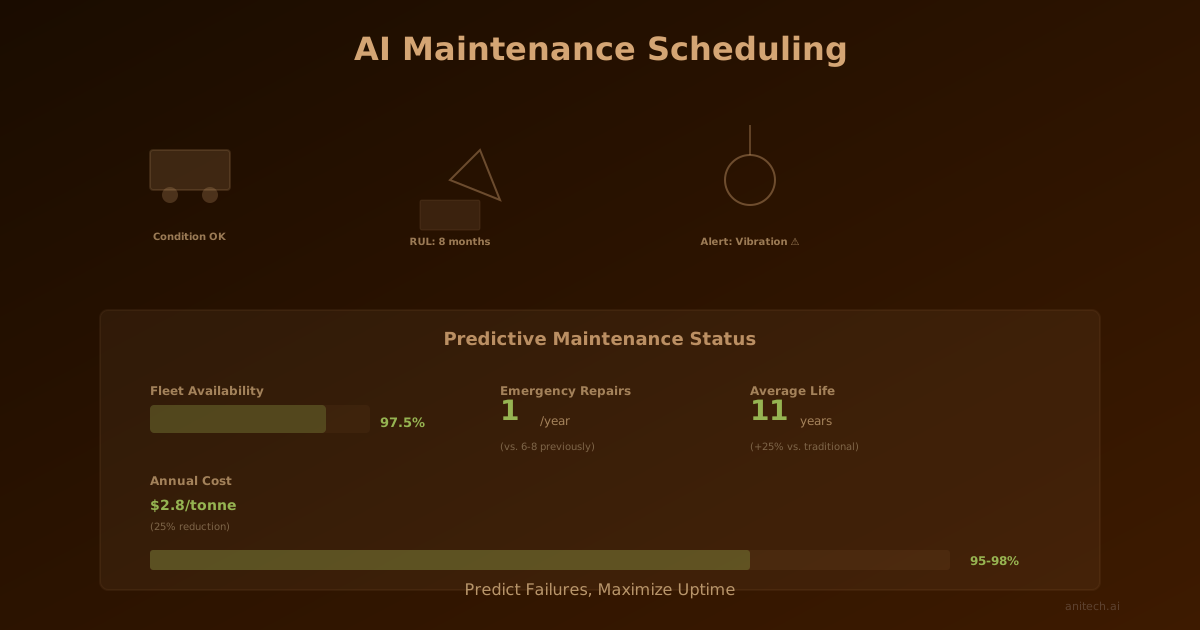
- After AI: Equipment availability 95-98% (reducing unplanned downtime through predictive maintenance)
- Benefit: Production increase from improved uptime. On a 50Mtpa operation, a 2-3% uptime improvement equals 1Mt additional annual production
Maintenance Cost Reduction
- Before AI: Maintenance cost $3-5 per tonne of ore processed
- After AI: Maintenance cost $2.5-4 per tonne (20-25% reduction from optimized intervals and reduced emergency repairs)
- Benefit: 50Mtpa operation saves $25-50M annually from maintenance cost reduction
Equipment Life Extension
- Before AI: Equipment replaced after 8-10 years based on age
- After AI: Equipment reliably operates 10-12 years (25-50% life extension through condition-based maintenance)
- Benefit: Deferred capital expenditure, stretched equipment life
Safety Improvement
- Unplanned failures eliminated: Fewer unexpected equipment failures reduce safety incidents from equipment operating in degraded condition
- Incident reduction: Mining safety improves when equipment operates reliably
Overall Economic Impact
- Uptime improvement: 2-3% uptime improvement on 50Mtpa = $30-50M production value
- Maintenance savings: $25-50M annual cost reduction
- Equipment life extension: Deferred capital replacement saves $20-50M in capital deferral
- Total annual value: $75-150M for typical large mining operation
Case Study: Major Australian Operator, 40Mtpa
A large Australian mining company implementing AI maintenance scheduling.
Baseline metrics (Year 1):
– Equipment availability: 93%
– Maintenance cost: $4.20/tonne
– Unplanned equipment failures: 6-8 annually
– Emergency maintenance as % of total: 35%
Implementation (16 weeks):
– Installed sensors on 25 pieces of critical equipment
– Integrated 5 years of maintenance history
– Developed predictive models for major equipment types
– Trained maintenance team (30+ personnel)
Results (Year 2, after 12 months operation):
– Equipment availability: 96.5% (3.5% improvement)
– Maintenance cost: $3.15/tonne (25% reduction)
– Unplanned equipment failures: 1-2 annually (75% reduction)
– Emergency maintenance as % of total: 12%
Business impact:
– Uptime improvement: 40Mt × 3.5% = 1.4Mt additional production = $21M value (at $15/t)
– Maintenance cost savings: 40Mt × ($4.20-$3.15) = $42M
– Emergency repair cost avoidance: Estimated $8-10M
– Capital expenditure deferral: Estimated $15-20M
– Estimated annual value: $86-93M
Key success factors:
– Strong operations and maintenance team alignment and buy-in
– Investment in comprehensive sensor infrastructure
– Disciplined data collection and quality control
– Regular communication between operations, maintenance, and planning teams about predicted failures
Advanced Features: Prognostic Maintenance
Most sophisticated implementations develop advanced capabilities:
Seasonal and Duty Adaptation
Equipment operates differently in different conditions:
- Summer vs. winter: Equipment operating in hot conditions experiences different wear patterns than cool conditions
- Heavy vs. light duty: Equipment operating under heavy load experiences faster wear
- Environmental factors: Humidity, dust levels, and other environmental factors affect failure rates
- Adaptive maintenance: AI adjusts maintenance intervals based on predicted seasonal and duty impacts
Supply Chain Integration
Maintenance scheduling integrates with supply chain:
- Spare parts availability: Scheduling maintenance when required spare parts are available
- Parts procurement: Predicting which parts will be needed, enabling advance procurement
- Equipment availability: Coordinating maintenance across multiple pieces of equipment to ensure spare equipment availability
- Supply shortage management: When supply chain disruptions occur, adjusting maintenance schedules to stretch equipment life
Cross-Site Portfolio Optimization
For multi-site operations:
- Best practice sharing: Learnings from one site inform maintenance practices at others
- Resource coordination: Coordinating specialized maintenance expertise across sites
- Parts inventory: Optimizing spare parts inventory across portfolio
- Performance benchmarking: Comparing maintenance performance across sites
Integration with Autonomous Operations
Advanced implementations integrate with autonomous equipment:
- Continuous monitoring: Autonomous equipment enables continuous operation, generating constant sensor data
- Real-time adaptation: Real-time maintenance recommendations adjust operation plans as equipment condition evolves
- Coordinated maintenance: Maintenance is scheduled for autonomous equipment without manual intervention complications
Regulatory and Safety Considerations
Mining equipment maintenance is regulated in Australia:
Work Health and Safety
- Equipment safety: Equipment must be maintained in safe operating condition per WHS legislation
- Inspection requirements: Regular inspections verify equipment safety
- Failure incident reporting: Equipment failures causing incidents must be reported to regulators
- Risk management: Predictive maintenance reduces risk of equipment failure causing incidents
Product Liability and Warranties
- Manufacturer requirements: Equipment manufacturers often require specific maintenance schedules
- Warranty compliance: Following recommended maintenance preserves warranties
- Liability protection: Proper maintenance documentation protects against liability claims
Frequently Asked Questions
Q: Won’t unplanned downtime increase if we extend maintenance intervals?
Contrary to intuition, properly executed condition-based maintenance reduces unplanned downtime. The key is that maintenance is scheduled before failure occurs, not deferred hoping nothing breaks. A truck with predicted RUL of 2 weeks is scheduled for maintenance in week 1, before failure. Unplanned downtime is prevented.
Q: What if sensor data is unreliable?
Sensor reliability and data quality are critical. Implementation includes substantial focus on sensor installation, calibration, and data validation. Initial implementations often reveal sensor issues; these are corrected. The system is designed to work with real-world, imperfect data, not perfectly clean data.
Q: Will maintenance technicians resist AI recommendations?
Experience is mixed. Most maintenance professionals appreciate data-driven recommendations that help them do their jobs better. Resistance typically occurs when implementation is perceived as threatening job security. Success requires clear communication that AI augments technician expertise, not replaces it.
Q: How do we validate that AI predictions are accurate?
Validation is built into implementation. As equipment operates, results are tracked against predictions. Did predicted failures materialize? Did unexpected failures occur? Over time, prediction accuracy is validated and refined. Initial implementations typically see 80-90% prediction accuracy; accuracy improves over time.
Q: What about equipment that’s mission-critical and can’t afford any downtime?
These are exactly the equipment benefiting most from predictive maintenance. For mission-critical equipment, spare capacity can be maintained (a backup truck, shovel, etc.). Planned maintenance removes equipment from service when spares are available; unplanned failures occur regardless. Predictive maintenance enables planned downtime when spares are available.
Q: How long before we see ROI?
Benefits appear in the first 3-6 months. Unplanned downtime reduction is immediate; uptime improvement follows within months. Maintenance cost reduction appears within 6-12 months as optimized intervals mature. Equipment life extension appears over 2-3 years.
Implementation Timeline and Investment
Typical AI maintenance scheduling implementation requires:
Timeline: 16-20 weeks from project initiation through full operational deployment
Investment: $200-400K depending on:
– Number of pieces of equipment with sensors
– Sensor types and installation complexity
– Historical data quality and availability
– Integration with existing CMMS systems
Return on investment: For a mining operation with $10M+ annual maintenance spend, typical ROI is 2-4 months. Implementations pay for themselves quickly.
Moving Forward
Equipment maintenance practices are evolving. Mining companies that implement AI-based predictive maintenance gain competitive advantage through higher equipment availability, lower maintenance costs, and extended equipment life. The technology is proven, implementation is straightforward, and business case is compelling.
The most sophisticated Australian mining operations are implementing this now.
Ready to bring AI to your mining operations? Talk to Anitech AI about implementing AI maintenance scheduling for your operations. We’ll assess your equipment fleet, install condition monitoring sensors, develop predictive maintenance models, and guide implementation to maximize uptime and minimize maintenance costs.
Talk to Anitech AI — Predict equipment failures, schedule maintenance strategically, maximize uptime, minimize costs. Let’s transform how your operation manages maintenance.
Further Reading
- AI Automation Australia — Complete Guide
- AI Automation in Australian Mining: The Complete Operations Guide (2025) — Industry Guide
- AI Drill and Blast Optimisation: Precision Blasting for Australian Mining Operations
- Mining Fleet Management AI: Autonomous Haulage and Dispatch Optimisation
- AI Tailings Management: Smarter Waste Processing and Rehabilitation
- Autonomous Mining Equipment and AI: How Australian Mines Are Running 24/7 With Fewer People