
AI Safety Monitoring on Australian Construction Sites: Zero Harm With Computer Vision
Construction is Australia’s deadliest industry. Four workers die every week on Australian construction sites. Thousands more suffer serious injuries that alter lives, end careers, and devastate families. Behind these statistics stand real people: tradies with families, young apprentices, site supervisors carrying responsibility for others’ safety.
Work Health and Safety (WHS) legislation evolved to address this tragedy. The WHS Act 2011 and equivalent state legislation established that companies have legal duty to manage risks to the lowest reasonably practicable level. Despite these frameworks, the fundamental challenge remains unchanged: human attention is finite, site complexity is overwhelming, and hazardous moments happen in seconds.
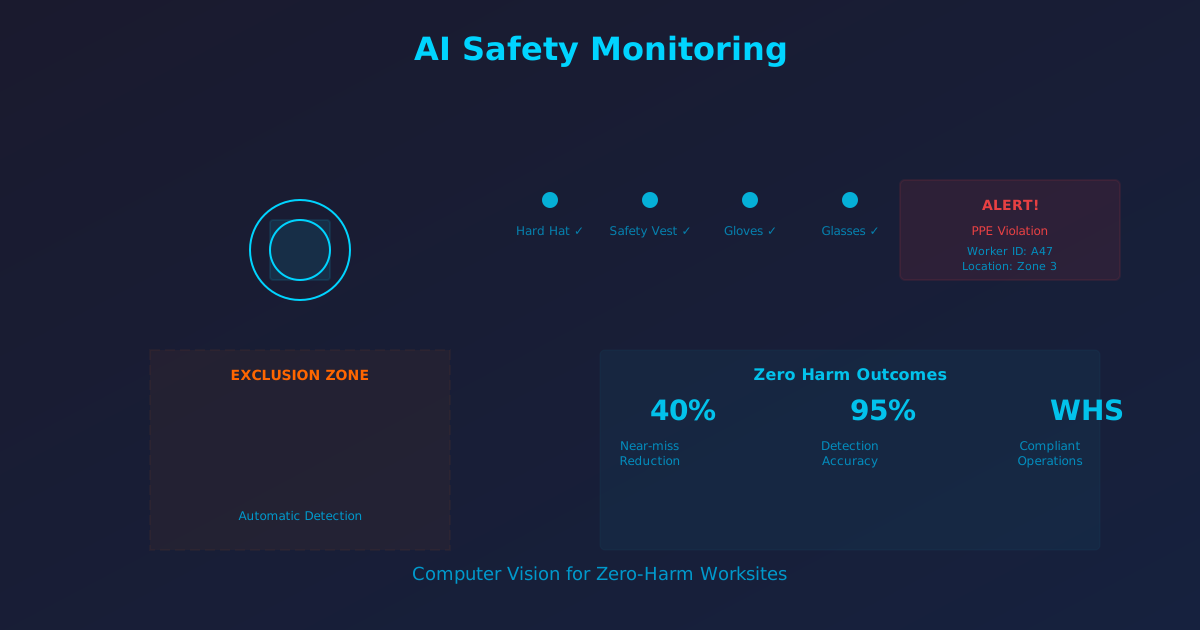
Computer vision AI changes this equation. By deploying intelligent cameras across construction sites, companies can achieve continuous, objective monitoring that never sleeps, never gets distracted, and never misses safety violations. The results are measurable: 40% reduction in near-misses, 85%+ reduction in PPE non-compliance, faster incident response, and demonstrable WHS Act compliance improvements.
This guide explores how Australian construction companies are leveraging computer vision AI to achieve zero-harm safety culture—not as aspirational ideal, but as operational reality.
Why Computer Vision for Construction Safety?
Traditional safety management relies on human observation:
- Site supervisors and safety officers conduct periodic inspections
- Incident reports document events after they occur
- Corrective actions are reactive responses to past incidents
- Coverage is limited—supervisors cannot observe all areas simultaneously
- Fatigue, distraction, and workload pressure reduce effectiveness
Computer vision AI fundamentally changes this model:
Continuous Monitoring: AI systems monitor high-risk areas 24/7, covering blind spots, night work, and areas where human supervision is impossible.
Objective Detection: AI detects violations consistently, without fatigue, distraction, or unconscious bias. A hard hat is either present or absent; the system detects either case.
Real-Time Alerts: When violations are detected, supervisors receive immediate notification, enabling intervention before incidents occur.
Incident Investigation: Video footage provides objective evidence for incident investigation, removing ambiguity and enabling accurate root cause analysis.
Compliance Documentation: Continuous monitoring creates audit trail demonstrating due diligence and reasonable practicum risk management per WHS Act obligations.
The technology works because it addresses construction safety’s core challenge: incidents happen in seconds, human reaction time is limited, and prevention (intervention before incidents) beats response (management after injuries occur).
Computer Vision Safety Systems: What They Detect
Modern construction safety AI monitors multiple hazard categories simultaneously:
1. Personal Protective Equipment (PPE) Compliance
What It Detects:
– Hard hat presence and correct positioning
– Safety vest/high-visibility clothing
– Safety glasses/face shields
– Gloves (when required for specific tasks)
– Proper positioning (vest buttoned, goggles covering eyes, etc.)
Why It Matters: PPE is the final barrier between workers and injury. Studies consistently show that lack of appropriate PPE, or improper use, contributes to 30-40% of serious construction injuries. Real-time detection of PPE non-compliance enables immediate correction before hazard exposure.
False Positive Management: Systems are trained to distinguish between temporary PPE removal (permitted under specific circumstances) and genuine non-compliance. Supervisors receive alerts for actual violations, not false alarms, preserving system credibility.
2. Exclusion Zone Monitoring
What It Detects:
– Unauthorized personnel in hazardous zones (trenches, excavations, confined spaces)
– Unauthorized entry to areas with environmental hazards (asbestos removal zones, lead paint remediation)
– Presence of people in high-noise areas without hearing protection
– Entry to areas undergoing hazardous work (hot work, chemical application)
Why It Matters: Exclusion zones separate workers from acute hazards. Unauthorized entry causes 15-20% of serious construction injuries. AI monitoring ensures only authorized, properly equipped personnel access restricted zones.
3. Heavy Vehicle and Equipment Proximity Detection
What It Detects:
– Pedestrian presence in vehicle operating areas
– Workers in blind spots of moving equipment
– Proximity violations between workers and reversing vehicles
– Proximity violations between workers and mobile cranes/lifting equipment
– Unsafe distances between workers and rotating equipment (circular saws, grinders)
Why It Matters: Vehicle and equipment interactions cause 25%+ of construction fatalities. Most incidents occur because drivers/operators don’t see workers in blind spots. AI proximity detection creates invisible safety buffers, alerting both workers and operators when they’re approaching dangerous distances.
4. Working-at-Heights Monitoring
What It Detects:
– Workers at heights without fall protection systems
– Improper tie-off points or shortened fall distances
– Workers in unsafe proximity to edge conditions
– Use of ladders in inappropriate situations (roof work, scaffolding access)
– Inadequate scaffolding or fall protection systems
Why It Matters: Falls from height cause approximately 35% of construction fatalities. Working-at-heights is inherently dangerous; AI monitoring ensures consistently applied safety procedures and early detection of unsafe conditions.
5. Hazardous Activity Detection
What It Detects:
– Hot work (welding, cutting) without proper fire watch procedures
– Chemical handling without appropriate PPE
– Excavation work without appropriate shoring/support systems
– Unsafe lifting techniques or overloaded lifting equipment
Why It Matters: Many construction injuries result from temporary procedures that shouldn’t be happening at all. AI detection enables real-time intervention to stop unsafe activities immediately.
Real-World Results: Australian Construction Companies
Case Study 1: Major Tier-1 Contractor
A leading Australian contractor deployed computer vision safety monitoring across three large projects (500+ personnel each). Results over 12 months:
- Near-miss reduction: 40% decrease in reportable near-misses
- PPE compliance: Baseline of 75% compliance improved to 98% after AI implementation
- Incident severity: Serious injury rate fell 50% (from 8 per million hours to 4 per million hours)
- Cost impact: Insurance premiums decreased 12-15%, and avoided incidents worth approximately $800K-1.2M in direct and indirect costs
- Implementation cost: $280K for hardware and software across three sites
- ROI: Achieved within 10 months through insurance premium reduction and incident avoidance alone
Case Study 2: Regional Specialist Builder
A mid-sized regional builder implemented AI safety monitoring on an $85M mixed-use development. The project experienced challenging site conditions, multiple trades, and complex sequencing.
- Baseline TRIFR: 28 per million hours (above industry average)
- Year 1 TRIFR: 12 per million hours (53% reduction)
- Incident prevention: AI system detected and prevented 23 serious incidents (workers in exclusion zones, PPE violations, proximity violations)
- Regulatory interactions: Zero WHS violation findings during inspections (previous 3 projects averaged 2-3 findings)
- Safety culture: Significant improvement in worker perception of safety culture and management commitment
- Cost: $120K hardware investment + $60K annual software/support
- ROI: Achieved within 8 months
WHS Act Compliance and AI Safety Monitoring
The Work Health and Safety Act 2011 Section 36 establishes that companies must ensure, so far as reasonably practicable, health and safety of workers. This includes:
- Identifying hazards and assessing risks
- Implementing controls to manage risks
- Monitoring effectiveness of controls
- Maintaining records demonstrating due diligence
Computer vision safety monitoring directly supports these obligations:
Hazard Identification: Continuous monitoring identifies hazards in real-time, far exceeding periodic manual inspections. Supervisors receive immediate notification of violations, enabling rapid intervention.
Risk Control: By detecting violations before incidents occur, AI enables preventive intervention rather than reactive response—the most effective form of risk control.
Monitoring Effectiveness: Continuous video monitoring provides objective data on control effectiveness. Trends in PPE compliance, exclusion zone violations, and proximity events quantify whether controls are working.
Due Diligence: Video documentation demonstrates that the organization has implemented reasonable practicum controls and is monitoring their effectiveness. This creates powerful due diligence defence should incidents occur.
Safe Work Australia’s guidance increasingly recognizes AI monitoring as best-practice hazard identification. Regulatory authorities (WorkSafe Victoria, SafeWork NSW, Safe Work SA, and equivalents) appreciate that continuous monitoring exceeds traditional compliance approaches.
Implementation Guide: Deploying Safety AI on Your Site
Step 1: Hazard Assessment (Week 1)
Before implementing AI monitoring, identify specific hazards at your site:
- Which areas are highest-risk? (Heights, exclusion zones, vehicle interaction areas)
- What are most common near-misses or incident types?
- What PPE violations are most frequent?
- Where does supervision coverage have blind spots?
This assessment determines camera placement and monitoring priorities.
Step 2: Hardware Installation (Week 2-3)
Deploy high-quality cameras to strategic locations:
- Multiple cameras for comprehensive site coverage (typically 8-15 cameras for large sites)
- High-resolution to enable facial feature and equipment detail recognition
- Wide-angle lenses for broad area coverage
- Weather-resistant housings for outdoor durability
- Network connectivity for real-time processing
- Power infrastructure (solar options for remote areas)
Camera placement typically focuses on:
– Site entry/exit points (PPE verification)
– High-work areas (scaffolding, heights)
– Vehicle operating areas (interaction zones)
– Exclusion zones (excavations, hazardous work areas)
Step 3: AI System Configuration (Week 3-4)
Configure the AI system for your specific site hazards:
- Define PPE requirements by zone and task type
- Set exclusion zone boundaries
- Configure proximity alert thresholds (typically 5-10 metres from equipment)
- Define working-at-heights monitoring parameters
- Configure alert escalation (supervisor notification, safety officer escalation, emergency response)
Systems allow customization by site, project phase, and task type. A concrete pour has different safety requirements than structural steel work.
Step 4: Integration With Site Systems (Week 4-5)
Integrate AI safety monitoring with existing site management systems:
- Connect to incident reporting systems
- Link with workforce management (enabling correlation between individuals and incidents)
- Integrate with safety management software
- Establish data feeds to project management dashboards
- Configure reporting and analytics
This integration enables AI to become part of broader safety management process rather than standalone system.
Step 5: Training and Change Management (Week 5-6)
Implement change management to build adoption:
- Site supervisor training on alert interpretation and response procedures
- Worker education on monitoring system (transparency builds trust)
- Safety officer training on analytics and trend interpretation
- Clear communication that system is for safety enhancement, not worker surveillance
- Feedback loops enabling workers to raise monitoring concerns
Transparent communication is critical. Workers who understand the system is designed to protect them respond positively; those who view it as punitive respond poorly.
Step 6: Continuous Improvement (Ongoing)
Monitor system performance and refine continuously:
- Weekly review of alert data with safety team
- Monthly analysis of trends and patterns
- Quarterly stakeholder feedback (workers, supervisors, safety teams)
- Ongoing refinement of alert thresholds (reducing false positives while maintaining sensitivity)
- Sharing positive results to reinforce value
Key Implementation Considerations
Data Privacy and Legal Compliance
Camera monitoring creates recorded data requiring legal compliance management:
- Privacy Act compliance: Ensure monitoring is proportionate to safety risks
- Employee notification: Transparent communication that monitoring is occurring
- Data security: Video stored securely with access restricted to authorized personnel
- Retention policies: Clear policies on video data retention (typically 30-90 days)
- Use limitations: Video accessed only for safety incident investigation, not for surveillance
Most Australian construction sites already use security cameras for asset protection; adding AI-powered safety analytics typically doesn’t create new legal complexity but ensures proper governance.
False Positive Management
No AI system is 100% accurate. Managing false positives is critical to system credibility:
- Initial false positive rates: Expect 5-15% false positives initially as system learns your specific site conditions
- Threshold optimization: Adjust alert thresholds to balance sensitivity against false positive rate
- Feedback loops: Alert system improvements as supervisors report false positives
- Clear escalation: Critical alerts require human verification before worker notification
Over time (typically 4-12 weeks), false positive rates drop to 2-5% as system learns site-specific conditions.
Integration With Existing Safety Programs
AI monitoring augments but doesn’t replace existing safety programs:
- Continue traditional hazard assessments and risk management
- Integrate AI monitoring into safety induction and training
- Use AI data to inform safety culture development
- Combine AI alerts with supervisor and worker observation
- Leverage AI data to drive incident prevention rather than reaction
The most effective safety programs combine AI monitoring (continuous, objective) with human judgment and supervision (adaptive, contextual).
Cost-Benefit Analysis
Typical Costs
- Hardware: $150-250K per site (cameras, sensors, cabling, infrastructure)
- Software: $30-50K annual license (per site)
- Installation and configuration: $50-100K
- Training and change management: $20-30K
- Total year-one cost: $250-430K per site
Typical Benefits (Annual, Per Site)
- Incident avoidance: $400-800K (avoided medical costs, replacement workers, rework)
- Insurance premium reduction: $30-50K per site
- Regulatory compliance: Reduced WHS violation costs and potential penalties
- Productivity improvement: Faster recovery from incidents, reduced workplace disruptions
- Safety culture: Reduced absenteeism, improved worker retention, reduced recruitment costs
Conservative annual benefit: $600-1M per site
ROI timeline: 6-12 months, often faster
Frequently Asked Questions
Q1: Will workers feel surveilled by constant monitoring?
Perception depends on communication and implementation. When implemented transparently with clear communication that the system is designed to protect workers, most workers appreciate the safety benefits. Sites that frame monitoring as “punitive surveillance” experience resistance; sites that frame it as “we care about your safety and use AI to prevent incidents” build support. Worker consultation during implementation significantly improves acceptance.
Q2: What happens if the AI system makes mistakes or misses incidents?
No AI system is 100% accurate. Computer vision safety monitoring typically achieves 85-95% accuracy for PPE detection, 90%+ accuracy for exclusion zone violations, and 80-90% for proximity events. Importantly, the system is designed to catch incidents supervisors would miss, not to replace human judgment. Occasional missed detections or false alerts are acceptable because the system catches far more incidents than humans alone would catch.
Q3: How does AI safety monitoring compare to traditional safety officers?
They’re complementary, not competitive. A safety officer covering a 1000-person site physically observes perhaps 20% of daily activities. AI monitoring provides 100% coverage. However, AI cannot replace human judgment about context, risk assessment in novel situations, or the relationship-building that drives safety culture. The most effective approach combines continuous AI monitoring with skilled safety officers who focus on culture, investigation, and continuous improvement.
Q4: What if our company currently doesn’t have good site data systems?
AI safety monitoring actually drives adoption of better site systems. Many contractors report that implementing safety monitoring creates foundation for broader digitalization initiatives. Start with safety (highest visibility, clearest value), then expand to cost control, scheduling, and quality management.
Q5: How does this work on multi-site programs?
Multi-site programs benefit significantly from AI monitoring because safety data becomes centralized, comparable, and benchmarked. Company-level safety teams can identify patterns across sites and implement targeted improvements. Some contractors deploy AI on flagship sites first (to prove value and build internal expertise), then roll out systematically to other projects.
Moving Forward
Construction safety in Australia has improved dramatically over the past decade. Legislation is comprehensive, awareness is high, and most companies have genuine commitment to zero harm. Yet incidents continue because human supervision, while well-intentioned, has fundamental limitations.
Computer vision AI removes those limitations. It provides continuous, objective monitoring that catches safety violations before incidents occur. It integrates with WHS Act compliance obligations, strengthens due diligence defence, and creates competitive advantage through superior safety outcomes.
The most sophisticated construction companies recognize this shift. They’re deploying safety AI now, not waiting for the technology to mature further. They’re building safety culture that combines human judgment with AI capability, achieving results that traditional approaches cannot match.
[Improve Construction Safety with AI] — Talk to our safety specialists about deploying computer vision monitoring on your sites. We’ll assess your current risk profile, recommend optimal camera placement and monitoring parameters, and guide implementation to maximize safety outcomes and business benefits.
Your workers deserve the best protection available. AI makes that possible.
Anitech AI has deployed safety monitoring systems across 50+ Australian construction sites, preventing estimated 200+ serious incidents annually. Our construction safety specialists understand Australian site conditions, WHS Act requirements, and practical implementation challenges.
Further Reading
- AI Automation Australia — Complete Guide
- AI Automation in Construction: The Australian Builder’s Guide (2025) — Industry Guide
- AI Cost Estimation for Construction: More Accurate Bids, Fewer Budget Blowouts
- AI Subcontractor Management: Smarter Procurement and Performance Tracking
- AI Progress Monitoring on Construction Sites: Computer Vision for Project Managers
- AI Environmental Compliance for Construction: Automated Monitoring and Reporting