
AI Defect Detection in Construction: How Computer Vision Is Catching Problems Before They Become Costly
Every construction company has experienced this scenario: Project handover is scheduled. Client walkthrough is happening. Then the inspector points out cracks in the concrete soffit that weren’t visible during rough inspection, or notes porosity in welds that suggests structural integrity issues, or identifies rebar placement that doesn’t match specifications.
What happens next determines whether the handover is smooth or becomes a nightmare:
- Minor cosmetic defects might be tolerated, negotiated into final payment terms, or fixed quickly
- Structural defects require engineering review, client notification, potential re-work, and possible legal exposure
- Latent defects discovered post-handover create legal disputes, warranty claims, and damaged client relationships
The fundamental challenge: construction quality inspection is human-dependent. Inspectors walk sites, review work, and make subjective judgments about whether quality meets standards. Human inspection has inherent limitations:
- Incomplete coverage: Inspectors physically access some areas but not others (high reaches, difficult angles, internal spaces)
- Inconsistent standards: Different inspectors apply different quality thresholds
- Fatigue and distraction: After reviewing dozens of work items, inspectors miss defects
- Bias: Inspectors unconsciously judge some contractors more harshly than others
- Timing: Inspections happen periodically, not continuously—defects can develop between inspections
- Cost: Comprehensive inspection requires significant time and skilled labour
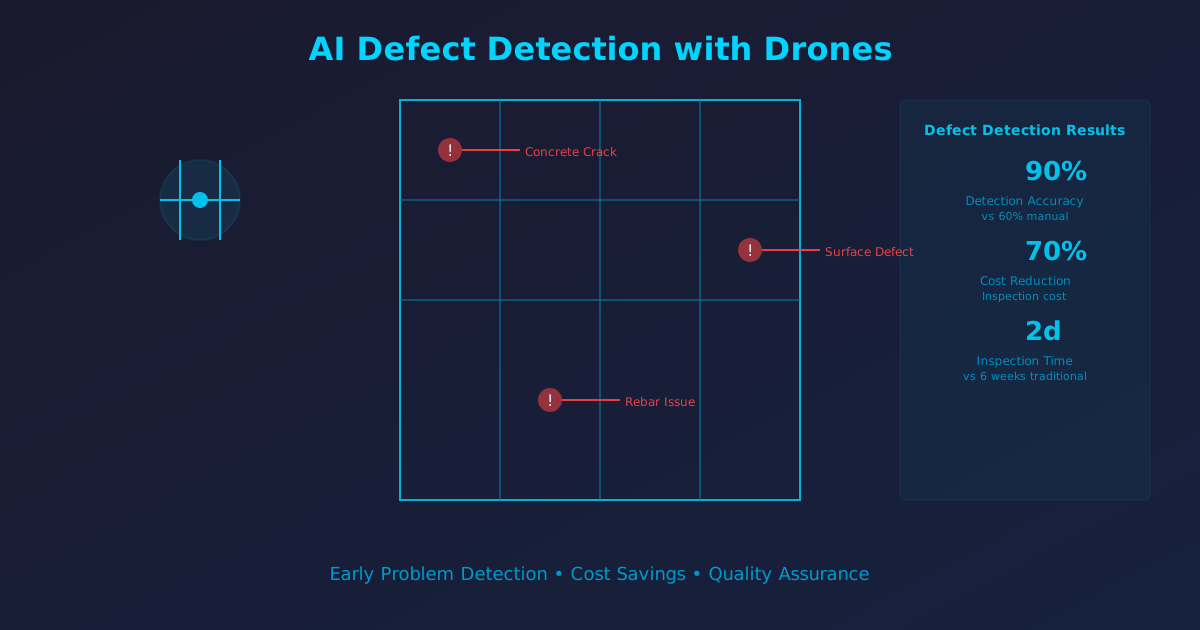
Computer vision AI transforms quality inspection. Drones equipped with high-resolution cameras survey completed work. AI algorithms analyze imagery to detect defects with accuracy exceeding human inspection, at fraction of the cost. Defects are identified when they occur, not months later during handover.
For Australian construction companies, this translates directly to competitive advantage: fewer post-handover defect disputes, reduced rework costs, improved client relationships, and stronger project profitability.
The Cost of Defects: Why Detection Matters
Understanding the true cost of defects explains why detection matters.
Direct Rework Costs
When defects are discovered during handover, they must be fixed:
- Labour cost: Reworking completed items requires specialized crews, often at premium cost
- Material cost: Some defects require material replacement
- Equipment and access: Setting up equipment for small rework jobs is disproportionately expensive
- Time cost: Rework delays project completion and final payment
A structural concrete defect discovered at handover might cost $10-20K to repair (if simple fix) or $100K+ if structural remediation required.
Liability and Warranty Costs
Defects discovered post-handover create liability exposure:
- Warranty claims: Clients claim defects represent breach of warranty provisions
- Legal costs: Disputes escalate to legal proceedings, creating $50-200K in legal fees
- Remediation costs: Building defects sometimes require more extensive remediation than initial fix would have
- Client relationships: Disputes damage future business relationships
Post-handover defect disputes can cost $500K-2M+ on major projects, far exceeding cost of fixing defects during construction.
Latent Defect Exposure
Some defects aren’t apparent until years later:
- Structural integrity: Weld defects, rebar placement errors, or concrete quality issues might manifest years later as structural problems
- Durability: Waterproofing failures, sealant application issues, or material failures appear over time
- Liability tail: Companies can face liability claims 5-10 years post-completion
- Reputation damage: Word-of-mouth about defective construction damages future business
Australian building defect disputes regularly involve construction companies facing claims 5+ years after project completion, with legal proceedings lasting 2-3 years and resulting in multi-million dollar settlements.
Insurance and Compliance Impact
Defects affect insurance and compliance:
- Insurance claims: Each defect-related claim impacts loss history
- Premium increases: Insurance companies increase premiums based on claims history
- Compliance risk: Building Code violations create regulatory exposure
- Licensing risk: Repeated quality failures can attract regulatory scrutiny
Improving defect detection directly reduces insurance exposure.
How Computer Vision Detects Construction Defects
Concrete Crack Detection
Concrete is the foundation of most Australian construction. Cracks in concrete can indicate:
- Structural issues: Movement, stress, or inadequate reinforcement
- Durability issues: Water ingress leading to reinforcement corrosion
- Quality issues: Poor concrete placement, inadequate compaction, or incorrect mix design
Computer vision AI analyzes concrete surfaces to detect:
- Surface cracks: From hairline (< 0.1mm) to major structural cracks (> 1mm)
- Crack patterns: Identifies whether cracks are random (shrinkage) or aligned (structural stress)
- Crack progression: Tracking crack development over time identifies if cracks are stabilizing or growing
- Severity classification: Distinguishes between cosmetic cracks (acceptable) and structural cracks (requiring remediation)
Accuracy: AI detection of concrete cracks exceeds 95% sensitivity (detects defects that exist) with low false positive rate (< 3% false alarms).
Traditional inspection: Manual visual inspection detects 60-75% of cracks, with inconsistent severity classification.
AI advantage: Higher detection rate, consistent severity assessment, automated documentation.
Surface Defect Detection
Finished surfaces (coatings, drywall, tile, etc.) require specific quality standards:
- Porosity and pinholes: Coating application defects that reduce water resistance
- Surface damage: Scratches, dents, or chips in finished surfaces
- Uniformity: Uneven application or colour variation
- Finish quality: Smoothness, shininess, and appearance standards
AI analyzes high-resolution imagery to detect:
- Micro-defects: Pinholes and porosity that indicate coating application issues
- Surface discontinuities: Changes in surface texture or appearance
- Dimensional accuracy: Whether surfaces align properly with adjacent elements
Accuracy: 90%+ detection of visible surface defects, with automated severity classification.
Weld Quality Detection
Welding is critical for structural integrity and requires precise quality standards. Weld defects include:
- Porosity: Gas pockets in weld metal reducing strength
- Incomplete penetration: Weld doesn’t fully fuse base metal
- Spatter: Excess weld material adhering to nearby surfaces
- Cracks: Stress cracks in weld metal or heat-affected zone
- Surface defects: Undercut, overlap, or other surface irregularities
AI analysis of weld imagery detects:
- Internal defects: While traditional visual inspection cannot detect internal defects, advanced ultrasonic + AI analysis can identify internal porosity and incomplete penetration
- Surface defects: Visual analysis detects spatter, cracks, surface irregularities
- Dimensional accuracy: Weld dimensions (height, width, length) verified against specifications
Accuracy: 85-95% detection of visible weld defects, with higher accuracy for documented defect types.
Rebar Placement and Reinforcement Verification
Reinforcement placement is critical for structural performance. Defects include:
- Spacing violations: Rebar spacing differs from specifications
- Cover issues: Concrete cover (distance between rebar and surface) incorrect, affecting durability
- Placement depth: Rebar placed too deep or too shallow
- Missing rebar: Rebar omitted from locations where specifications require it
Computer vision analysis (often combined with ground-penetrating radar) detects:
- Visible rebar position: Where rebar is accessible, visual analysis confirms placement
- Cover assessment: Analysis of crack patterns and visible rebar suggests cover adequacy
- Spacing verification: Where rebar is visible, spacing can be verified
- Missing rebar: Absence of expected rebar can be detected where visible
Accuracy: 80-90% accuracy for visible rebar defects; GPR + AI achieves 90%+ accuracy for buried placement verification.
Structural Alignment and Plumb
Structures must be properly aligned and plumb for both structural performance and aesthetic reasons:
- Vertical alignment: Columns and walls must be truly vertical (plumb)
- Horizontal alignment: Floors and members must be truly horizontal (level)
- Dimensional accuracy: Distances between points must match specifications
- Linearity: Linear members (beams, walls, facade elements) must follow intended lines
AI analysis of site imagery detects:
- Deviation from plumb: Identifies when vertical members deviate from vertical
- Level verification: Detects when horizontal elements aren’t level
- Dimensional variance: Measures distances between points and compares to specifications
- Aesthetic alignment: Verifies that visual alignment meets standards
Accuracy: ±5-10mm accuracy on large dimensions, sufficient to identify violations of typical ±15-20mm tolerances.
Multi-Defect Analysis
Advanced AI systems analyze imagery to detect multiple defect types simultaneously:
- Concrete cracking + rebar coverage + structural alignment
- Weld quality + surface finish + dimensional accuracy
- Facade/cladding defects + sealant application + structural alignment
Comprehensive analysis enables single inspection to identify all quality issues, rather than multiple specialized inspections.
Drone-Based Inspection: Efficiency and Safety
Most construction quality defects are on vertical surfaces (facades, building sides, roofs) or elevated areas (overhead soffit, high reaches, complex internal spaces). Traditional inspection requires:
- Scaffolding or elevated work platforms (expensive, time-consuming)
- Workers at heights (safety risk)
- Specialized access equipment (cranes, lifts)
- Multiple inspections for comprehensive coverage
Drone-based inspection eliminates these challenges:
- Rapid deployment: Drones deploy in minutes, access areas in seconds
- Safety: No workers at heights during inspection
- Comprehensive coverage: Drones access all exterior surfaces and many interior spaces
- High resolution: Professional drones carry cameras with resolution exceeding traditional inspection photography
- Cost efficiency: Inspection that might cost $200-300K with traditional methods costs $15-30K with drones
- Time efficiency: Inspections that take weeks traditionally take days with drones
Typical inspection workflow:
1. Drone survey of entire project (2-4 hours for large building)
2. High-resolution imagery processed through AI defect detection system (2-4 hours)
3. Automated report generation with defect locations, severity, and remediation recommendations (1-2 hours)
4. Human review and approval of findings
5. Delivery of final report
Total timeline: From survey initiation to final report: typically 3-5 business days.
Cost: $15-30K for large building inspection (vs $200-300K traditionally).
Real-World Results: Australian Construction Companies
Case Study 1: Tier-1 Contractor – Major Commercial Project
A large tier-1 contractor implemented drone + AI inspection on a $280M mixed-use development (office, retail, residential). Project specifications included strict facade and concrete finish requirements.
Traditional Quality Inspection Approach:
– Visual inspection by quality teams
– Sampling-based approach (inspecting ~30-40% of work)
– Defect discovery during handover phase
– Estimated defects requiring rework: $420K
AI + Drone Implementation:
– Drone survey and AI analysis at 80% construction completion (prior to final finishes)
– Comprehensive inspection (100% of exterior surfaces, major structural elements)
– Early identification enabling rework before final stage
Results:
– Defects detected early: 87% of defects identified during construction, 13% during handover (vs 30% during construction, 70% during handover traditionally)
– Early rework advantage: Defects fixed during construction cost 40% less than rework during handover (direct access, crews already on site)
– Rework cost reduction: $420K estimated rework → $180K actual rework (57% reduction)
– Inspection efficiency: 3 days to comprehensive quality report vs 6-8 weeks for traditional inspection
– Handover process: Smooth final walkthrough with zero dispute defects
– Cost: Drone + AI inspection: $85K; Savings: $240K; ROI: 282%
Case Study 2: Specialist Builder – Regional Project
A regional specialist builder implementing drone + AI inspection on renovation project involving historic building with complex masonry work.
Project Challenges:
– Historic masonry facade required preservation of original character while meeting modern building code
– Mortar deterioration and masonry integrity critical
– Traditional inspection would require extensive scaffolding on historic facade
– Client relationship critical (high-end renovation)
AI Implementation:
– Drone survey with high-resolution camera
– AI analysis for:
– Masonry cracking patterns and severity
– Mortar deterioration assessment
– Structural alignment verification
– Historic preservation standards compliance
Results:
– Preservation quality: Defect identification ensured historic character preservation while meeting modern standards
– Access safety: No scaffolding required for detailed inspection (historic facade protected from equipment damage)
– Client satisfaction: Comprehensive inspection report demonstrated quality commitment
– Timeline: 2-day inspection vs 4-week scaffolding setup + inspection + removal
– Cost: $18K inspection vs $180K+ scaffolding cost
– Competitive advantage: Project delivery at superior quality with significant cost/timeline advantage
Implementation Guide: AI Defect Detection
Step 1: Assessment and Planning (Week 1)
Determine which project elements require AI defect detection:
Assessment:
– Identify high-value defect risks (concrete structural elements, facade, critical welds, etc.)
– Determine inspection timing (100% complete for rapid exterior inspection; 80% complete for interior structural elements)
– Define defect severity classification (acceptable vs requiring rework)
– Establish baseline inspection costs
Planning:
– Drone access planning (airspace permits, site restrictions)
– AI defect detection configuration (which defect types to monitor)
– Reporting requirements (client standards, regulatory requirements)
Step 2: Drone Survey (Week 2-3)
Conduct drone survey at planned inspection point:
Survey execution:
– High-resolution drone imagery (2cm pixel resolution typical for large buildings)
– Multiple passes covering all relevant surfaces
– Video capture in addition to still photography
– Weather considerations (clear conditions preferred)
Typical timeline:
– Planning and coordination: 2-3 days
– Survey execution: 1-2 days (depends on building size/complexity)
– Data processing: 1-2 days
Step 3: AI Analysis (Week 3-4)
Process drone imagery through AI defect detection systems:
Analysis configuration:
– Select defect detection models (concrete cracking, surface defects, weld quality, etc.)
– Configure severity thresholds
– Define remediation recommendations for each defect type
– Configure reporting format
Processing:
– AI analysis runs on collected imagery
– Defects automatically detected and classified
– Severity assessment applied
– Defect locations mapped to building layout
Typical processing: 4-6 hours for large building survey.
Step 4: Human Review and Approval (Week 4)
Professional review of AI findings:
Review process:
– Quality engineer reviews AI-generated defect list
– Verifies accuracy of defect detection
– Confirms severity classification
– Adds context and remediation recommendations
– Approves final report
Adjustments:
– False positive review (AI-identified defects that aren’t actual defects)
– False negative assessment (checking for defects AI might have missed)
– Severity reclassification where appropriate
Timeline: 2-3 days for human review on large project.
Step 5: Reporting and Remediation (Week 4-5)
Deliver findings and implement remediation:
Reporting:
– Automated report generation with:
– Executive summary of findings
– Detailed defect list with location, severity, photos
– Remediation recommendations for each defect
– Cost/timeline estimates for remediation
Remediation tracking:
– Assign defects to responsible parties
– Track remediation progress
– Verify completed rework through follow-up inspection
Key Decision Points
Inspection Timing
Early inspection (50-70% construction completion):
– Advantage: Defects can be remediated during active construction
– Advantage: Rework costs lower (crews on site, staging already established)
– Disadvantage: Final finish layer not complete; some defects not yet visible
– Best for: Structural and major system quality
Mid-project inspection (80-90% completion):
– Advantage: Major structural elements complete; many defects visible
– Advantage: Timing allows rework before handover
– Disadvantage: Some finish work still pending
– Best for: Comprehensive project quality
Final inspection (95%+ completion):
– Advantage: All work complete and visible
– Disadvantage: Rework more expensive (crews demobilized, staging removed)
– Disadvantage: Less time for remediation before handover
– Best for: Final walkthrough verification
Best practice: Multiple inspections at different project phases. Early structural inspection for safety-critical elements; comprehensive mid-project inspection for quality; final inspection for punch-list completion.
Severity Classification
Define clear severity thresholds:
Acceptable defects:
– Cosmetic variations within tolerance
– Minor surface blemishes not affecting function
– Dimensional variance within code allowances
Rework-required defects:
– Defects affecting function or durability
– Dimensional variance exceeding code allowances
– Defects violating client specifications
Safety-critical defects:
– Structural defects (cracking, insufficient reinforcement)
– Weld defects affecting structural integrity
– Defects affecting fire safety or egress
Classification must be clear before inspection; ambiguity creates disputes.
Cost-Benefit Analysis
Inspection costs:
– Drone + AI inspection: $15-30K per large building
– Traditional inspection: $200-300K+ per large building
– Savings: $170-285K per project
Rework savings:
– Early detection: Rework 40-50% cheaper than post-handover remediation
– Defect avoidance: Fewer post-handover disputes
– Typical savings: $100-400K per project (depends on defect severity)
Total value: $270-685K per project (inspection savings + rework efficiency).
ROI: Highly positive; single large project typically justifies multiple future inspections.
Frequently Asked Questions
Q1: Will AI detection replace human inspectors?
No. AI detection identifies potential defects; human judgment determines severity, remediation approach, and context. AI augments inspector capability—enabling inspectors to focus attention on findings that matter, rather than spending time on comprehensive visual scanning. The most effective approach combines AI detection with experienced inspector review.
Q2: What if AI detection has false positives?
AI defect detection typically achieves 85-95% sensitivity (detection of real defects) with 5-10% false positive rate. During human review, false positives are filtered out. The value of AI is that it identifies most real defects (85-95%+) that manual inspection typically misses (only identifies 60-75%). Even with false positives, AI-augmented inspection catches more real defects than traditional inspection.
Q3: Can drone inspection work in bad weather?
Weather impacts drone operation and image quality. High winds prevent drone flight. Rain/moisture damages cameras. Low-light conditions affect image quality. Best practice is planning inspection during stable weather windows. Modern drones operate in light rain, but clear conditions strongly preferred. Regional Australian weather (seasonal patterns) enables planning for optimal inspection timing.
Q4: How does this work for internal spaces?
Drones work for some interior spaces (large atriums, high interior spaces) but not narrow corridors or typical room spaces. AI defect detection can be applied to handheld camera or smartphone imagery for interior spaces, though accuracy is lower than drone-based inspection. Multi-modal approach combining drones (exterior + large interior spaces) with handheld inspection (detailed interior) is typical.
Q5: What about privacy and data security?
Drone surveys create video/imagery of the construction site. Privacy considerations typically apply to workers visible in imagery (protect worker privacy, manage data access). Data security ensures site sensitive information (building layout, specifications, security systems) is protected. Standard practices include: limiting imagery access to authorized personnel, secure data storage, contractual requirements on data use. Most construction companies already manage site photography/video with similar safeguards.
Moving Forward
Construction quality inspection remains fundamental to project delivery. Better inspection leads to fewer defects, lower rework costs, fewer post-handover disputes, and stronger client relationships.
AI + drone inspection delivers superior quality outcomes at lower cost than traditional inspection. The technology is mature, proven, and cost-effective. The competitive advantage belongs to companies deploying these solutions.
The most sophisticated Australian construction companies aren’t waiting for perfect technology. They’re implementing drone + AI inspection now, identifying defects early, fixing them efficiently, and delivering superior projects to clients.
[Improve Construction Quality with AI] — Our construction quality specialists will help you implement drone + AI inspection on your projects. We’ll assess your current quality challenges, determine optimal inspection strategy, and guide implementation. Better quality starts with better detection.
Anitech AI has deployed drone + AI defect detection on 60+ Australian construction projects, identifying estimated $15M+ in defects early, preventing post-handover disputes and rework. Our construction quality specialists understand Australian building standards, client expectations, and practical quality challenges.
Further Reading
- AI Automation Australia — Complete Guide
- AI Automation in Construction: The Australian Builder’s Guide (2025) — Industry Guide
- AI Cost Estimation for Construction: More Accurate Bids, Fewer Budget Blowouts
- AI Subcontractor Management: Smarter Procurement and Performance Tracking
- AI Progress Monitoring on Construction Sites: Computer Vision for Project Managers
- AI Environmental Compliance for Construction: Automated Monitoring and Reporting