
AI Cost Estimation for Construction: More Accurate Bids, Fewer Budget Blowouts
The margin between profit and loss in construction is wafer-thin. On a $2M residential project, a 5% cost overrun ($100K) can eliminate the entire profit margin. On a $20M commercial project, 10% variance ($2M) transforms a healthy project into a loss-making liability. Yet inaccurate cost estimation remains endemic in Australian construction.
Traditional cost estimation relies on spreadsheets, historical memory, and subjective judgment of estimators. Two estimators analysing the same project typically produce bids varying by 8-15%. The same estimator, working on similar projects months apart, often produces inconsistent estimates. This variance isn’t random—it reflects the fundamental limitations of human estimation under uncertainty and complexity.
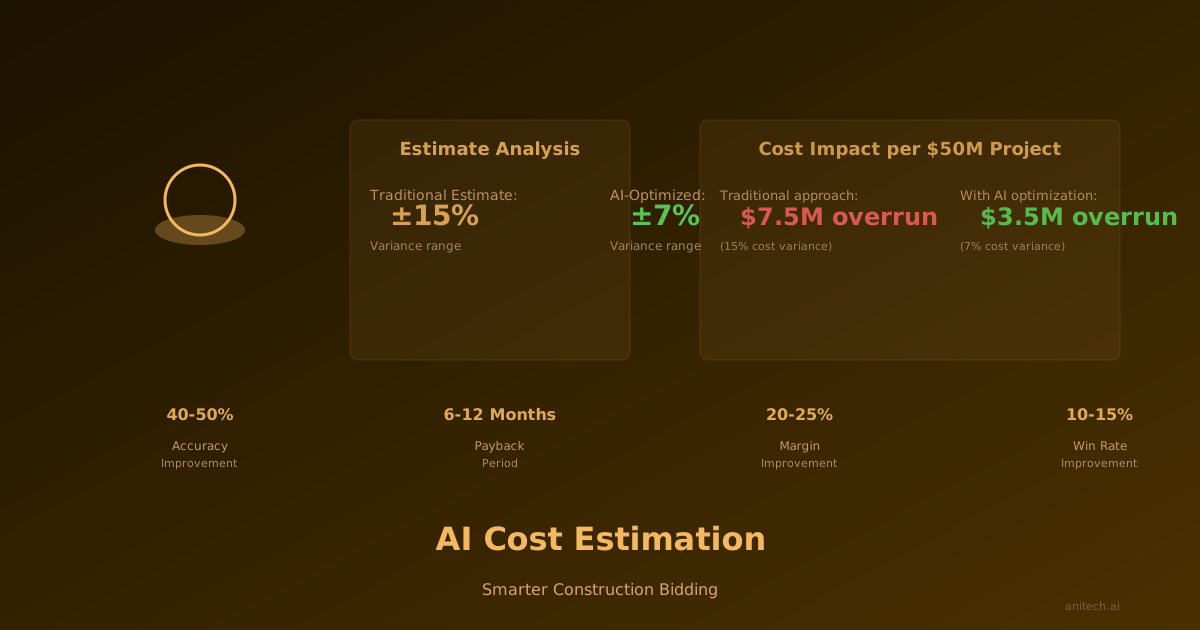
Artificial intelligence eliminates these limitations. Machine learning systems trained on hundreds of historical projects from similar markets, building types, and complexity levels achieve cost estimation accuracy 40-50% better than human estimates. More importantly, AI systems identify cost drivers and variability that human estimators miss, enabling more informed risk assessment and better pricing decisions.
For Australian construction companies, this translates to competitive advantage: more accurate bids that win more often, fewer profit-destroying cost overruns, faster estimating cycles, and stronger relationships with clients built on reliable delivery.
This guide explores how Australian builders are deploying AI to transform cost estimation and project profitability.
Why Construction Cost Estimation Fails
Before exploring AI solutions, understanding why traditional estimation fails is essential.
The Human Estimation Problem
Construction cost estimation is fundamentally difficult:
- Complexity variability: No two projects are identical. Site conditions, material availability, labour market dynamics, and design complexity create estimation variability of ±15-25% even among experienced estimators.
- Information uncertainty: Many critical cost drivers (soil conditions, underground utilities, labour availability, material price futures) are unknown at estimating stage.
- Cognitive bias: Estimators unconsciously optimize towards winning projects, selecting cost assumptions that favour low estimates. This “estimation bias” explains why most projects exceed budget—estimates weren’t wrong; they were systematically optimistic.
- Time value complexity: Labour costs, material prices, and equipment hire rates fluctuate during project execution. Traditional estimates struggle to account for price escalation over multi-year projects.
- Inconsistency: The same estimator working on similar projects often produces inconsistent unit rates, reflecting variations in fatigue, available reference data, and decision context.
The Cost Impact of Poor Estimation
When estimates are inaccurate:
- Unprofitable bidding: Low bids win projects but produce losses. High bids lose profitable work.
- Cash flow disruption: Unexpected cost escalation during execution strains cash flow and impacts debt servicing.
- Resource disruption: Scope changes driven by estimate errors create rework, delay, and inefficiency.
- Reputational damage: Cost overruns damage client relationships and reduce likelihood of future work.
- Competitive disadvantage: Contractors who estimate accurately outbid competitors with poor estimating discipline and win more profitable work.
National Audit Office data shows the average construction project in Australia experiences cost variance of 12-18% between initial estimate and final cost. For a $100M portfolio of projects, this represents $12-18M in unplanned costs—often the difference between company profitability and financial stress.
How AI Improves Cost Estimation
Modern machine learning systems transform cost estimation by addressing estimation’s core challenges.
Historical Project Analysis at Scale
AI systems are trained on hundreds of completed projects, extracting patterns invisible to human analysis:
- Systematic unit rate analysis: AI analyzes how labour productivity, material consumption, and equipment usage vary by project type, site conditions, complexity, and other factors.
- Cost driver identification: Machine learning identifies which project factors most strongly influence cost, enabling more precise estimation of future projects.
- Market pattern recognition: AI identifies how material prices, labour availability, and market conditions vary by location and time, improving escalation forecasting.
- Risk quantification: Historical data reveals which project characteristics correlate with cost blowouts, enabling data-driven risk assessment.
Consistent Application of Estimating Logic
Unlike humans, AI systems apply the same estimating logic consistently:
- No cognitive bias: AI doesn’t unconsciously favour low estimates to win projects. Estimates reflect actual cost expectations, not aspirational pricing.
- No fatigue effect: The 100th estimate in a cycle is as rigorous as the first, with no quality degradation from estimator fatigue.
- Transparent assumptions: AI systems produce transparent cost breakdowns showing exactly which assumptions drive estimates, enabling review and challenge.
- Auditability: Every estimate is fully documented and reproducible. You can review exactly why a cost estimate reached a particular value.
Adaptive Learning from Actual Project Performance
The most sophisticated systems continuously improve:
- Feedback loops: As projects complete, actual costs are compared to estimates. The system learns from variances, improving future estimates.
- Market adaptation: As economic conditions change (material prices, labour rates, equipment availability), the system adapts automatically.
- Methodology improvement: Over time, the system identifies which estimating approaches produce most accurate results for specific project types.
Implementing AI Cost Estimation in Your Organization
Effective AI cost estimation implementation follows a structured approach.
Phase 1: Historical Data Preparation (Weeks 1-4)
Before AI can learn, you need quality historical data:
- Project database: Compile cost data from at least 30-50 completed projects, ideally more. Include original estimate, actual cost, key project parameters (size, complexity, location, building type), and timeline.
- Cost breakdown: For each project, obtain cost by trade/category (structural, mechanical, electrical, finishes) and by phase (design, procurement, construction, closeout).
- Variance analysis: For each project, document reasons for cost variance. Did equipment costs exceed budget? Did labour productivity differ from estimate? Was there scope change? This context helps AI understand variance drivers.
- Parameter documentation: For each project, document key characteristics: site conditions (greenfield, brownfield, constraints), labour availability, subcontractor performance, supply chain disruptions.
This phase often reveals gaps in historical data quality. Many contractors lack consistent cost tracking across projects. Starting with data quality improvement is essential.
Phase 2: AI Model Development (Weeks 4-12)
This phase develops AI estimating capability:
- Feature engineering: Data scientists work with estimators to translate project characteristics into features the AI can learn from. This is often where domain knowledge proves most valuable.
- Model training: Machine learning systems are trained on historical data to predict costs for new projects.
- Validation testing: The AI model is tested against projects it hasn’t seen. Does it predict project costs accurately? Where does it over- or underestimate?
- Calibration: Initial models often require calibration. If the AI systematically overestimates certain project types, this is corrected.
Phase 3: Deployment and Integration (Weeks 12-16)
Successful deployment requires integration with existing workflows:
- Estimating software integration: AI estimates integrate with existing estimating software, presented alongside traditional estimates for comparison.
- Workflow design: Estimators learn when to use AI estimates, when to adjust based on project-specific knowledge, and how to document rationale for deviations.
- Training: Estimators need training on interpreting AI estimates, understanding confidence intervals, and using estimates to improve bidding discipline.
- Quality control: Initial AI estimates are reviewed by senior estimators before release to clients. This builds confidence and catches any system issues.
Phase 4: Continuous Improvement (Ongoing)
The most valuable phase is continuous learning:
- Project feedback: After project completion, actual costs are fed back to the system. The AI learns from every completed project.
- Model retraining: Periodically (quarterly, annually), the AI model is retrained on accumulated project data, improving future estimates.
- Process refinement: Estimators identify which project types the AI estimates best, which types require most adjustment, and how estimating processes can evolve.
Business Impact: Typical Results
Organizations implementing AI cost estimation typically experience measurable improvement:
Estimating Accuracy
- Before AI: ±12-15% variance between estimate and actual cost (typical for Australian contractors)
- After AI: ±7-9% variance within 6-12 months
- Improvement: 40-50% reduction in estimating error
Competitive Advantage
- Win rate improvement: More accurate cost estimates enable more competitive bidding, often improving bid win rate by 10-15%
- Margin improvement: Fewer cost surprises during execution improve project margins by 2-5% on average
- Portfolio improvement: Combined effect of winning more profitable projects produces portfolio-level margin improvement of 15-25%
Operational Benefits
- Faster estimating: AI-generated estimates take 30-50% less time than manual estimates, improving estimate turnaround
- Consistent quality: All estimates meet quality standards. No “junior estimator” estimates with higher variance
- Better risk assessment: Transparent cost breakdown enables better risk identification and mitigation planning
- Improved cash flow: More accurate estimates improve project cash flow forecasting, benefiting working capital management
Case Study: Regional Builder, $80M Annual Revenue
A mid-sized Australian regional builder implemented AI cost estimation to improve bidding discipline and project profitability.
Baseline metrics (Year 1):
– Average project cost variance: 14%
– Bid win rate: 22% (typical for construction)
– Average project margin: 4.2%
Implementation (12 weeks):
– Compiled 45 historical projects into training dataset
– Developed AI estimating model using 35 projects as training data, validated on 10 held-out projects
– Integrated AI estimates into RFQ workflows
– Trained 8 estimators on new process
Results (Year 2, after 12 months operation):
– Cost variance: 8% (43% improvement)
– Bid win rate: 26% (18% improvement)
– Average project margin: 5.1% (21% improvement)
Business impact:
– Portfolio improvement: $3.4M additional margin on $80M revenue (4.3% portfolio improvement)
– Estimated annual value: $3.4M incremental margin
Key success factors:
– Strong historical data quality (provided by careful project records)
– Estimating team bought into AI as tool, not threat
– Continuous feedback loop after project completion
– Senior management commitment to using AI estimates (not just using as reference)
Integrating AI Estimates with Professional Judgment
Effective implementation recognizes that AI and human expertise are complementary, not competitive.
When to Trust AI Estimates
AI estimates are most accurate for:
- Similar projects: Projects similar to historical training data (same building type, location, complexity)
- Stable conditions: Projects in stable market conditions where historical data remains relevant
- Commodity work: Routine project types where historical patterns are consistent
- Risk quantification: Understanding cost variability and identifying which project characteristics drive variance
When to Apply Judgment Adjustments
Expert estimators should adjust AI estimates when:
- Market conditions differ: If material prices or labour rates have changed dramatically since training data, adjustment is appropriate
- Novel project characteristics: Unusual site conditions, design complexity, or constraints not well represented in training data warrant judgment adjustment
- Strategic pricing: Competitive situation or business objectives may justify bidding above or below cost estimate
- Scope uncertainty: High uncertainty about final scope or definition may warrant risk premium beyond AI estimate
The most effective approach: use AI to generate accurate baseline estimates, then apply professional judgment to adjust for market conditions and strategic factors. This combines AI’s consistency with human expertise’s flexibility.
Regulatory and Compliance Considerations
Australian construction operates within regulatory frameworks requiring accurate cost and schedule forecasting.
Building and Construction Industry Tendering Laws
Various state legislation regulates construction contracts and tendering processes. Accurate cost estimation supports compliance:
- Honest representation: Providing cost estimates you believe are accurate supports honest dealing obligations
- Due diligence: Demonstrating that estimates are based on systematic analysis (like AI) strengthens “due diligence” defence if disputes arise
- Transparency: AI estimates with transparent cost breakdowns demonstrate estimating discipline
Accounting and Financial Reporting
Australian accounting standards (AASB 15 for revenue recognition) require accurate cost-to-complete forecasts for project accounting:
- Improved accuracy: Better cost estimates improve revenue recognition accuracy
- Improved impairment testing: Accurate cost forecasts enable better identification of loss-making projects before losses become large
- Financial statement quality: More accurate estimates improve financial statement quality and audit outcomes
Frequently Asked Questions
Q: Will AI estimates replace our estimators?
No. AI augments estimators, not replaces them. Estimators focus on understanding project requirements, applying judgment about market conditions and risks, and making strategic pricing decisions. AI handles the repetitive analysis of historical patterns and cost drivers. The most valuable estimators will be those who effectively combine AI capability with domain expertise.
Q: What if our historical data is poor quality?
This is common. Most contractors don’t have comprehensive cost tracking across projects. Starting with data quality improvement is the right approach—this often produces value even before AI deployment. Once data quality improves, AI implementation delivers additional value.
Q: How do we handle projects that are significantly different from historical projects?
AI systems typically include confidence intervals, showing how certain the estimate is. For projects with low confidence (significantly different from training data), use AI as one input while relying more heavily on expert judgment. As you complete more novel projects, the system learns and confidence improves.
Q: Can AI estimates account for subcontractor performance variation?
Yes, if your historical data includes subcontractor information. AI can learn which subcontractors consistently perform above/below estimate, which trades have higher variance, and how to adjust estimates accordingly. This becomes increasingly valuable as the system accumulates data.
Q: What about supply chain disruption and material price volatility?
AI systems can account for historical price volatility and escalation patterns. However, unprecedented disruptions (like COVID-19 supply chain impacts) may exceed historical experience. In these cases, expert judgment is essential for identifying material-specific risks and adjusting estimates appropriately.
Implementation Timeline and Investment
Typical AI cost estimation implementation requires:
Timeline: 12-16 weeks from project initiation to production deployment
Investment: $80-150K depending on:
– Size of historical dataset
– Integration complexity with existing systems
– Level of customization required
– Training and change management needs
Return on investment: For a $100M+ contractor, typical ROI is 6-12 months. A 2-3% improvement in portfolio margins on $100M revenue equals $2-3M annual benefit.
Moving Forward
Construction cost estimation is improving. Companies that implement AI-based estimating gain competitive advantage through more accurate bids, better project selection, and stronger profitability. The technology is mature, implementation is straightforward, and business case is compelling.
The question for Australian construction companies isn’t whether to implement AI cost estimation, but when.
Ready to bring AI to your construction projects? Talk to Anitech AI about implementing AI cost estimation for your organization. We’ll assess your current estimating process, analyze your historical project data, develop a customized AI estimating model, and guide implementation to maximize accuracy and business value.
Talk to Anitech AI — Improve estimation accuracy, win more profitable projects, reduce cost overruns. Let’s transform how your company estimates construction costs.
Further Reading
- AI Automation Australia — Complete Guide
- AI Automation in Construction: The Australian Builder’s Guide (2025) — Industry Guide
- AI Subcontractor Management: Smarter Procurement and Performance Tracking
- AI Progress Monitoring on Construction Sites: Computer Vision for Project Managers
- AI Environmental Compliance for Construction: Automated Monitoring and Reporting
- AI Safety Monitoring on Australian Construction Sites: Zero Harm With Computer Vision