
Introduction
Every retailer, distributor, and manufacturer faces the same tension: stock too much inventory and you’re paying for storage and markdowns. Stock too little and you miss sales while customers buy from competitors.
Traditional demand planning—based on historical averages, manual adjustments, and spreadsheet forecasts—struggles with real-world complexity: seasonal swings, promotional lifts, competitive moves, supply disruptions, and macroeconomic shifts.
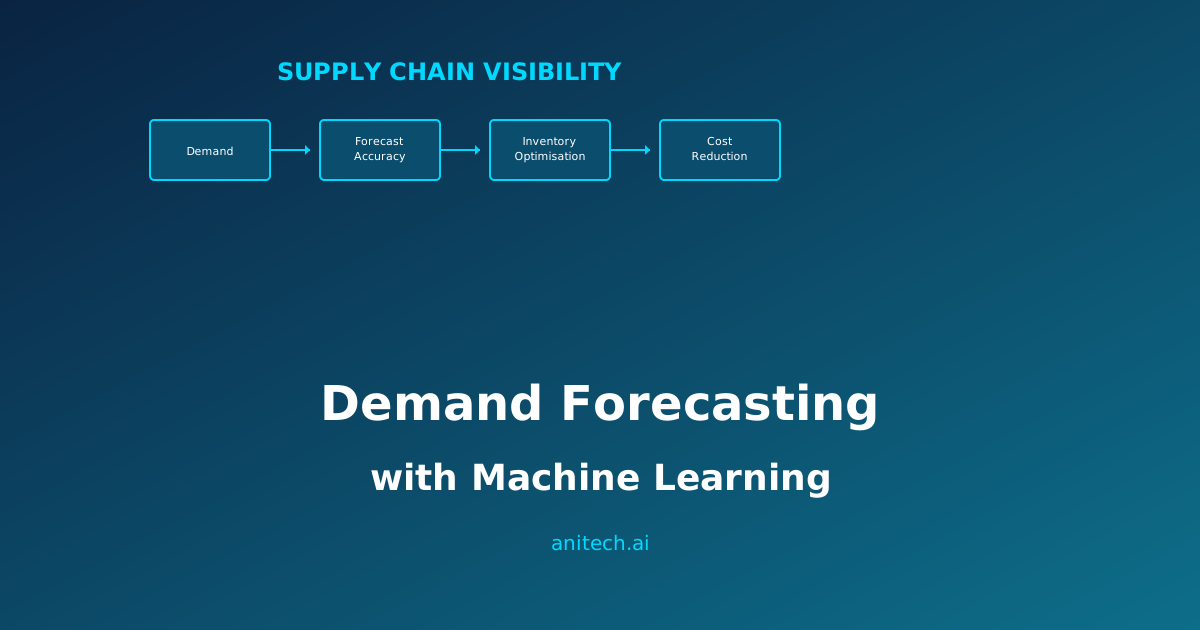
Machine learning–powered demand forecasting captures these dynamics automatically. By analysing years of historical sales, promotional calendars, market trends, and operational data, ML models forecast demand with 85–92% accuracy—10–15 percentage points better than traditional methods.
For Australian retailers, distributors, and manufacturers, better demand forecasts translate to:
– 15–25% inventory optimisation
– 30–40% markdown loss reduction
– 20–30% improvement in fill rates (fewer stockouts)
– 5–10% working capital efficiency gains
Why Demand Forecasting Matters
Demand forecasting sits at the intersection of supply chain, finance, and operations. Get it right, and the entire business hums. Get it wrong, and costs multiply.
The Cost of Forecast Error
Overstocking scenario:
– Inventory sits unsold
– Storage, shrinkage, and obsolescence costs accumulate
– Seasonal items must be marked down aggressively
– Cash is tied up instead of deployed elsewhere
– Markdown losses: 15–25% of cost on excess inventory
Understocking scenario:
– Demand exceeds supply
– Lost sales (and market share to competitors)
– Rushed, expensive orders to fill gaps
– Poor customer satisfaction; likelihood of repeat purchase declines
– Lost sales: AUD 500 per item per week on average retail
The Forecast Accuracy ROI
A large Australian retailer with AUD 100M annual inventory investment:
10% inventory reduction through better forecasting:
– Freed working capital: AUD 10M
– Markdown loss avoided: AUD 2–4M
– Storage & carrying cost savings: AUD 1–2M
– Net annual benefit: AUD 13–16M
Cost of demand forecasting ML project: AUD 150–300K
Payback period: 2–4 months
Year-one ROI: 3,000–5,000%
These numbers explain why leading Australian retailers (Wesfarmers, JB Hi-Fi, Bunnings) invest heavily in demand forecasting.
How ML Demand Forecasting Works
Traditional forecasting typically extrapolates historical trends: “Last year at this time, we sold 500 units, so this year we’ll sell 500 units” (or 510 if we expect 2% growth).
ML forecasting is different. It learns complex, nonlinear relationships:
Historical Sales Data
The foundation. At minimum, 2+ years of granular sales data (daily or weekly for retail; monthly for less frequent items):
– Unit volume sold
– Revenue
– By product, store, or region (the finer the granularity, the better the forecast)
– SKU-level data is ideal; category-level data is workable
Promotional Calendar
Major driver of demand lift. ML models learn:
– “When we run a 20% promotion on category X, sales lift 40–60%”
– “Email campaigns generate 15% sales lift; in-store promotions, 25%”
– “Promotional effect lasts 2 weeks post-promotion; then returns to baseline”
Seasonality & Trend
ML automatically extracts:
– Seasonality: Christmas demand spikes; summer slumps; back-to-school peaks
– Trend: Long-term growth or decline
– Cyclicality: Longer-term patterns (economic cycles, fashion cycles)
External Drivers
Smart demand models incorporate:
– Economic indicators: GDP growth, unemployment, consumer confidence
– Weather: Temperature, precipitation (crucial for seasonal retail)
– Competitor activity: Competitor promotions, new store openings, price cuts
– Holidays: Public holidays affect demand patterns
– Social media trends: Viral products, trending categories
The Forecast Process
- Data preparation: Aggregate sales, promotional, and external data into a single dataset
- Feature engineering: Create meaningful variables (e.g., “days since last promotion,” “competitor promotion active”)
- Algorithm selection: Test multiple algorithms (ARIMA, Prophet, Gradient Boosting, Neural Networks) on historical data
- Training & validation: Train on 80% of data; validate on 20%; measure accuracy
- Forecasting: Apply the best model to recent data to forecast future demand
- Monitoring & retraining: Monitor forecast accuracy monthly; retrain quarterly to capture seasonality shifts
ML Algorithms for Demand Forecasting
Different algorithms excel in different contexts:
ARIMA (AutoRegressive Integrated Moving Average)
Best for: Stable, stationary time series with clear seasonality and trend
Accuracy: 80–88%
Strengths: Interpretable, fast, handles seasonality well
Limitations: Struggles with sudden demand shocks; can’t easily incorporate external drivers
Prophet (Facebook’s open-source library)
Best for: High-volume, high-frequency data with seasonality
Accuracy: 82–90%
Strengths: Robust to missing data; handles multiple seasonalities; detects trend changes
Limitations: Less accurate when external drivers are critical
Gradient Boosting (XGBoost, LightGBM, CatBoost)
Best for: Complex, nonlinear relationships; many external drivers
Accuracy: 85–92%
Strengths: Highest accuracy; captures feature interactions; handles promotions and external drivers well
Limitations: Requires more data; less interpretable
Neural Networks (LSTMs, Transformers)
Best for: Ultra-high-frequency data; complex temporal dependencies
Accuracy: 86–93%
Strengths: Capture intricate nonlinear patterns
Limitations: Require large datasets; computationally expensive; hard to explain
Australian practice: Most retailers start with ARIMA or Prophet (fast POC), then move to Gradient Boosting or hybrid approaches once accuracy requirements are clear.
Real-World Case Study: Australian Retailer Demand Forecasting
Company: Large Australian fashion retailer (multiple stores, online channel)
Challenge: Seasonal inventory management; excessive markdown losses; occasional stockouts
Baseline accuracy: 72% MAPE (Mean Absolute Percentage Error) using traditional methods
Implementation Approach
Data: 3 years daily sales by SKU, store, and category; promotional calendar; weather; competitor pricing (scraped monthly)
Feature engineering:
– Seasonality indices (week of year, day of week)
– Promotion flags and type (discount level, duration)
– Competitor pricing (relative to own)
– Weather variables (temperature, humidity)
– Prior-year sales (same week, prior year)
– Trend decomposition (growth trajectory)
Model: Gradient Boosting ensemble (XGBoost + LightGBM)
Forecast horizon: 12 weeks ahead (quarterly planning cycle)
Results
| Metric | Before | After | Improvement |
|---|---|---|---|
| Forecast accuracy (MAPE) | 72% | 87% | +15pp |
| Inventory level | 100% baseline | 85% | -15% |
| Markdown % of revenue | 12% | 8% | -4pp |
| Stockout incidents/month | 45 | 12 | -73% |
| Working capital tied to inventory | AUD 45M | AUD 38M | -16% |
Annualised financial impact:
– Markdown loss reduction: AUD 4.2M
– Working capital freed: AUD 7M (opportunity cost: 3% = AUD 210K annual benefit)
– Service level improvement (fewer stockouts, faster replenishment): AUD 1.5M in incremental sales
– Total: AUD 12.9M annually
Project cost: AUD 280K (data engineering, model building, system integration, training)
Payback period: 9 weeks
Building Your Demand Forecasting Capability
Step 1: Data Audit
Demand forecasting requires quality data. Assess:
– Do we have 2+ years daily (or weekly) sales data by product/store/region?
– Is the data clean and complete? (Missing days? Data quality issues?)
– Do we have promotional calendar and campaign metadata?
– Can we access weather, economic, or competitive data?
– Are systems in place to collect data regularly?
Step 2: Define Success Metrics
- Accuracy target: What MAPE (or accuracy %) is “good enough”? (85%+ is excellent for retail)
- Business impact target: What inventory reduction are we targeting? (typically 10–20% is achievable)
- Forecast horizon: How far ahead do we need to forecast? (Retail: 4–12 weeks; Manufacturing: 8–26 weeks)
- Granularity: Forecast by SKU? Category? Store? Channel?
Step 3: Select Use Cases
Start with high-impact, data-rich categories:
– High-volume, fast-moving items — Abundant data, easier to forecast accurately
– High-margin categories — Accuracy has big financial impact
– Seasonal categories — Where ML excels (captures complex seasonal patterns)
Avoid starting with:
– Slow-moving items — Sparse data makes learning harder
– Highly irregular demand — Innovation products, one-off orders
– Externally driven demand — New market entries, regulatory changes (insufficient historical data)
Step 4: Proof of Concept (4–8 weeks)
- Gather historical data for selected categories
- Build and test multiple algorithms
- Measure accuracy on validation data
- Estimate business impact (inventory reduction, markdown savings)
- Prepare for pilot deployment
Step 5: Pilot Deployment (8–16 weeks)
- Integrate forecast model into inventory/planning system
- Set up monitoring and alerting
- Run model-generated forecasts alongside traditional forecasts for 4–8 weeks
- Compare accuracy; build confidence with planners
- Train inventory and procurement teams
Step 6: Full Rollout (3–6 months)
- Transition fully to ML forecasts
- Monitor and retrain monthly/quarterly
- Add additional categories or SKUs
- Integrate with supply chain systems (procurement, manufacturing, logistics)
Integrating Demand Forecasts Into Operations
Accurate forecasts are only valuable if they’re acted upon. Integration points:
Inventory Planning:
– Automated SKU-level safety stock calculation based on forecast accuracy
– Reorder point and quantity optimisation
– Clearance and markdown timing for seasonal items
Procurement:
– Demand forecasts feed purchase order generation
– Lead time management (purchase 6–8 weeks before demand surge)
– Supplier allocation (when demand exceeds supply)
Manufacturing & Production:
– Production schedules aligned with demand forecasts
– Capacity planning (when to add shifts, hire temps, or outsource)
– Raw material procurement
Pricing & Promotion:
– Dynamic pricing: adjust prices based on forecast demand and inventory
– Promotional timing: front-load promotions when forecast demand is low; reduce promotions during peak demand
– Markdown timing: markdown slow-moving items early to free cash
Logistics & Distribution:
– Network design: where to store inventory (central distribution centre vs. store-level)
– Cross-store replenishment: move inventory from low-demand to high-demand locations
– Last-mile routing: adjust delivery routes based on predicted order volume
Data Sovereignty & Privacy Considerations
Privacy Act Compliance
If your forecasting model uses customer-level data (purchase history, demographics, location), you must:
– Document consent basis (typically, existing consent for business purposes covers internal forecasting)
– Implement access controls (only authorised staff access)
– Ensure data is adequately protected (encryption, secure backups)
– Enable transparency (customers have a right to know their data trains ML models)
Data Sovereignty
Forecasting models for sensitive products (pharmaceuticals, defence, critical infrastructure) may require:
– Models trained and deployed on Australian infrastructure only
– Data remains within Australian jurisdiction
– No transfer to third countries or cloud providers outside Australia
Anitech AI’s infrastructure is Australian-based, supporting full data sovereignty.
Getting Started: A Practical Checklist
- [ ] Identify top 5 products/categories by revenue or margin
- [ ] Assess data availability (2+ years sales history available?)
- [ ] Estimate current forecast error rate and cost of that error
- [ ] Quantify target: What inventory reduction would we realistically achieve? What’s the financial value?
- [ ] Allocate resources: 1 FTE (internal sponsor) + AUD 150–300K budget for POC + pilot
- [ ] Engage IT/data teams: What systems need to integrate with forecasts?
- [ ] Set success criteria: accuracy target, timeline, business impact metrics
Connecting to the Broader ML Cluster
This article focuses on demand forecasting. For related concepts, explore:
- Machine Learning for Business Australia — Foundational ML concepts and deployment
- Predictive Analytics for Business — General predictive analytics framework
- Time Series Forecasting — Advanced forecasting techniques
Conclusion
Demand forecasting is one of the highest-ROI ML applications for Australian retailers and manufacturers. Better forecasts directly reduce costs (markdowns, storage), improve service (fewer stockouts), and free working capital.
The technology is proven. The algorithms are battle-tested. The main barrier is getting started.
Call to Action
Ready to optimise your inventory with ML-driven demand forecasting? Anitech AI specialises in Australian supply chain solutions. We’ll assess your data, build models, and integrate forecasts into your planning systems.
Talk to Anitech AI today. Let’s discuss how demand forecasting can transform your supply chain.
Further Reading
- AI Automation Australia — Complete Guide
- Machine Learning for Business Australia: From Data to Decisions — Industry Guide
- Predictive Analytics for Business: Turning Historical Data Into Future Advantage
- Customer Lifetime Value Prediction: AI Models That Maximise Revenue
- Predictive Maintenance with Machine Learning: Cut Downtime Before It Happens
- MLOps for Australian Enterprises: Deploying and Managing ML Models at Scale