
Introduction
Not all customers are equal. A loyal customer buying weekly for three years generates far more revenue than a one-time buyer. A customer with high purchase frequency and large order value creates more margin than a price-sensitive bargain hunter.
Yet most businesses treat all customers the same: same marketing spend, same service level, same retention effort.
Machine learning changes this equation. By predicting which customers will generate the most lifetime value, you can:
– Focus premium service and loyalty benefits on high-value customers
– Invest strategically in retention for mid-tier customers
– Optimize acquisition and engagement for different segments
– Price and promote more intelligently
– Align sales and marketing spend with customer value
Customer Lifetime Value (CLV) prediction is one of the highest-ROI machine learning applications. Australian companies using ML-driven CLV models report:
– 20–35% improvement in customer retention rates
– 15–25% increase in average customer value
– 25–40% better targeting efficiency for marketing and retention spend
– 30–50% improvement in cross-sell and upsell success rates
What Is Customer Lifetime Value?
Customer Lifetime Value is the total profit a customer generates across their entire relationship with your business.
The Calculation
At its simplest:
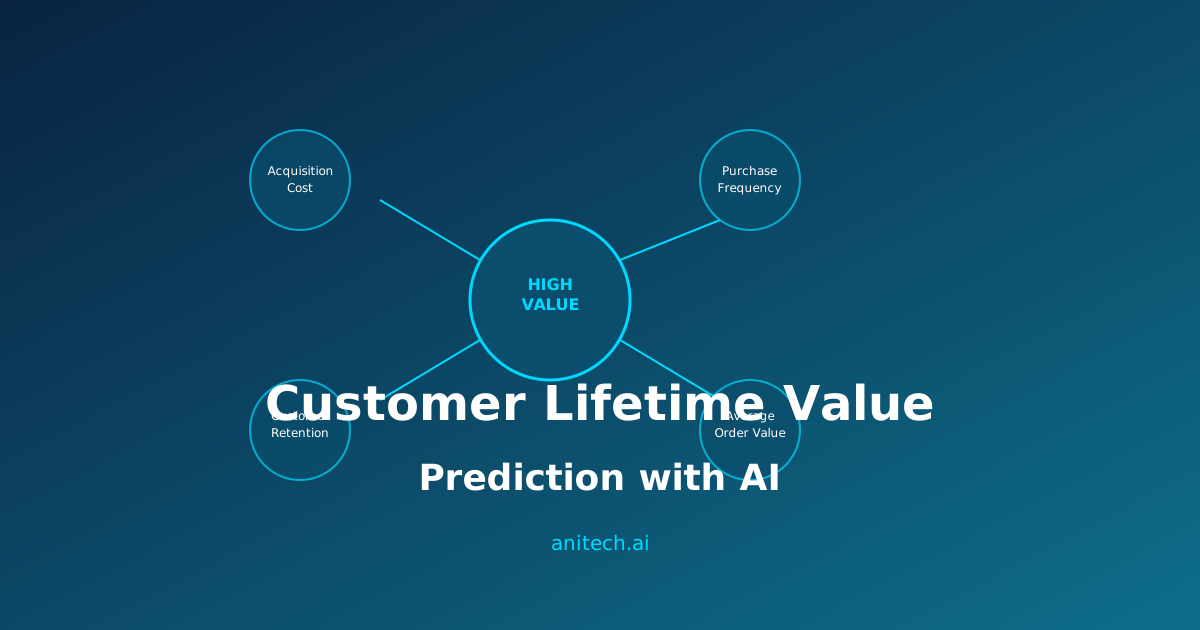
CLV = (Average Order Value × Purchase Frequency × Customer Lifetime) – Acquisition Cost – Servicing Cost
But this formula has limitations. Average customer, average order, average lifetime don’t capture the diversity of your customer base. Some customers are trending upward in value; others are declining. Some are highly profitable; others are margin-destructive.
Machine learning models segment customers and predict individual CLV more accurately by learning patterns:
– How does tenure affect purchase frequency? (Often increases for first 2 years, then plateaus)
– How does order value correlate with product category? (Luxury items: high value per order; consumables: high frequency, lower value)
– Which customer acquisition channels deliver higher-value customers?
– Which products or categories predict churn risk vs. loyalty?
Why CLV Prediction Matters
Traditional approach: All customers receive similar treatment. Marketing spend is budgeted broadly. Retention effort is reactive (only when churn signals appear).
Outcome: Some customers receive excessive investment (unlikely to churn; low response to offers). Others receive insufficient investment (high propensity to churn; disproportionate value).
Result: Suboptimal marketing ROI, preventable churn, and revenue loss.
ML-driven approach: Segment customers by predicted CLV. Allocate investment strategically.
Example: A telco with 2M customers.
– Top 20% by predicted CLV: High-touch service, loyalty rewards, targeted retention
– Middle 50%: Standard service, targeted acquisition of high-value products
– Bottom 30%: Efficient self-service, minimal manual touchpoints, selective retention
Financial impact:
– Reduce churn in top 20% by 8% (each 1% churn reduction = AUD 40M+ revenue protection)
– Improve top 20% retention: AUD 25M+ incremental revenue
– Redirect savings from bottom 30% to top 20%: AUD 5M efficiency gain
– Total: AUD 30M+ annual benefit on a customer base worth AUD 3B+ revenue
Building a CLV Prediction Model
Data Requirements
To predict CLV, you need:
– Customer transaction history: Every purchase, with date, amount, product/category
– Customer attributes: Demographics, acquisition channel, account tenure, geography
– Engagement metrics: Email opens, website visits, support contacts, product usage
– Churn indicators: Payment failures, service cancellations, complaints
– Historical CLV: Actual customer lifetime value for 2+ years of cohorts (for model training)
Features That Predict CLV
Effective CLV models learn from dozens of features. Key ones:
Behavioural features:
– Purchase frequency (transactions per month)
– Average order value (AUD per transaction)
– Product diversity (number of different categories purchased)
– Seasonality index (does customer buy during specific seasons?)
– Recency (days since last purchase)
– Engagement (email opens, website visits)
Account features:
– Customer tenure (months as a customer)
– Acquisition channel (organic, paid search, referral, partnership)
– Account type (individual, business, enterprise)
– Payment method (credit card, direct debit, invoice)
Customer attributes:
– Geography (state, urban/rural)
– Industry (for B2B)
– Company size (for B2B)
– Demographics (age, profession, if available)
Trend features:
– Month-over-month growth in purchase value
– Change in purchase frequency (accelerating or declining?)
– Product category shifts (trading up? trading down?)
Model Development
- Data preparation: Aggregate transaction history; compute features; define labels (actual CLV for cohorts)
- Cohort analysis: Segment by acquisition cohort; validate CLV patterns (do mature cohorts have higher CLV than new ones?)
- Model training: Test algorithms (Gradient Boosting, Neural Networks, SVM) to predict CLV
- Validation: Measure prediction accuracy on holdout data; compare against traditional CLV calculation
- Segmentation: Use predicted CLV to create segments (High/Medium/Low Value; Stable/Growing/Declining)
- Operationalisation: Integrate segments into customer data platform, CRM, and marketing systems
Typical Accuracy
A well-trained CLV model predicts customer lifetime value with:
– Mean Absolute Percentage Error (MAPE) of 20–30% for individual customers
– 70–80% accuracy in segmenting customers into high/medium/low buckets
This is sufficient to drive significant business impact.
Strategic Use Cases
1. Retention Targeting
Use: Identify high-value customers at churn risk; deploy targeted retention offers.
Approach:
– CLV model ranks customers by predicted value
– Churn risk model identifies customers likely to leave in next 30–60 days
– Intersection: high-value, high-churn-risk customers get premium retention offers (upgrade discount, concierge service, exclusive benefits)
Impact: Retain 2–5% of flagged customers at AUD 20–50K average value each = significant incremental revenue
2. Acquisition Targeting
Use: Identify which customer acquisition channels deliver highest-CLV customers.
Approach:
– Track acquisition channel for every customer
– Compare predicted CLV by acquisition channel
– Reallocate marketing spend to high-CLV channels
Australian example: Telco discovers that referral-acquired customers have 25% higher predicted CLV than paid search. Shifts budget from paid search to referral incentives. CLV-weighted acquisition cost improves 18%.
3. Pricing & Promotion
Use: Price and promote based on customer value.
Approach:
– High-CLV customers: premium pricing, exclusive offers, loyalty bonuses
– Mid-tier: standard pricing, seasonal promotions, bundle offers
– Low-CLV: discount pricing, volume incentives, entry-level products
Impact: Capture higher margin from high-value customers; retain low-value customers through efficient, price-driven offers
4. Cross-Sell & Upsell
Use: Identify high-value customers with growth potential; recommend high-value products.
Approach:
– CLV model predicts potential CLV (upside)
– Compare current CLV vs. potential CLV to find growth targets
– Target high-potential customers with relevant upsell offers
– Recommend products/services likely to increase their value
5. Service Level Allocation
Use: Differentiate service by customer value.
Approach:
– High-CLV: dedicated account manager, priority support, custom solutions
– Mid-tier: standard support, self-service portal, online community
– Low-CLV: self-service, chatbot support, minimal manual touch
Impact: Improve satisfaction and retention for high-value customers; optimise cost for low-value customers
Real-World Case Study: Australian Financial Services
Company: Mid-sized Australian superannuation (pension) fund
Challenge: Rising member churn; competitive pressure
Baseline: 18% annual churn; average member lifetime value AUD 150K; no segmentation
Implementation
Data: 3 years transaction data on 200K members; contribution history; investment performance; demographics
Features: Member tenure, contribution frequency, balance growth, portfolio composition, engagement (website logins), demographic segment
Model: Gradient Boosting (XGBoost) to predict member CLV
Segments:
– High-Value (top 10%): CLV > AUD 450K
– Growth (20%): CLV AUD 200–450K
– Standard (50%): CLV AUD 80–200K
– At-Risk (20%): CLV < AUD 80K (likely to exit)
Strategy by Segment
| Segment | Strategy | Investment |
|---|---|---|
| High-Value | Dedicated relationship manager, quarterly reviews, bespoke solutions | AUD 3K/member/year |
| Growth | Online portal, quarterly statements, educational content, cross-product recommendations | AUD 500/member/year |
| Standard | Self-service platform, annual statements, email newsletters | AUD 100/member/year |
| At-Risk | Win-back campaigns, fee waivers, simplified options | AUD 200/member/year (if engaged) |
Results (Year 1)
| Metric | Before | After | Improvement |
|---|---|---|---|
| Overall churn rate | 18% | 15% | -3pp |
| High-Value churn | N/A | 8% | -60% vs. baseline |
| Growth segment churn | N/A | 12% | -33% vs. baseline |
| Avg member CLV | AUD 150K | AUD 168K | +12% |
| Member satisfaction (NPS) | 42 | 51 | +9pp |
Financial impact:
– Churn reduction on high-value members: AUD 32M (3,000 members × AUD 450K × 2.3% churn reduction)
– Cross-sell uplift in growth segment: AUD 8M
– Operational efficiency (reduced service spend on low-value members): AUD 3M
– Total: AUD 43M net benefit
Investment: AUD 420K (model development, CRM integration, staff training)
Payback period: 4 months
Year-1 ROI: 10,000%+
Privacy & Compliance Considerations
Privacy Act Compliance
CLV prediction models use customer transaction and behavioural data. You must:
– Document consent basis (typically, use of customer data for business analytics is covered by existing consent)
– Protect data with encryption and access controls
– Enable transparency (customers have right to know their data trains models)
– Respect deletion requests (if a customer requests their data deleted, remove from future model retraining)
Fairness & Discrimination
CLV models can inadvertently discriminate. For example, if historical data shows certain demographic groups had lower retention, the model might predict lower CLV for similar customers in that group—a fairness issue.
Best practices:
– Audit CLV predictions by demographic group; ensure disparity is minimal
– Test retention offers by segment; ensure similar conversion rates across groups
– Document fairness considerations in model governance
Implementation Timeline & Cost
| Phase | Duration | Cost | Deliverable |
|---|---|---|---|
| Assessment & POC | 4–8 weeks | AUD 40–80K | CLV model, accuracy validation, business case |
| Pilot | 8–12 weeks | AUD 80–150K | Segmentation, CRM integration, initial retention campaigns |
| Full rollout | 3–6 months | AUD 150–300K | Integrated solution, team training, ongoing monitoring |
Most CLV projects show payback within 4–12 months.
Getting Started
- Quantify baseline: What’s your current churn rate? Average customer lifetime value? Cost of customer acquisition?
- Assess data: Do you have 2+ years transaction history? Customer attributes? Churn signals?
- Identify opportunities: Which segments (acquisition channel, geography, product) matter most?
- Define target: What churn reduction or CLV uplift would be meaningful? (2–5% churn reduction is realistic)
- Estimate impact: What’s the financial value of your target? (Should be millions for a company considering CLV models)
Connecting to the Broader ML Cluster
This article focuses on CLV prediction. For related applications, explore:
- Machine Learning for Business Australia — Foundational ML concepts
- Predictive Analytics for Business — General predictive framework
- Recommendation Engines for Australian Business — Personalisation to increase customer value
Conclusion
Customer Lifetime Value prediction transforms how you allocate marketing and service investment. By identifying high-value customers and targeting retention strategically, you protect revenue, improve efficiency, and grow margins.
The technology is proven. The ROI is substantial. The question is: how much revenue are you leaving on the table by treating all customers the same?
Call to Action
Ready to maximise customer value with ML-driven CLV prediction? Anitech AI specialises in customer analytics for Australian businesses. We’ll build CLV models, segment your customer base, and integrate insights into your CRM and marketing systems.
Talk to Anitech AI today. Let’s discuss how CLV prediction can transform your customer strategy.
Further Reading
- AI Automation Australia — Complete Guide
- Machine Learning for Business Australia: From Data to Decisions — Industry Guide
- Predictive Analytics for Business: Turning Historical Data Into Future Advantage
- Demand Forecasting with Machine Learning: Smarter Inventory and Supply Chain Planning
- Predictive Maintenance with Machine Learning: Cut Downtime Before It Happens
- MLOps for Australian Enterprises: Deploying and Managing ML Models at Scale