
Introduction
Equipment failure costs Australian businesses billions annually. In mining, a mill breakdown halts production and costs AUD 2–5M per hour. In manufacturing, a conveyor failure cascades across the production line. In utilities, a transformer failure leaves customers without power.
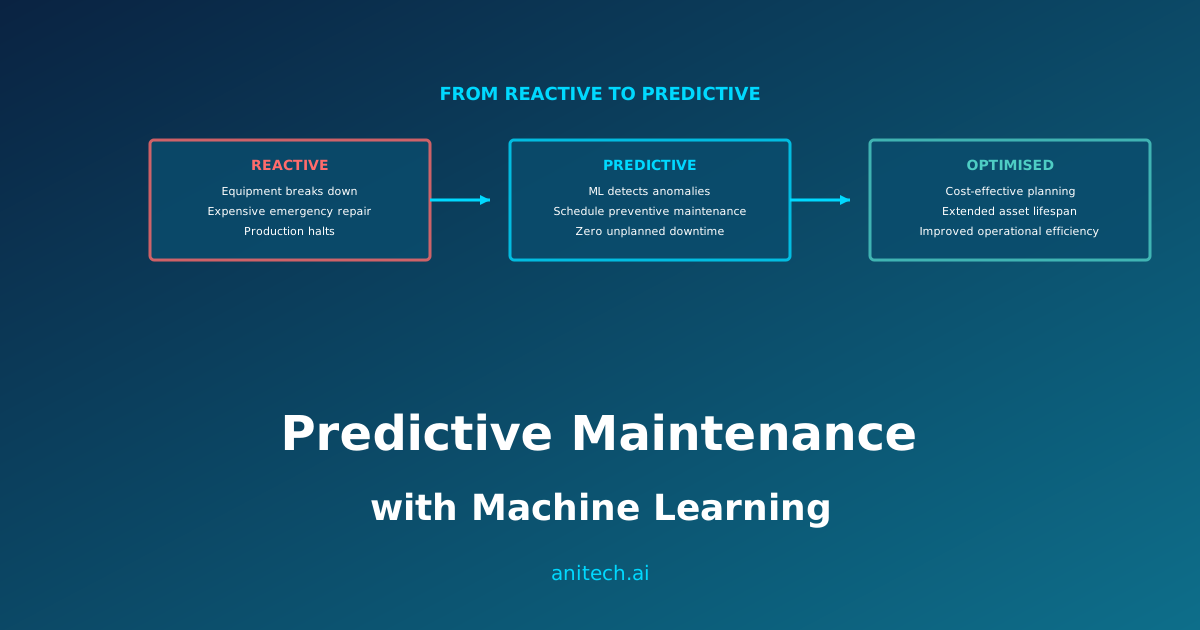
Historically, maintenance has followed two approaches:
Scheduled maintenance: Replace or service equipment on a fixed schedule (every 12 months, every 5,000 hours), regardless of condition. Wastes resources on items still performing well; misses items degrading faster than the schedule.
Reactive maintenance: Wait until equipment fails, then scramble to repair. Catastrophically expensive—emergency service calls, overtime labour, lost production, customer impact.
Machine learning enables a third approach: Predictive maintenance. By continuously monitoring equipment health through sensors and analysing patterns with ML models, you can predict failure 7–30 days in advance, then schedule maintenance proactively.
For Australian manufacturers and operators, predictive maintenance delivers:
– 50–70% reduction in unplanned downtime
– 30–40% reduction in maintenance costs
– 20–30% extension in equipment lifespan
– 10–20% improvement in production throughput
– Faster return on investment: 12–24 months typical payback
How Predictive Maintenance Works
The Data Foundation: IoT Sensors
Modern equipment is instrumented with sensors measuring:
– Vibration: Abnormal vibration signals bearing wear, misalignment, looseness
– Temperature: Rising temperature signals friction, electrical stress, or impending failure
– Pressure: Abnormal pressure indicates hydraulic, pneumatic, or flow system issues
– Current/Power: Electrical current patterns reveal motor stress, load imbalance
– Acoustic emissions: High-frequency sound signals incipient failures
These sensors stream data continuously (or at intervals) to a central system.
Pattern Recognition: How ML Detects Degradation
Consider a bearing. When new, it runs smoothly: consistent vibration signature, stable temperature, normal acoustic emissions.
Over months, microscopic wear accumulates. Vibration begins to increase subtly. Temperature creeps up. The bearing is degrading but still functional.
A human technician inspecting monthly might not catch this gradual drift. Scheduled maintenance might not arrive for 3 months. By then, wear has accelerated exponentially.
An ML model trained on thousands of bearing life cycles learns:
– “Vibration increasing 2% per week + temperature rising 0.5°C per day + acoustic signature changing = bearing will fail in 14 days”
– “Pressure fluctuating with frequency X + temperature stable = normal operation, no action needed”
The model detects degradation patterns humans would miss, weeks before catastrophic failure.
The Prediction Pipeline
- Data ingestion: Sensors stream continuous measurements (vibration, temperature, pressure, current)
- Feature engineering: Compute statistics (mean, standard deviation, peak, frequency content) from raw signals
- Anomaly detection: Flag when current measurements deviate from normal patterns
- Degradation tracking: Monitor trend in key features (is vibration increasing? accelerating?)
- Failure prediction: ML model predicts time-to-failure (days remaining before likely failure)
- Alerting: Alert maintenance team when time-to-failure drops below threshold (e.g., < 7 days)
- Action: Schedule maintenance before predicted failure; replace/service equipment proactively
Real-World Case Study: Australian Mining Company
Company: Large iron ore mining operation (Western Australia)
Equipment: Primary crusher (AUD 2M asset; critical to production)
Problem: Bearing failures occur unpredictably, causing 12–20 hours downtime per incident; 3–5 incidents annually
Baseline (Reactive)
- Bearing fails suddenly
- Emergency maintenance called; technician mobilised
- Equipment down 14–18 hours (including travel time)
- Lost production: 800–1,200 tonnes ore
- Revenue loss at AUD 80/tonne: AUD 64–96K
- Emergency labour & parts: AUD 30–50K
- Cost per failure: AUD 94–146K
- Annual cost: AUD 280–730K
Implementation
Sensors: Installed vibration, temperature, and acoustic emission sensors on crusher bearings
Data: 18 months baseline data on bearing condition + maintenance logs + failure incidents
Model: Trained gradient boosting model to predict bearing time-to-failure using:
– Vibration spectral features (frequency content across different bands)
– Temperature trend (current vs. 7-day average)
– Acoustic emission patterns
– Historical maintenance dates and actions
Alerts: Model triggers maintenance alert when predicted time-to-failure < 7 days
Results
| Metric | Before | After | Improvement |
|---|---|---|---|
| Unplanned failures/year | 4 | 1 | -75% |
| Downtime per failure | 16 hours | 2 hours (planned) | -87% |
| Annual downtime | 64 hours | 2 hours | -97% |
| Production loss | 5,120 tonnes | 160 tonnes | -97% |
| Emergency maintenance cost/year | AUD 500K | AUD 80K | -84% |
| Bearing lifespan | 18 months (avg) | 28 months | +56% |
Annual financial impact:
– Avoided downtime cost: AUD 420K
– Extended bearing lifespan (fewer replacements): AUD 60K
– Improved production throughput: AUD 200K (fewer unplanned stoppages)
– Total: AUD 680K annually
Investment: AUD 180K (sensors, data infrastructure, ML model development)
Payback period: 3 months
Year-1 ROI: 380%
Challenges & Considerations
Data Requirements
Predictive maintenance models need:
– Baseline data: At least 12 months continuous sensor data before any failures, to learn “normal” equipment behaviour
– Failure examples: Historical records of actual equipment failures (timestamps, root cause, failure mode)
– Feature engineering: Domain expertise to compute meaningful features from raw sensor data
Many organisations lack this baseline. Anitech AI can help retrofit sensors and establish baseline monitoring before deploying predictive models.
Sensor Costs & Deployment
Industrial IoT sensors are relatively cheap (AUD 500–2,000 per sensor), but deployment can be complex:
– Cable routing through hazardous areas requires safety compliance
– Power supply (batteries need regular replacement; wired power requires infrastructure)
– Wireless transmission (some facilities have poor connectivity; safety-critical areas have restrictions)
Budget: AUD 500–1,000 per sensor for hardware + AUD 1,000–3,000 per sensor for installation in industrial settings.
Model Accuracy Expectations
Predictive maintenance models typically achieve:
– Anomaly detection: 92–98% sensitivity (catch real problems)
– False positive rate: 5–15% (model sometimes alerts on normal fluctuations)
– Time-to-failure prediction: Within ±20% of actual failure timing
A 10% false positive rate might seem high, but context matters: a false alert triggers inspections costing AUD 500–1,000; a missed failure costs AUD 100K+. The economics are heavily in favour of catching every possible failure.
Combining Predictive & Scheduled Maintenance
Most organisations don’t abandon scheduled maintenance entirely. Instead:
– Core systems: Scheduled maintenance remains (replacing worn parts, fluid changes) on a planned cycle
– Failure-prone components: Shift to predictive maintenance based on condition monitoring
– Result: Hybrid approach maximising uptime while minimising unnecessary maintenance
Building Your Predictive Maintenance Program
Phase 1: Assessment (Weeks 1–4)
Identify highest-impact equipment:
– Which equipment failures cost the most (production loss + repair cost)?
– Which equipment fails frequently?
– Which equipment is monitored or can be instrumented cost-effectively?
Priority scoring: (Failure cost) × (Failure frequency) × (Instrumentation feasibility)
Typical priority: High-cost, high-failure-rate equipment (motors, pumps, bearings, compressors).
Phase 2: Instrumentation (Weeks 4–12)
For selected equipment:
– Install vibration, temperature, and/or acoustic sensors
– Establish data pipeline (sensors → data collection → cloud/on-premise storage)
– Begin collecting baseline data
– Document equipment history and past failures
Phase 3: Model Development (Weeks 12–20)
- Analyse baseline data; establish normal operating signatures
- Engineer features from raw sensor data
- Train ML model on historical failures (if available) or on anomaly detection (if failures are rare)
- Validate model accuracy on holdout data
- Test alerting thresholds (optimize sensitivity vs. false positive rate)
Phase 4: Pilot Deployment (Weeks 20–28)
- Deploy model to predict equipment health for selected assets
- Monitor predictions; validate against actual equipment condition
- Train maintenance teams on interpreting predictions and taking action
- Refine alert thresholds based on feedback
Phase 5: Full Rollout (Weeks 28+)
- Expand to all critical equipment
- Integrate predictions into maintenance management system (CMMS)
- Automate scheduling: model triggers maintenance work order automatically
- Monitor model performance; retrain quarterly or semi-annually
Integration with Maintenance Systems
Effective predictive maintenance requires integration:
Maintenance Management System (CMMS/EAM):
– Receive failure predictions
– Automatically generate work orders
– Schedule technicians and spare parts
– Track maintenance completion and cost
Enterprise Resource Planning (ERP):
– Track spare parts inventory
– Trigger procurement when parts needed
– Integrate maintenance costs into operational dashboards
IoT/SCADA platforms:
– Collect and stream sensor data
– Provide real-time equipment dashboards
– Enable remote equipment monitoring and diagnostics
Analytics/BI platforms:
– Visualise equipment health trends
– Track maintenance KPIs (uptime, MTBF—mean time between failures, maintenance spend)
– Benchmark performance vs. targets
Data Sovereignty & Security
IoT Data Protection
Sensor data from industrial equipment can reveal operational secrets (production capacity, yield, failure patterns). You need:
Data encryption:
– Encrypt data in transit (sensors → cloud/on-premise storage)
– Encrypt data at rest (stored data)
– Encrypt sensor communications (prevent tampering or eavesdropping)
Access controls:
– Limit who can access sensor data and predictions
– Audit logs for all data access
– Separate OT (Operational Technology) networks from IT networks
Australian Data Sovereignty
For critical infrastructure or sensitive operations, keep predictive models and data within Australia:
– Sensors and gateways on Australian infrastructure
– Data processed and stored on Australian servers
– Models trained and deployed domestically
Anitech AI’s infrastructure is Australian-based, supporting full data sovereignty for industrial predictive maintenance.
Industry-Specific Applications
Manufacturing
Assets: Production machinery (CNC, presses, welders), conveyor systems, hydraulic systems
Failure modes: Tool wear, electrical failures, hydraulic leaks, mechanical wear
Typical ROI: 200–400% within 2 years
Mining
Assets: Crushers, mills, haul trucks, drilling equipment, conveyors
Failure modes: Bearing wear, motor failure, pump failure, component fatigue
Typical ROI: 300–500% within 2 years; higher impact (fewer mission-critical failures)
Energy & Utilities
Assets: Transformers, generators, switchgear, distribution lines
Failure modes: Insulation degradation, bearing wear, thermal stress, corrosion
Typical ROI: 250–400% within 2 years
Transportation & Logistics
Assets: Trucks, forklifts, conveyor systems, loading equipment
Failure modes: Engine wear, brake failure, hydraulic failure, electrical failure
Typical ROI: 150–300% within 2 years
Getting Started: A Practical Checklist
- [ ] List your top 10 highest-cost equipment (by failure cost and frequency)
- [ ] Identify sensors already installed (many modern equipment has built-in sensors)
- [ ] Estimate cost of instrumentation (sensors + installation) for priority equipment
- [ ] Quantify downtime cost per hour for each asset
- [ ] Engage maintenance team: What failure modes are most problematic?
- [ ] Identify data infrastructure: Where will sensor data be collected and stored?
- [ ] Allocate resources: AUD 200–500K + internal sponsorship for pilot program
Connecting to the Broader ML Cluster
This article focuses on predictive maintenance. For related applications, explore:
- Machine Learning for Business Australia — Foundational ML concepts and deployment
- Anomaly Detection with ML — General framework for detecting unusual patterns
- MLOps for Australian Enterprises — Deploying and monitoring models in production
Conclusion
Predictive maintenance is one of the highest-ROI machine learning applications. By predicting equipment failure weeks in advance, you prevent catastrophic downtime, extend asset lifespan, and dramatically improve operational efficiency.
The technology is proven. IoT sensors are affordable. ML models are battle-tested across mining, manufacturing, utilities, and logistics.
The main barrier is instrumentation and baseline data. But even that is increasingly manageable with modern sensor technology and cloud platforms.
Call to Action
Ready to prevent equipment failures and cut downtime? Anitech AI specialises in predictive maintenance for Australian mining, manufacturing, and industrial operations. We’ll assess your equipment, design sensor architectures, and build ML models that predict failure before it happens.
Talk to Anitech AI today. Let’s discuss how predictive maintenance can transform your operations.
Further Reading
- AI Automation Australia — Complete Guide
- Machine Learning for Business Australia: From Data to Decisions — Industry Guide
- Predictive Analytics for Business: Turning Historical Data Into Future Advantage
- Demand Forecasting with Machine Learning: Smarter Inventory and Supply Chain Planning
- Customer Lifetime Value Prediction: AI Models That Maximise Revenue
- MLOps for Australian Enterprises: Deploying and Managing ML Models at Scale