
Introduction
Think about your last shopping experience online. You browsed a product. The system showed “customers who bought this also bought…”. You clicked one. Revenue was made.
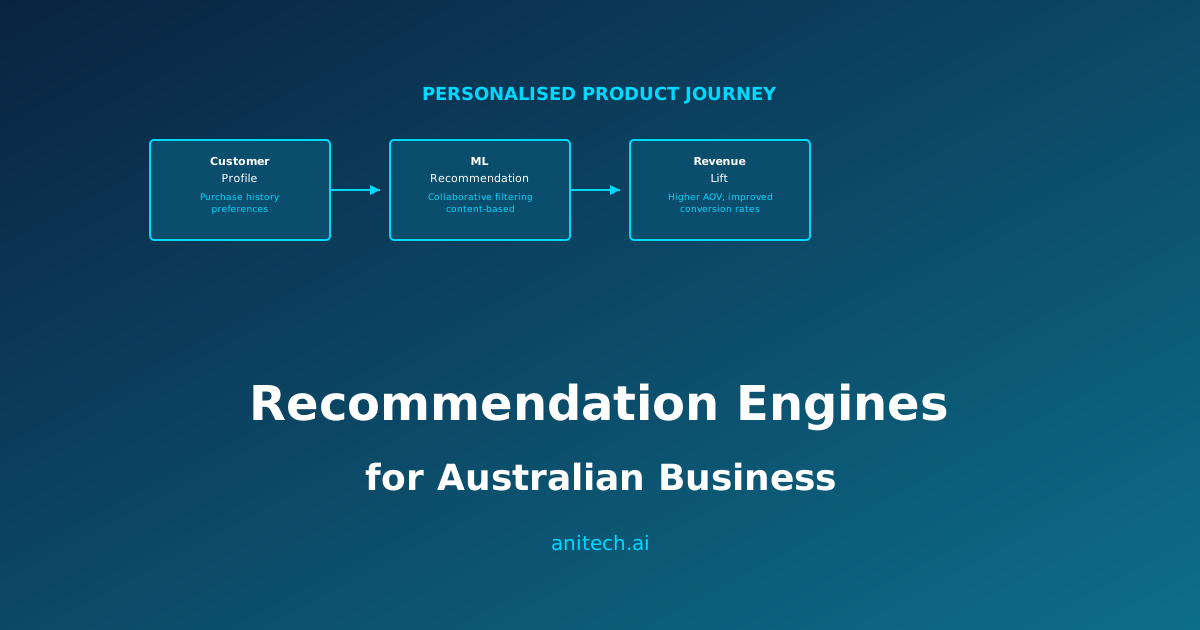
That recommendation likely came from a machine learning recommendation engine. Amazon credits recommendations with 35% of revenue. Netflix says recommendations drive 80% of viewing hours. Spotify’s “Discover Weekly” playlists have driven billions in streams.
Recommendation engines work because they’re aligned with customer interests. Instead of showing everyone the same “featured products,” they personalise at scale, showing each customer products they’re likely to find valuable.
For Australian retailers and e-commerce businesses, recommendation engines deliver:
– 15–30% increase in average order value (customers buy related products they discover through recommendations)
– 10–25% improvement in conversion rate (personalised recommendations convert at 2–3x higher rate than generic recommendations)
– 20–40% increase in customer lifetime value (discovery and engagement improve repeat purchase)
– 10–15% reduction in returns (fewer off-target recommendations = fewer disappointed customers returning items)
How Recommendation Engines Work
Recommendation engines predict which products a customer will find valuable and enjoy. They use three primary approaches:
1. Collaborative Filtering
Concept: “Users who liked what you liked also liked these products.”
How it works: Analyse patterns across many customers. If Customer A and Customer B both bought products P1, P2, P3, they’re similar. If Customer B also bought P4 (which Customer A hasn’t), recommend P4 to Customer A.
Strengths:
– No product information needed (works even for books with no metadata)
– Captures subtle patterns (customers with similar taste have subtle similarities)
– Can discover unexpected but valuable recommendations (serendipity)
Limitations:
– Requires many customers and many transactions (cold-start problem: new customers have few transactions, hard to find similar customers)
– Can reinforce popularity (bestsellers recommended more often, niche products underrecommended)
Use cases: Netflix (users with similar viewing history), Amazon Prime (similar purchase patterns)
2. Content-Based Filtering
Concept: “You liked these attributes; we recommend other products with similar attributes.”
How it works: Analyse product attributes (genre, brand, price, colour, size, style). Find products similar to ones the customer liked. Recommend those.
Strengths:
– Works for new products (attribute-based matching even if few customers have bought yet)
– Explainable (customer understands why recommended: “you liked tall heels; here are other tall heels”)
– No cold-start problem for new users (can recommend based on profile/preferences)
Limitations:
– Requires detailed product data (attributes, descriptions, tags)
– Limited serendipity (recommendations stay within the category the customer likes)
– Doesn’t capture subtle customer preferences
Use cases: Spotify (recommend songs by artists you like; with similar genre/tempo), YouTube (recommend videos in channels you watch)
3. Hybrid Approaches
Concept: Combine multiple signals (collaborative + content + explicit feedback).
How it works:
1. Collaborative filtering finds users similar to you (collaborative component)
2. Content-based matching finds products similar to ones you liked (content component)
3. Explicit signals weight them (customer ratings, clicks, add-to-cart)
4. Combine into unified score
Strengths:
– Best of both worlds (collaborative insight + content explainability)
– Handles cold-start better (hybrid systems work for new users/products)
– More robust (if one signal is weak, others compensate)
Limitations:
– More complex to build and maintain
– Requires both good product data and user behaviour data
Use cases: Amazon (products similar to browsing + users similar to you + explicit ratings), Spotify (songs users like + similar artists + playlist curation)
Real-World Case Study: Australian Online Retailer
Company: Mid-sized Australian fashion e-commerce (AUD 50M annual revenue; 100K+ products; 500K+ customers)
Problem: Generic “featured products” page; no personalisation; customers discover products by browsing or search
Baseline: Average order value AUD 85; conversion rate 2.1%; customer returns 18%
Implementation
Algorithm: Hybrid collaborative + content-based
Collaborative component:
– Track every customer interaction (view, add-to-cart, purchase, return)
– Compute user-user similarity (customers with similar purchase/browsing patterns)
– For each customer, find similar customers and their products
Content component:
– Product attributes: brand, category, size, colour, style, price, rating
– Find products similar to ones customer viewed/purchased
– Rank by similarity and customer preferences
Hybrid combination:
– Weight collaborative 60%, content 40%
– Adjust weights based on data quality and testing results
– Boost recommendations with high customer ratings
Deployment:
– Homepage: “Recommended for you” section (top 12 products)
– Product detail page: “Similar items,” “Customers also viewed,” “Customers also bought”
– Checkout: “Frequently bought together,” “Complete your look”
– Post-purchase email: “You might also like” (based on purchased item)
Results (Year 1)
| Metric | Before | After | Improvement |
|---|---|---|---|
| Avg order value | AUD 85 | AUD 98 | +15% |
| Conversion rate | 2.1% | 2.8% | +33% |
| Return rate | 18% | 15% | -3pp |
| Customer repeat rate | 32% | 41% | +28% |
| Revenue from recommendations | 0% | 14% | New revenue stream |
Financial impact:
– Revenue uplift from higher AOV & conversion: AUD 5.2M (14% of baseline AUD 50M)
– Reduced return rate (fewer off-target products): AUD 800K
– Improved repeat purchase (better customer experience): AUD 2M (lifetime value uplift)
– Total: AUD 8M annually
Investment: AUD 320K (data engineering, algorithm development, platform integration)
Payback period: 2 months
Year-1 ROI: 2,500%
Building Your Recommendation Engine
Phase 1: Data & Infrastructure (Weeks 1–4)
Gather required data:
– Transaction data: Every purchase (product, customer, date, quantity, price)
– Behaviour data: Views, clicks, add-to-cart, wishlist, ratings/reviews
– Product data: Product attributes (category, brand, colour, size, price, descriptions, images, ratings)
– Customer data: Demographics, preferences, purchase history, browsing history
Infrastructure:
– Warehouse or data lake for historical data
– Real-time event streaming for current behaviour (clicks, adds-to-cart)
– Model training environment
Phase 2: Algorithm Selection & Development (Weeks 5–10)
Test multiple algorithms:
For small data (< 10K transactions): Content-based filtering (attribute-based)
For medium data (10K–1M transactions): Hybrid (collaborative + content)
For large data (> 1M transactions): Advanced algorithms (matrix factorisation, neural collaborative filtering)
Evaluation metrics:
– Precision@N: Of top N recommendations, how many did customer interact with?
– Recall@N: Of items customer interacted with, how many appear in top N recommendations?
– NDCG (Normalized Discounted Cumulative Gain): Quality of ranking (relevant items ranked higher)
– Diversity: Are recommendations varied or repetitive? (too similar items reduce appeal)
Target: Precision@5 of 15–25%, Recall@10 of 20–40%, NDCG@10 of 0.6–0.8 (varies by baseline)
Phase 3: Pilot Deployment (Weeks 11–14)
- Implement recommendations in one section (e.g., homepage “Recommended for you”)
- A/B test vs. baseline (generic or rule-based recommendations)
- Measure impact: click-through rate, conversion rate, customer feedback
- Refine algorithm based on results
Phase 4: Full Rollout (Weeks 15+)
- Deploy across all recommendation surfaces (product detail, checkout, email, app)
- Monitor performance continuously (precision, recall, user engagement)
- Test variations (different algorithms for different product categories)
- Iterate and improve
Handling Key Challenges
Cold-Start Problem: New Users
A new customer has no purchase history. How do you recommend to them?
Solutions:
1. Content-based: Recommend based on explicit preferences (customer selects interests on signup)
2. Popularity: Show bestsellers until you have more data
3. Hybrid: Blend popularity with attribute matches based on browsing
4. Demographic: If customer shares profile, match to similar demographic cohorts
Cold-Start Problem: New Products
A new product has few purchases. How do you make recommendations about it?
Solutions:
1. Content-based: Recommend to customers interested in similar products (same category, brand, attributes)
2. Manual curation: Staff add new products to recommendation lists (temporary)
3. Hybrid: Content similarity + expected demand based on category trends
Popularity Bias
Bestselling items get recommended disproportionately. Niche products are underrecommended.
Solutions:
1. Diversify recommendations: Ensure variety across categories and popularity tiers
2. Re-ranking: Favour diverse recommendations (if you’ve already recommended 2 sports items, diversify next recommendation)
3. Stratified approach: Segment customers (some want popular items, others want niche recommendations)
Recommendation Fatigue
Showing the same recommendations repeatedly annoys customers.
Solutions:
1. Freshness: Rotate recommendations frequently (based on latest behaviour)
2. Diversity: Mix different recommendation types (collaborative, content, trending)
3. Feedback loops: Let customers rate recommendations; use feedback to improve
Explainability
Customers want to understand why something was recommended.
Solutions:
1. Content-based explanations: “You viewed similar products; we recommend this”
2. Popularity explanations: “Bestseller in your interest category”
3. Collaborative explanations: “Customers who purchased X also bought this”
4. Explicit signals: “Based on your rating of X”
Use Cases Across Australian Businesses
E-Commerce & Retail
Product recommendations: “Customers who bought this also bought…”; “Recommended for you”
Cross-sell: “Frequently bought together”; “Complete your look”
Upsell: “Upgrade to premium”; “Save with bundle”
Impact: 15–30% AOV increase; 10–25% conversion uplift
Media & Entertainment
Content recommendations: “Recommended for you”; “Similar content”; “Trending in your interests”
Playlist generation: Spotify’s “Discover Weekly”; Netflix “Because you watched…”
Impact: 20–40% increase in engagement; improved user retention
B2B SaaS
Feature recommendations: “Other customers with your profile use feature X”
Upsell recommendations: “Customers in your industry benefit from add-on X”
Educational content: “Recommended resources for your use case”
Impact: 10–20% increase in feature adoption; improved NPS
Financial Services
Product recommendations: Investment products, insurance, credit products
Compliance: Ensure recommendations are appropriate (suitability for customer profile)
Impact: 5–15% increase in product adoption; improved compliance
Telecommunications
Service recommendations: Add-on services, upgrades, bundles
Churn prevention: Recommend value to at-risk customers
Impact: 10–20% increase in ARPU (average revenue per user); improved retention
Privacy & Fairness
Privacy Considerations
Recommendation engines use customer behaviour data (purchases, browsing, ratings). You must:
– Document consent basis (Privacy Act)
– Protect customer data (encryption, access controls)
– Enable transparency (explain how recommendations work)
– Respect privacy choices (allow opt-out from recommendations if customer prefers)
Fairness & Bias
Recommendation systems can have unintended biases:
– Gender bias: If historical data shows men buy more electronics, system might over-recommend electronics to men
– Popularity bias: Bestsellers recommended more, niche products underrecommended
– Demographic bias: Different groups get systematically different recommendations
Best practices:
– Audit recommendations across demographic groups
– Test for disparate impact
– Monitor recommendation diversity
– Document fairness considerations
Implementation Timeline & Cost
| Phase | Duration | Cost | Deliverable |
|---|---|---|---|
| Data & infrastructure | 2–4 weeks | AUD 40–80K | Data warehouse, event tracking |
| Algorithm development | 4–6 weeks | AUD 60–120K | Trained models, evaluation metrics |
| Pilot deployment | 2–4 weeks | AUD 40–80K | One recommendation surface, A/B test |
| Full rollout | 2–4 weeks | AUD 40–80K | All recommendation surfaces, monitoring |
| Total | 10–18 weeks | AUD 180–360K | Full recommendation engine |
ROI typically materialises within 2–4 months.
Getting Started
- [ ] Quantify baseline: What’s current AOV? Conversion rate? Return rate?
- [ ] Identify improvement targets: 10% AOV uplift? 5% conversion improvement?
- [ ] Assess data: Do you track customer purchases? Browsing behaviour? Product attributes?
- [ ] Map recommendation surfaces: Where would recommendations be visible? (homepage, product detail, checkout, email)
- [ ] Define success metrics: Precision, recall, AOV, conversion, returns
- [ ] Budget AUD 200–400K for 3–6 month implementation
Connecting to the Broader ML Cluster
This article focuses on recommendation engines. For related concepts, explore:
- Machine Learning for Business Australia — Foundational ML concepts
- Customer Lifetime Value Prediction — Understanding which customers are valuable
- Predictive Analytics for Business — General predictive framework
Conclusion
Recommendation engines are among the highest-ROI machine learning applications. By personalising customer experiences at scale, you increase revenue, improve customer satisfaction, and drive loyalty.
The technology is mature and battle-tested. The main barriers are data infrastructure and getting aligned on success metrics.
Call to Action
Ready to boost revenue with AI-powered recommendations? Anitech AI specialises in recommendation engines for Australian e-commerce and retail. We’ll design algorithms, build platforms, and integrate recommendations across all customer touchpoints.
Talk to Anitech AI today. Let’s discuss how recommendations can transform your business.
Further Reading
- AI Automation Australia — Complete Guide
- Machine Learning for Business Australia: From Data to Decisions — Industry Guide
- Predictive Analytics for Business: Turning Historical Data Into Future Advantage
- Demand Forecasting with Machine Learning: Smarter Inventory and Supply Chain Planning
- Customer Lifetime Value Prediction: AI Models That Maximise Revenue
- Predictive Maintenance with Machine Learning: Cut Downtime Before It Happens