
AI Automation in Education: How Australian Schools and Universities Are Transforming Learning (2025)
Australia’s education sector stands at an inflection point. Across the country, teachers face unprecedented challenges: rising class sizes, shrinking budgets, staff shortages, and increasing pressure to deliver personalised learning outcomes in an era of diverse student needs.
Meanwhile, universities grapple with declining enrolments, rising student expectations, and the cost of maintaining competitive programs in a global market. TAFE institutions struggle with outdated infrastructure and outdated curriculum cycles that can’t keep pace with industry demand.
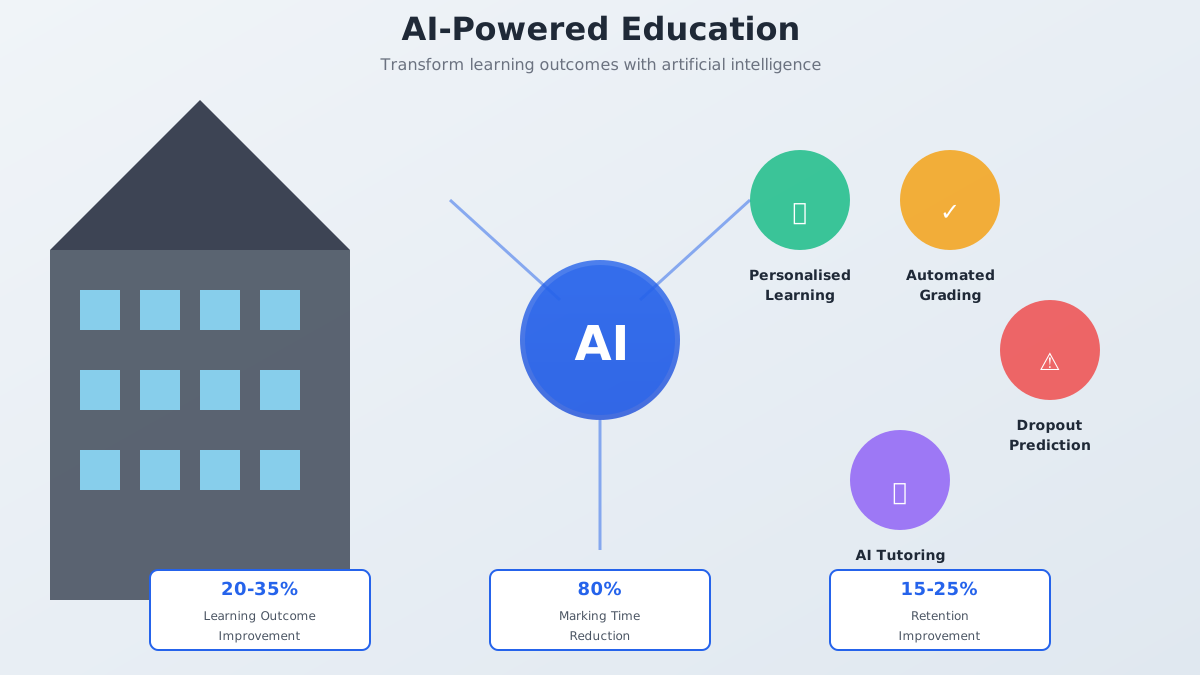
But artificial intelligence offers a path forward—not to replace educators, but to amplify their impact. From personalised learning paths that adapt to each student’s pace, to automated grading that frees up 80% of marking time, to early warning systems that identify at-risk students before they drop out, AI is transforming how Australian education works.
This comprehensive guide explores the seven most impactful AI applications for Australian schools and universities, the regulatory landscape you need to navigate, the return on investment benchmarks, and a practical implementation roadmap for educational leaders.
Why AI Matters for Australian Education Now
The Current Crisis in Australian Education
Australia’s education system is stretched thin. According to the 2024 Australian Institute for Teaching and School Leadership (AITSL) report, teacher workload is at its highest in a decade. The average Australian teacher spends 50+ hours per week on teaching and administration combined—with marking and assessment accounting for 7-9 hours.
For universities, the picture is equally challenging:
– Student retention rates have declined 3-5% over the past three years across major Australian universities
– International student enrolments remain 15-20% below pre-COVID levels
– The cost per student for personalised academic support has increased 40% since 2020
– Administrative overhead (student records, academic planning, enrolment) consumes 30% of institutional IT budgets
TAFE institutions face even steeper pressures:
– Funding cuts have forced course consolidations in many states
– Waiting lists for practical training (plumbing, electrical, nursing) are extending 6-12 months
– High staff turnover (20-25% annually) disrupts program consistency
– Curriculum updates lag industry needs by 12-18 months
Why AI is the Solution
Artificial intelligence doesn’t replace teachers—it removes friction from the teaching and learning experience. By automating routine, time-consuming administrative tasks and delivering personalised support at scale, AI allows educators to focus on what they do best: mentoring, challenging, and inspiring learners.
The data is compelling:
– Schools using adaptive learning platforms report 20-35% improvements in learning outcomes
– Universities implementing AI student monitoring systems achieve 15-25% improvements in retention rates
– Teachers using AI-assisted grading recover 80% of marking time—approximately 8-10 hours per week per educator
– Institutions automating enrolment and scheduling workflows reduce administrative bottlenecks by 40-60%
Seven High-Impact AI Applications for Australian Education
1. Personalised Learning and Adaptive Content Delivery
How it works: AI-powered learning platforms track each student’s performance—questions answered, time spent on topics, error patterns—and dynamically adjust difficulty and content presentation. The system might identify that a student struggles with fractions but excels at spatial reasoning, then resequence future content accordingly.
Australian context: This is transformative for inclusive education. With Australia’s commitment to personalised learning in the National Curriculum, adaptive AI platforms help schools deliver on that promise at scale. Integration with existing Learning Management Systems (Canvas, Moodle, Blackboard) is seamless.
Outcomes:
– 20-35% improvement in learning outcomes (literacy and numeracy)
– 40% reduction in time-to-competency
– Better engagement for students with diverse learning needs
– Reduced achievement gaps across socioeconomic demographics
Implementation: Start with a pilot in one or two year levels. Personalised learning AI vendors like DreamBox, ALEKS, and Smart Sparrow all have Australian deployments.
2. Automated Grading and Assessment
How it works: AI systems grade assignments across the learning spectrum:
– Multiple choice: instant scoring
– Short answer: pattern matching + semantic understanding
– Essays: NLP models trained on rubric-based feedback
– Code assignments: automated test suites + code quality analysis
Australian context: Automated grading is critical for AITSL compliance—educators must maintain assessment quality while managing spiralling workload. Australian education software vendors (including Anitech partners) have built AI grading tools compliant with Australian Curriculum requirements.
Outcomes:
– 80% reduction in marking time (8-10 hours recovered per week per teacher)
– Consistent, bias-free assessment
– Instant feedback for students (vs. 1-2 week delays)
– Academic integrity tools detect plagiarism and contract cheating
Implementation: Begin with objective assessments (multiple choice, short answer), then expand to essay and coding assignments as confidence grows. Staff training is essential—teachers must understand how AI grades and validate quality.
3. Student Dropout and At-Risk Prediction
How it works: Machine learning models ingest student engagement data—login frequency, assignment submission patterns, grades, attendance, library usage, forum posts—and predict dropout risk. Early intervention workflows then trigger: advisor outreach, tutoring offers, financial aid checks.
Australian context: For universities, student attrition directly impacts funding (the Unified Student Contribution system ties funding to completion rates) and institutional reputation. At-risk prediction is vital. TEQSA (Tertiary Education Quality and Standards Agency) increasingly expects institutions to demonstrate proactive student success strategies.
Outcomes:
– 15-25% reduction in dropout rates
– Earlier intervention = higher intervention success rates
– Better allocation of limited academic support resources
– Improved institutional retention metrics (and funding stability)
Implementation: Partner with a higher ed analytics vendor (e.g., Civitas Learning, Tableau Education, or local AU providers). Data governance and student privacy compliance are essential.
4. Administrative Automation: Enrolment, Scheduling, and Records
How it works: Robotic process automation (RPA) + AI handles routine administrative workflows:
– Student enrolment: automating form processing, prerequisite checking, schedule conflicts
– Timetabling: AI algorithms optimise room and lecturer availability
– Record management: automating transcript requests, document processing
– Financial workflows: invoice reconciliation, financial aid eligibility checking
Australian context: Schools and universities waste enormous time on paper-based or manual-digital workflows. TEQSA and school regulatory bodies don’t prescribe systems—they focus on outcomes. Automating here frees finance, enrolment, and registrar teams for higher-value work.
Outcomes:
– 40-60% reduction in administrative processing time
– Faster student onboarding (enrolment to first day)
– Fewer manual errors in scheduling and records
– Better financial controls and audit trails
Implementation: Map current workflows, identify bottlenecks, pilot with one process (e.g., enrolment), then expand.
5. AI Tutoring and Learning Support at Scale
How it works: Conversational AI (chatbots) provide 24/7 academic support. Subject-specific tutors answer homework questions, explain concepts, provide worked examples. Unlike human tutors, AI tutors are available instantly, infinitely scalable, and never tired.
Australian context: Regional schools and universities struggle to recruit specialist tutors. AI tutoring bots level the playing field—a student in rural Tasmania gets the same quality support as one in Sydney’s east.
Outcomes:
– 30% improvement in student satisfaction with support services
– 20% reduction in demand for paid tutoring (cost to families)
– Better learning outcomes for struggling students
– Availability regardless of geography or time of day
Implementation: Deploy subject-specific AI tutors (maths, science, English, languages). Integration with your LMS is essential.
6. Curriculum and Learning Content Generation
How it works: Large language models generate learning materials—lessons, worked examples, practice problems, assessments—adapted to student level, learning style, and curriculum requirements. Educators curate and refine generated content rather than creating from scratch.
Australian context: With Australian Curriculum requirements and state-specific variations, generating aligned content is time-intensive. AI accelerates this—and allows rapid updates when curriculum changes.
Outcomes:
– 60% reduction in time creating learning materials
– Content personalised to student level and learning style
– Rapid curriculum pivots
– Reduced content costs
Implementation: Use AI writing tools with curriculum guardrails. Human review is non-negotiable—educators remain the quality gate.
7. Accessibility and Inclusive Learning
How it works: AI-powered accessibility tools remove barriers for students with disabilities:
– Real-time captioning for deaf/hard of hearing students
– Text-to-speech and speech-to-text for students with dyslexia
– Learning content adaptation for neurodivergent students
– Visual descriptions of images and diagrams for blind students
Australian context: Australian education providers have legal obligations under the Disability Discrimination Act and the NDIS to provide accessible education. AI accessibility tools are cost-effective compliance tools.
Outcomes:
– Equitable access for students with disabilities
– Legal compliance with disability discrimination requirements
– Better outcomes for neurodivergent learners
– Reduced cost of manual accommodation support
Implementation: Integrate accessibility tools into your LMS. Many platforms (Canvas, Blackboard) now have AI accessibility modules built-in.
Privacy, Security, and Compliance: The Australian Regulatory Landscape
Before implementing AI in education, you must understand the compliance landscape.
Data Protection: Privacy Act and Privacy Principles
The Australian Privacy Act 1988 governs how Australian institutions collect, store, and use student data. Key principles:
- Collection Limitation: Collect only data necessary for educational purposes. Don’t collect data “just in case”—data minimisation is essential.
- Use Limitation: Data collected for learning analytics cannot be repurposed for marketing or commercial use without explicit consent.
- Data Security: Student data must be protected with industry-standard encryption and access controls. AI training on student data must not expose PII.
- Transparency: Students and parents have a right to know what data is collected and how AI uses it.
- Individual Access: Students can request copies of data collected about them.
FERPA-Adjacent Protections for Australian Education
While Australia doesn’t have a direct equivalent to FERPA, the Privacy Act creates similar protections. Additionally:
- School records are protected under state-based education legislation
- University records are governed by institutional policies aligned with the Privacy Act
- TEQSA oversight for universities includes data governance audits
AI-Specific Compliance Considerations
When implementing AI in education, ensure:
- Algorithmic Transparency: You can explain how the AI makes decisions about individual students (e.g., why a student was flagged as at-risk)
- Bias Audits: Regularly audit AI models for demographic bias—ensure the system doesn’t disadvantage students from specific populations
- Human Oversight: Critical decisions (expulsion, academic probation, intervention) should not be made by AI alone
- Data Retention: Define how long student data is retained and when it’s deleted
- Third-Party Vendor Management: Ensure AI vendors comply with Privacy Act requirements
ROI Benchmarks: What to Expect
Implementing AI in education delivers measurable financial return:
For Schools
Marking Automation (Tier 2 AI – Automated Grading)
– Investment: $50,000-$100,000 per 500 students (software + integration + training)
– ROI: 8-12 hours recovered per teacher per week = $40,000-$60,000 annual labour value per 20 teachers
– Payback: 12-18 months
Personalised Learning (Tier 2 AI – Adaptive Content)
– Investment: $15,000-$30,000 per school (for platform + teacher training)
– ROI: 20-35% improvement in learning outcomes = measurable improvement in NAPLAN results (institutional reputation + funding improvements)
– Payback: Difficult to quantify financially, but critical for school performance and funding
For Universities
At-Risk Prediction (Tier 2 AI – Dropout Prediction)
– Investment: $100,000-$200,000 per year (platform subscription + analytics team)
– ROI: 15-25% improvement in retention = $2-3M annual revenue impact for medium-sized universities (1,000+ students at $15,000 AUD per student)
– Payback: 12-24 months
Administrative Automation (Tier 3 AI – RPA)
– Investment: $150,000-$300,000 (automation platform + integration + change management)
– ROI: 40-60% reduction in enrolment/records processing = 2-3 FTE staff reallocation
– Payback: 18-24 months
For TAFE
Curriculum Generation + Scheduling Automation
– Investment: $80,000-$150,000
– ROI: 50% reduction in curriculum development time + 30% faster scheduling adjustments = better alignment with industry demand + improved competency completion rates
– Payback: 18-30 months
Implementation Roadmap: A 12-Month AI Transformation Plan
Month 1-2: Assessment and Planning
Week 1-2:
– Audit current processes. Where do educators waste the most time? Where are students struggling the most?
– Define success metrics: What does success look like for your institution? (Improved learning outcomes? Reduced marking time? Better retention?)
– Identify stakeholders: Teachers, IT staff, senior leadership, parents, students themselves
Week 3-4:
– Research AI vendors aligned to your needs and budget
– Assess data readiness: Do you have clean, usable student data? What gaps exist?
– Plan change management: Who will champion AI adoption? How will you address staff anxiety?
Month 3-4: Pilot Selection and Vendor Engagement
Select ONE high-impact, low-risk pilot:
– For schools: Automated grading for Year 10 Maths (concrete, measurable benefit; clear ROI)
– For universities: At-risk prediction for first-year cohort (directly addresses attrition challenge)
– For TAFE: Curriculum content generation for one high-demand course
Vendor engagement:
– RFP process (request for proposal) for shortlisted vendors
– Proof-of-concept with live data (anonymised)
– Reference calls with peers who’ve deployed the solution
Month 5-6: Pilot Deployment
Go live with pilot:
– Migrate pilot cohort data (with robust privacy controls)
– Train educators/staff on the new system
– Monitor adoption: Who’s using it? What questions arise?
– Collect baseline metrics: Current marking time, current retention rates, etc.
Weekly standups:
– Feedback loops with educators and students
– Quick wins to build momentum
– Address emerging issues (data quality, usability, accuracy)
Month 7-9: Pilot Evaluation and Expansion Planning
Measure pilot impact:
– Reduced marking time? By how much?
– Improved learning outcomes? (Formative assessment data)
– Better at-risk prediction accuracy? (Validate against actual outcomes)
– User adoption rates? (Percentage of eligible students engaged)
Expand or pivot:
– If pilot successful: Expand to additional year levels or cohorts
– If pilot needs refinement: Diagnose and fix issues before scaling
– Identify next AI application to pilot (e.g., if grading pilot successful, move to personalised learning)
Month 10-12: Full Rollout and Continuous Improvement
Scale across institution:
– Migrate remaining cohorts
– Full staff training
– Updated policies and guidelines (data retention, AI transparency, etc.)
– Integration with other systems (SIS, LMS, etc.)
Establish governance:
– AI ethics committee or data governance board
– Regular audits for bias and fairness
– User feedback mechanisms
– Continuous improvement cycles
Seven Critical Success Factors
-
Teacher and educator buy-in: AI only works if educators trust and use it. Invest heavily in training and gather feedback.
-
Data quality: Garbage in, garbage out. Clean your student data before deploying AI. Poor data quality undermines model accuracy.
-
Clear success metrics: Define what success looks like before you start. Measure impact throughout.
-
Privacy-first approach: Don’t collect data you don’t need. Be transparent with students and parents. Build trust.
-
Vendor accountability: Ensure your AI vendor is committed to Australian education. Do they understand AITSL, TEQSA, state curriculum requirements?
-
Change management: AI transforms workflows. Invest in change management—communication, training, support—or adoption will stall.
-
Iterative deployment: Don’t try to boil the ocean. Pilot one application, measure impact, then expand. Small wins build momentum.
FAQ: AI in Australian Education
Q1: Will AI replace teachers?
A: No. AI handles time-consuming administrative and routine assessment tasks, allowing teachers to focus on mentoring, inspiration, and complex problem-solving. Teachers remain central to learning. In fact, AI frees teachers to do more of the high-value work that makes teaching rewarding.
Q2: What about student privacy? Isn’t AI data dangerous?
A: Student data protection is taken seriously. Australian institutions must comply with the Privacy Act, which includes strong data protection requirements. Choose vendors committed to data minimisation (collecting only necessary data), encryption, and transparency. Regular privacy audits are essential.
Q3: How much does AI for education cost?
A: It varies widely. Simple automated grading tools start at $50,000-$100,000 per school. Institutional learning platforms for universities can range $200,000-$500,000 annually. TAFE-specific solutions are typically $100,000-$250,000. ROI is usually achieved within 18-24 months.
Q4: Does AI work for all learners?
A: AI personalised learning is most effective for students with diverse learning needs—it removes barriers and adapts to pace. However, some students prefer human interaction. Best practice: hybrid approach where AI provides support and personalisation, and educators provide mentoring and complex instruction.
Q5: What’s the first step?
A: Audit your current pain points. Where do educators waste the most time? Where are students struggling? Start small with a high-impact, low-risk pilot. Measure results. Scale what works.
Ready to Transform Education with AI?
Australian schools and universities are at the forefront of educational innovation. AI is no longer a theoretical future—it’s available now, proven, and delivering measurable results.
Your next step: Audit your current processes. Identify one high-impact opportunity. Pilot it. Measure. Scale.
Anitech AI specialises in AI implementation for Australian education institutions. We’ve deployed personalised learning, automated grading, at-risk prediction, and administrative automation across schools and universities nationwide. We understand Australian Curriculum, AITSL, TEQSA, and state education regulations. We prioritise data privacy and teacher empowerment.
Let’s discuss your institution’s unique challenges and opportunities. Book a consultation with Anitech’s education AI specialists today.
Related Articles
For deeper dives into specific AI applications:
- AI Personalised Learning in Australian Schools and Universities: Every Student Gets Their Own Pace
- AI Student Dropout Prediction: How Australian Universities Are Keeping Students Enrolled
- AI Automated Grading and Assessment for Australian Educators: Time Back for Teaching
- AI Tutoring Chatbots for Australian Students: 24/7 Learning Support Without the Staffing Cost
Master pillar: AI Automation Australia — explore AI automation across all Australian industries.
Further Reading
- AI Automation Australia — Complete Guide
- AI Personalised Learning in Australian Schools and Universities: Every Student Gets Their Own Pace
- AI Student Dropout Prediction: How Australian Universities Are Keeping Students Enrolled
- AI Automated Grading and Assessment for Australian Educators: Time Back for Teaching
- AI Student Assessment: Beyond Multiple Choice to Intelligent Evaluation