
AI Dynamic Pricing for Australian Retailers: Maximise Margins in Real Time
For decades, retail pricing was static. A product had a “regular price” and a “sale price.” Changes happened quarterly, seasonally, or in response to major competitor moves.
That model is obsolete.
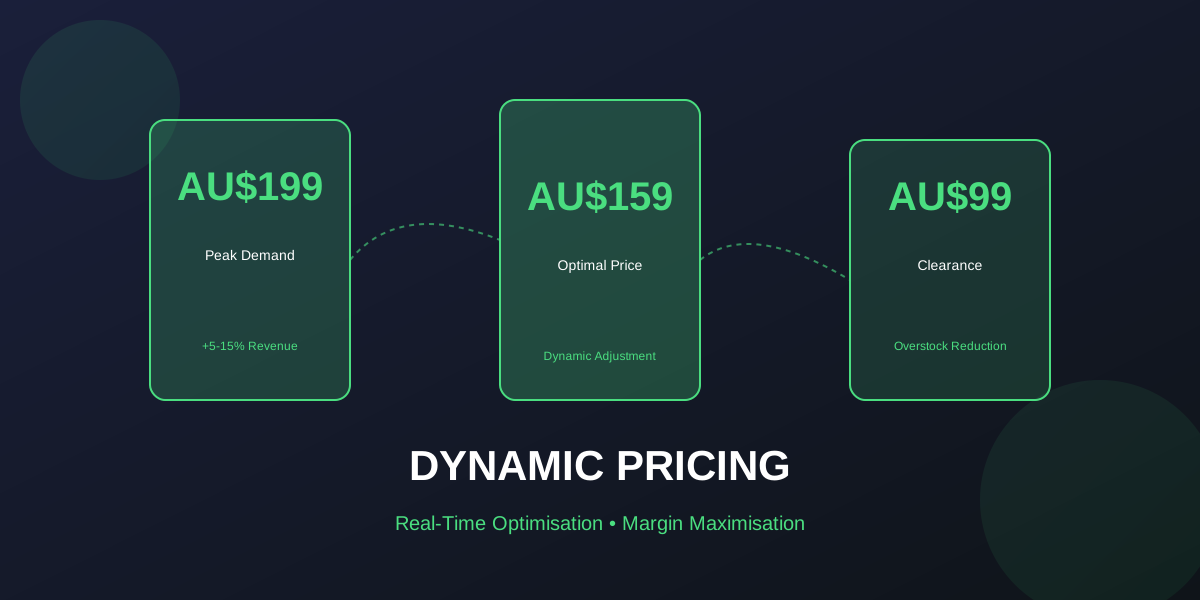
AI-powered dynamic pricing adjusts prices automatically—in real time—based on dozens of signals: competitor prices, demand signals, inventory levels, time of day, customer segment, product elasticity, and margin goals. The result: 5-15% revenue uplift, improved inventory turnover, and recaptured margin that would otherwise erode.
Australian retailers in fuel, groceries, fashion, and electronics are already deploying dynamic pricing. This guide explains the mechanics, regulatory considerations, and implementation strategies.
How AI Dynamic Pricing Works
The Core Mechanics
Dynamic pricing algorithms answer a single question: For this customer, at this moment, what price maximizes revenue or profit?
The algorithm considers:
- Competitor prices (in real time, via APIs or web scraping)
- Demand signals (search volume, trending products, seasonality)
- Inventory levels (overstocked items get price reductions; low-stock items hold premium pricing)
- Time and context (Friday night shopper behaves differently than Monday morning; mobile vs. desktop)
- Customer segment (high-value repeat customer vs. first-time browser)
- Product elasticity (how sensitive is demand to price? luxury goods are less elastic than grocery staples)
- Margin targets (ensure margin doesn’t fall below acceptable threshold)
The Math: Price Elasticity
Price elasticity measures how much demand changes when price changes.
Formula: Elasticity = % Change in Quantity / % Change in Price
Examples:
– Luxury handbag: 10% price increase → 3% demand decrease. Elasticity = -0.3 (inelastic). These customers care about brand/status, not price. You can raise prices.
– Grocery milk: 10% price increase → 15% demand decrease. Elasticity = -1.5 (elastic). Milk is commoditized; customers switch stores for small price differences. You can’t raise prices much.
AI models learn elasticity from historical data (how did sales change when we last changed prices?) and adjust pricing accordingly.
Real-World Example: Australian Fashion Retailer
Scenario: Retailer sells winter jackets. Competitor (Kathmandu) prices a jacket at AU$199.
Dynamic pricing logic:
| Scenario | Inventory | Demand Signal | Competitor Price | AI Decision | Rationale |
|---|---|---|---|---|---|
| High stock, slow demand | 500 units | Declining | AU$199 | Price at AU$179 | Liquidate excess; elasticity suggests 5-8% demand bump from AU$20 discount |
| Medium stock, peak demand | 50 units | Trending #3 product | AU$199 | Price at AU$219 | Scarce inventory; elastic demand is low during peak season; margin recovery |
| Low stock, high demand | 10 units | Trending #1 product | AU$199 | Price at AU$249 | Scarcity premium; willingness-to-pay is high; margin maximization |
| Seasonal transition | 100 units | Declining (spring approaching) | AU$199 | Price at AU$159 | Aggressive reduction to clear seasonal stock; elasticity allows this |
In 24 hours, the same jacket might be priced at AU$179, AU$219, AU$249, then AU$159 based on these signals. Customers see different prices based on real-time conditions.
Key Signals and Algorithms
1. Competitor Price Monitoring
How it works: Retailers use APIs or web scraping to monitor competitor prices (usually updated hourly or daily).
Tools:
– Competera, Wiser, or Keepa: SaaS platforms that monitor competitor prices across major retailers
– Custom scraping: Build APIs that crawl competitor websites hourly
For Australian retailers, typical competitors:
– Direct competitors (e.g., another activewear brand)
– Channel competitors (e.g., department stores selling similar products)
– Amazon/eBay (if selling online)
– International retailers (Shein, ASOS) if competing on price
Pricing strategy:
– Match pricing (keep prices within 2-3% of competitor to stay competitive)
– Undercut pricing (always 5-10% cheaper; works for commodities but kills margin)
– Premium positioning (price 10-15% higher; works for brands, quality differentiation)
Result: Automated responses to competitive moves without manual intervention.
2. Demand Sensing
How it works: ML models forecast short-term demand (next day to 4 weeks) based on:
– Historical sales data
– Seasonality (winter coats sell more in April-June in Australia)
– Trending signals (social media mentions, news coverage, celebrity endorsements)
– Weather data (cold snaps drive coat sales; heatwaves drive ice cream sales)
– External events (Black Friday, payday cycles, holidays)
Implementation: Models predict demand for each product category/SKU. High-demand items get premium pricing; low-demand items get discounted.
Result: Prices rise before customers realise they want the product (capturing willingness-to-pay); prices fall as demand wanes (liquidating before obsolescence).
3. Inventory Optimization
How it works: Pricing reflects inventory level. Overstocked items get price reductions to encourage turnover; low-stock items get premiums to maximize margin on scarce stock.
Logic:
– Inventory > 60 days of supply: Reduce price 5-15% to accelerate turnover
– Inventory = 20-60 days of supply: Maintain baseline pricing
– Inventory < 20 days of supply: Increase price 5-20% to maximize margin
– Inventory = 0 (out of stock): Consider pre-order at premium
Financial impact: Inventory carrying cost is typically 25-30% of product value annually in retail. Every day inventory sits is cost. Dynamic pricing that accelerates turnover is directly profitable.
4. Time-of-Day and Customer Segment
How it works: Prices can vary by time of day, day of week, and customer segment.
Examples:
– Friday/Saturday night: Leisure shopping, lower price sensitivity. Maintain or increase prices.
– Monday morning: Work commute, convenience shopping, high price sensitivity. Offer discounts on quick-win products.
– High-value customers: Offer exclusive early access or loyalty discounts rather than broad price reductions.
– New customers: Offer first-purchase discounts (acquisition cost is high).
Data source: Customer CRM/loyalty program, anonymous session data (time, device, location).
Pricing Strategies: How to Think About It
Revenue vs. Profit Optimization
Two fundamental strategies:
1. Revenue Maximisation: Find the price that maximizes total revenue (price × quantity). Works for:
– High-margin categories (luxury, premium brands)
– Growing businesses (market share > margin)
– Products with elastic demand
Example: A luxury activewear brand might price a bra at AU$95 even though competitors price at AU$85. At AU$95, they sell 100 units/day and earn AU$9,500. At AU$85, they sell 130 units/day and earn AU$11,050. They optimize for revenue.
2. Profit Maximisation: Find the price that maximizes margin (price – cost) × quantity. Works for:
– Competitive categories (low differentiation)
– Mature businesses (profitability > growth)
– Products with inelastic demand
Example: A grocery retailer selling milk. Milk costs AU$2.50 to source. If they price at AU$3.50, they sell 500 units and earn AU$500 profit. If they price at AU$4.50, they sell 250 units and earn AU$500 profit. Margin is same but lower volume. They might optimize for volume to drive store traffic.
Ethical Considerations
Dynamic pricing is legal but ethically fraught. Here’s how to navigate it:
1. Avoid discrimination on protected attributes
– Legal: Don’t increase prices for customers based on race, gender, age, disability, or protected characteristics
– Safeguard: Audit pricing by customer segment for discrimination
– Best practice: Use price only on economic signals (willingness-to-pay based on behaviour, not identity)
2. Transparency builds trust
– Disclose dynamic pricing in terms of service (“Prices may vary based on demand, inventory, and market conditions”)
– Don’t hide it—customers will notice and feel cheated if they discover they paid different prices
3. Avoid predatory practices
– Don’t exploit behavioural biases (e.g., stranded checkout cart hostage tactics: “Price about to increase!”)
– Don’t deliberately disadvantage loyal customers (long-time customers should get fair pricing, not punishment)
4. Avoid collusion
– Don’t use competitor price monitoring to coordinate pricing across retailers (illegal under competition law)
– Price unilaterally based on your costs/demand, not to match competitors’ signals
Australian Regulatory Landscape
ACCC Competition Law
The Australian Competition and Consumer Commission enforces competition law. Dynamic pricing raises specific concerns:
1. Cartel conduct (price fixing)
– Illegal: Retailers meeting and agreeing to set prices at certain levels
– Illegal: Information sharing that facilitates price coordination (e.g., sharing competitor pricing via industry body)
– Legal: Unilateral response to competitor prices (“We noticed Kathmandu priced jacket at AU$199, so we priced ours at AU$189”)
Guidance: As long as your dynamic pricing is unilateral (you decide based on your algorithms, not collusion), you’re fine.
2. Unconscionable conduct
– Illegal: Taking advantage of consumer vulnerability (e.g., targeting elderly customers with price hikes)
– Safeguard: Audit pricing to ensure vulnerable groups aren’t systematically disadvantaged
3. Exclusive dealing
– Rare in pricing: Could apply if you’re using dynamic pricing to exclude competitors, but unlikely
– Safeguard: Use pricing for your own profit, not to predatorily target competitors
ACCC guidance: Unilateral dynamic pricing based on economic signals (demand, inventory, costs) is presumed legal. Coordinate or discriminatory pricing faces scrutiny.
Australian Consumer Law (ACL)
Key principle: Prices must not be misleading. Common issues with dynamic pricing:
1. Misleading “savings” claims
– Illegal: “Was AU$199, now AU$99” when you just raised price to AU$199 yesterday to show a fake discount
– Safeguard: Only show savings from genuine recent prices (e.g., price 30 days ago)
2. Misleading “limited time” claims
– Illegal: “Sale ends tonight!” when you’ve offered the same price weekly for months
– Safeguard: Use genuine scarcity/time-limited offers
3. Bait and switch
– Illegal: Advertise low price to lure customers, then claim out of stock and push them to higher-priced alternatives
– Safeguard: Maintain inventory proportional to demand; don’t artificially create scarcity
Privacy Act Considerations
If you use customer data to set prices (e.g., higher prices for high-value customers), you must:
– Disclose this in privacy policy (“We use purchase history and customer segment to personalise pricing”)
– Get consent (opt-in or implied consent via privacy notice)
– Ensure fair processing (don’t discriminate on protected attributes)
Best practice: Be transparent. “We use dynamic pricing to offer relevant pricing based on demand and inventory.”
Implementation Approaches
Approach 1: Competitor Price Monitoring + Rule-Based Pricing
What it does: Monitor competitor prices, apply rules to your pricing (e.g., “always be 5% cheaper than Kathmandu”).
Tools: Competera, Wiser, Keepa, or custom scraping + rule engine.
Timeline: 4-8 weeks.
Cost: AU$3,000-8,000 annually (SaaS) or AU$20,000-40,000 custom build.
Pros:
– Fast implementation
– Easy to understand and control
– Transparent rules
Cons:
– Rule-based (not AI learning)
– Limited to competitor signals; ignores demand, inventory
– Can trigger race-to-the-bottom dynamics with competitors
Result: 2-5% margin improvement via competitive positioning.
Approach 2: Demand Forecasting + Inventory-Based Pricing
What it does: Forecast demand and set prices based on inventory level relative to demand.
Tools: Custom ML models (demand forecasting) + pricing rules + integration to POS/e-commerce.
Timeline: 12-16 weeks.
Cost: AU$40,000-80,000 build; AU$3,000-6,000 monthly operational.
Pros:
– Sophisticated (learns from data)
– Captures inventory/demand dynamics
– Avoids stockouts and dead stock
Cons:
– More complex implementation
– Requires good historical data
– Not real-time (usually daily repricing)
Result: 8-12% revenue improvement via inventory optimization.
Approach 3: Full AI Dynamic Pricing
What it does: Real-time pricing that combines competitor prices, demand sensing, inventory, customer segment, elasticity learning, and margin constraints.
Tools: Custom ML platform (Competera, Omnia, or custom build with Python + Databricks).
Timeline: 16-24 weeks.
Cost: AU$60,000-150,000 build + AU$5,000-15,000 monthly operational.
Pros:
– Optimal pricing across all signals
– Real-time adjustments (multiple times per day)
– Learns continuously (elasticity improves with more data)
– Highest ROI
Cons:
– High complexity
– Requires strong data foundations
– Needs ongoing data science expertise
Result: 10-20% revenue improvement (depends on category elasticity and baseline strategy).
Real-World Results: Australian Retailers
Case Study 1: Fuel Retailing (National Chain)
Baseline: Manual pricing (daily decision by category manager), prices set based on ACCC data feeds and intuition.
Implementation: Dynamic pricing using competitor prices (Shell, Caltex, Mobil) + demand sensing (weather, weekend vs. weekday).
Timeline: 12 weeks.
Results:
– Revenue per litre: AU$1.51 → AU$1.58 (+4.6%)
– Volume: No significant change (demand is inelastic for fuel)
– Incremental revenue Year 1: AU$2.3M (on 50M litres)
– Margin improvement: 0.7 percentage points
– Implementation cost: AU$45,000
– Year 1 ROI: 5,000%+
Case Study 2: Fashion E-Commerce (AU$20M revenue)
Baseline: Quarterly pricing by season (spring, summer, autumn, winter); clearance sales 2x per year.
Implementation: Demand forecasting + inventory-based dynamic pricing. Prices update daily based on inventory age, demand forecasts, and competitive positioning.
Timeline: 14 weeks.
Results:
– Gross margin: 42% → 46% (+4 percentage points)
– Inventory turnover: 3.2x → 3.8x (faster turnover)
– Dead stock (write-offs): 4% → 1.5% of inventory value
– Incremental revenue Year 1: AU$480,000 (4% margin improvement × AU$20M)
– Inventory savings: AU$180,000 (faster turnover + less dead stock)
– Total benefit: AU$660,000
– Implementation cost: AU$70,000
– Year 1 ROI: 840%
Case Study 3: Grocery Retailer (20 stores, AU$15M revenue)
Baseline: Weekly pricing set by category manager (often delayed 3-5 days to implement); limited competitor monitoring.
Implementation: Competitor price monitoring + rule-based dynamic pricing (match competitor prices within 2% for commodities).
Timeline: 8 weeks (simple implementation).
Results:
– Competitive positioning improved (prices now match within 1-2% of major competitors)
– Volume: +2% (more competitive on key loss-leaders)
– Margin: Slight decrease on commodities but offset by volume gains
– Incremental revenue Year 1: AU$150,000
– Implementation cost: AU$25,000
– Year 1 ROI: 500%
Frequently Asked Questions
Q1: Won’t customers notice and complain about different prices?
A: They will notice and will complain. The question is: does the benefit (lower prices for some, better inventory management) outweigh the perception problem?
Mitigation:
– Be transparent in terms of service
– Show the same price to the same customer consistently (don’t change price mid-session while they’re shopping)
– Use dynamic pricing for inventory/demand optimization, not to exploit individuals
– When prices do vary (e.g., by time or location), explain why
Real example: Surge pricing on Uber caused massive backlash, but most customers now understand and accept it. Dynamic pricing in retail is more accepted than ride-share because margins are lower and prices are lower overall.
Q2: How often should we reprice?
A: Depends on category dynamics and competitive intensity.
Typical cadences:
– Daily repricing: Fashion, homewares, electronics (inventory-driven)
– Hourly repricing: Fuel, perishables, high-competition categories (demand/competitor-driven)
– Real-time repricing: Airline dynamic pricing, hotel room pricing (extreme scarcity + high willingness-to-pay)
Most retail starts with daily repricing and adjusts based on competitive response and inventory dynamics.
Q3: What if competitors undercut our prices?
A: Dynamic pricing doesn’t solve a fundamentally uncompetitive cost structure. If your cost is AU$50 and competitor cost is AU$40, dynamic pricing won’t help you compete on price.
What dynamic pricing does:
1. Quickly respond to moves (you reprice daily instead of weekly)
2. Optimize your margins given your cost structure
3. Protect high-margin products (don’t get drawn into price wars on premium items)
If competitors are undercutting consistently, you need to:
– Reduce costs (sourcing, supply chain)
– Differentiate on value (quality, service, brand)
– Focus on higher-margin categories where you can compete
Dynamic pricing is an efficiency tool, not a cost advantage.
Q4: Is dynamic pricing legal in Australia?
A: Yes. Unilateral dynamic pricing is legal under competition law and consumer law. Key safeguards:
- Don’t collude with competitors on pricing
- Don’t discriminate on protected attributes (race, gender, etc.)
- Don’t mislead about prices (fake “was” prices, false urgency)
- Be transparent in terms of service
As long as you’re following these principles, dynamic pricing is legal and increasingly common in Australian retail.
Q5: What’s the difference between dynamic pricing and surge pricing?
A: Surge pricing is dynamic pricing in extreme scarcity (Uber, concert tickets). Dynamic pricing is the broader practice of adjusting prices based on demand/supply.
Surge pricing = dramatic price increases in peak demand.
Dynamic pricing = continuous optimization across all signals.
Call to Action
Dynamic pricing is one of the highest-ROI AI use cases for Australian retailers. 5-15% revenue uplift is achievable in 12-16 weeks with the right approach.
Get started:
- Assess category elasticity: Which products have elastic demand (price-sensitive)? Which are inelastic (price-insensitive)?
- Start with inventory: Use dynamic pricing to clear seasonal/slow-moving inventory (quick win, 2-5% margin improvement)
- Layer in competitor monitoring: Stay competitive without manual daily checks
- Expand to demand signals: Forecast demand and optimize pricing proactively
Anitech AI has implemented dynamic pricing for 15+ Australian retailers. We’ll help you build the business case, navigate regulatory considerations, and implement pricing that maximizes margin without alienating customers.
Get a Dynamic Pricing Assessment – We’ll model ROI for your category, assess regulatory risk, and provide a phased implementation plan.
Additional Resources
- AI Automation in Retail and E-Commerce: The Australian Business Guide (2025)
- AI Personalisation for Australian Retailers: Driving Revenue Through Hyper-Relevant Experiences
- AI Inventory Management for Australian Retailers: Stop Stockouts and Overstock for Good
Further Reading
- AI Automation Australia — Complete Guide
- AI Automation in Retail and E-Commerce: The Australian Business Guide (2025) — Industry Guide
- AI Personalisation for Australian Retailers: Driving Revenue Through Hyper-Relevant Experiences
- AI Inventory Management for Australian Retailers: Stop Stockouts and Overstock for Good
- AI Customer Segmentation for Retail: Target the Right Shoppers, Every Time
- AI Fraud Prevention in Retail: Stop Theft, Returns Fraud and Payment Fraud