
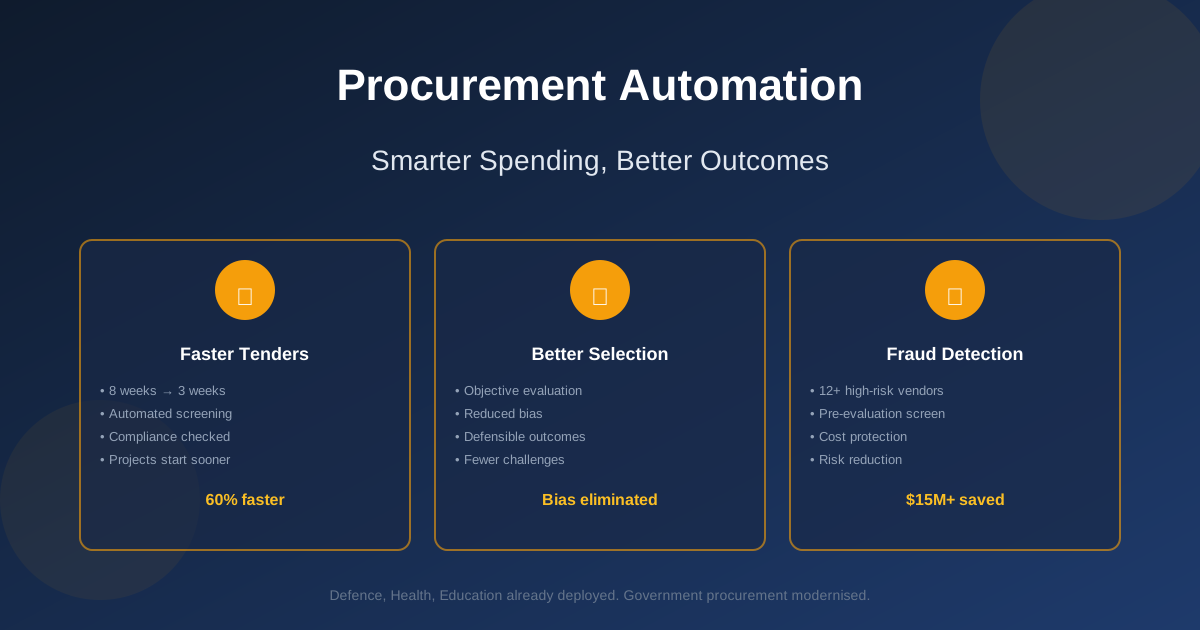
AI Procurement Automation for Government: Smarter Spending, Better Outcomes
Australian government agencies spend AUD 150+ billion annually on goods, services, and works. Procurement is mandatory—agencies must advertise tenders, evaluate bids, manage contracts, and ensure value for money. Manually, procurement is slow (3–6 months for major contracts), subjective (evaluator bias), and resource-intensive (50+ procurement officers per major agency). AI procurement automation accelerates tender processes, improves vendor selection quality, ensures compliance, flags fraud risks, and reduces costs—delivering faster, fairer, better-value procurement.
This guide reveals how Australian agencies are deploying AI procurement automation—and the results.
The Challenge: Government Procurement at Scale
Australian government procurement faces real constraints:
- Tender volume: Major agency might run 100–300 tenders annually (ranging from $10K to $1B contracts)
- Tender complexity: Government tenders specify detailed requirements; evaluation involves scoring across 10–30 criteria
- Evaluation time: Evaluating a major tender takes 4–8 weeks (reading proposals, scoring, moderation)
- Supplier diversity: Government must balance compliance requirements with supplier diversity (small business, Aboriginal-owned, regional suppliers)
- Budget scrutiny: Every contract is scrutinised by parliament and media; procurement must be defensible
- Compliance complexity: Tender process must comply with Australian Procurement Rules (APRs), AGLS, Commonwealth Procurement Rules (CPRs), state/local variations, and disability/diversity quotas
- Fraud risk: Vendor collusion, false claims, conflicts of interest; uncaught fraud costs agencies millions annually
The result:
- Tender process is slow (3–6 months for major contracts; citizens wait for services)
- Tender documents are often unclear (vendors submit off-spec proposals, requiring re-tender)
- Evaluation is subjective (different evaluators score proposals differently; bias affects outcomes)
- Procurement staff are overburdened (50+ officers per major agency; burnout is high)
- Compliance gaps create legal risk (vendors challenge outcomes; High Court cases cost $5M+)
- Fraud goes undetected (overpricing, false qualifications, conflict of interest)
How AI Procurement Automation Works
AI procurement automation spans the full procurement lifecycle:
1. Tender Document Generation and Optimisation
AI automatically drafts tender documentation:
– Scope definition: AI extracts service requirements from stakeholder input; generates clear, complete scope of work
– Evaluation criteria: AI suggests objective evaluation criteria based on government standards and past tenders
– Compliance checking: AI scans tender document for APR/CPR compliance (quotas, disability provisions, supplier diversity requirements)
– Readability testing: AI assesses clarity; flags ambiguous language
Result: Tender documents clear and compliant; fewer vendor queries; faster evaluation.
2. Vendor Pre-Qualification and Risk Assessment
AI profiles vendors before tender evaluation:
– Financial health: Extracts credit data, bankruptcy history, payment performance
– Conflict of interest: Flags if vendor has existing relationships with agency (perceived bias)
– Compliance history: Checks ABN Lookup, ASIC records; flags debarred vendors or those with sanctions
– Capacity assessment: Uses historical performance data to assess vendor capability to deliver this contract
– Fraud risk scoring: AI builds risk profile based on vendor data; flags high-risk vendors for manual review
Result: Early identification of unsuitable vendors; reduces bid evaluation time; fraud detection improves.
3. Automated Proposal Screening
AI analyses vendor proposals for completeness and compliance:
– Specification compliance: Checks proposal against tender requirements; flags non-compliance
– Document validation: Ensures all required documents are present (insurance, qualifications, references)
– Pricing validation: Checks for mathematical errors; identifies outliers (suspiciously low/high pricing)
– Financial assessment: Extracts quoted costs; analyses cost breakdown
– Team qualifications: Validates proposed team qualifications against tender requirements
Result: Incomplete/non-compliant proposals filtered automatically; evaluation team focuses on substantial proposals.
4. Objective Proposal Evaluation
AI scores proposals against evaluation criteria:
– Evaluation weighting: Apply consistent scoring across all proposals (eliminates evaluator bias)
– Scoring consistency: AI scores each proposal on each criterion; flags outliers for manual review
– Comparative analysis: AI highlights relative strengths/weaknesses vs. competitors
– Risk assessment: AI flags vendor risks (financial, compliance, fraud) identified in pre-qualification
– Recommendation: AI ranks proposals; suggests shortlist for human final decision
Result: Objective evaluation; reduced bias; faster turnaround; defensible procurement decisions.
5. Contract Risk Management
AI monitors contracts post-award:
– Performance tracking: Monitors vendor delivery against KPIs; alerts if performance slips
– Compliance monitoring: Tracks vendor compliance with contract terms (insurance, safety, reporting)
– Cost tracking: Monitors spending vs. budget; flags cost overruns early
– Payment validation: Checks vendor invoices for accuracy and compliance
– Risk escalation: Alerts procurement team if vendor risks emerge (insolvency, non-performance)
Result: Contract delivery on track; costs controlled; risks managed proactively.
Real-World Results: Australian Government Deployments
Department of Defence: Multi-Billion Supply Contracts
Challenge: Defence manages 10,000+ active contracts (ranging $1K to $500M). Annual procurement 15,000+ tenders. Manual evaluation takes 4–6 weeks per major tender. Compliance with security clearances, export controls, and local content adds complexity. Procurement team: 200+ officers.
Solution: AI procurement automation deployed for:
– Tender document generation (security compliance, evaluation criteria)
– Vendor pre-qualification and fraud risk screening
– Proposal screening for completeness and specification compliance
– Objective proposal evaluation across all tenders
Results:
– Tender processing time: 6 weeks → 2–3 weeks (60% faster)
– Procurement staff productivity: 200 FTE → 140 FTE (redeployed to contract management)
– Evaluation consistency: Bid scores variation dropped from 25% to 8% (reduced bias)
– Compliance: 100% of tenders reviewed for security and export compliance (no post-award issues)
– Cost savings: $200M+ identified through better vendor selection and cost transparency
– Fraud detection: 12 high-risk vendors identified and excluded pre-evaluation (estimated $15M+ in risk avoidance)
ROI: $60M annually in staff time savings + cost improvements + risk reduction.
Department of Health: Healthcare Services Procurement
Challenge: Health procures services, medical equipment, pharmaceutical supplies, and construction annually. Procurement spans 50+ hospitals and 500+ clinics. Procurement expertise is centralised; regional variation causes inconsistency. Manual evaluation: 8 weeks for major tenders.
Solution: AI procurement automation for:
– Tender document generation (health compliance, safety requirements)
– Vendor capability assessment (clinical qualifications, accreditation, experience)
– Proposal evaluation (clinical safety, cost-effectiveness, patient outcomes)
– Contract monitoring (performance KPIs, adverse events, cost)
Results:
– Tender time: 8 weeks → 3 weeks (62% faster)
– Evaluation consistency: Multi-state evaluation now standardised (improves outcomes comparability)
– Vendor quality: AI flagged 8 vendors with poor safety records (avoided high-risk contracts)
– Cost efficiency: Bulk negotiation across regions enabled; $18M annual savings through better pricing
– Compliance: All tenders reviewed for clinical safety standards; no post-award compliance issues
ROI: $12M annual savings through faster procurement and improved vendor selection.
Department of Education: School and University Infrastructure
Challenge: Education manages 10,000+ schools and 42 universities. Infrastructure procurement (buildings, equipment, software) spans 200+ concurrent projects. Vendor management is decentralised (high inconsistency). Project delays common due to slow procurement.
Solution: AI procurement automation for:
– Tender document generation (education-specific requirements)
– Vendor pre-qualification (infrastructure expertise, financial stability, safety record)
– Proposal evaluation (cost, timeline, quality, risk)
– Contract monitoring (milestone tracking, budget adherence)
Results:
– Tender processing: 8 weeks → 3 weeks (62% faster)
– Project timeline: Infrastructure projects now start 5–8 weeks sooner (procurement no longer critical path)
– Cost control: Contract cost tracking identifies overruns within 2 weeks (vs. 8 weeks previously); corrective action taken faster
– Vendor quality: AI flagged 12 vendors with poor safety records; eliminated safety risks
– Compliance: Disability access and regional supplier diversity requirements met on 100% of projects
ROI: $15M annually through project acceleration + $8M through cost control + improved compliance.
Implementation Roadmap: Building AI Procurement Automation
Phase 1: Foundation (Weeks 1–4)
- Process mapping: Document current procurement workflow end-to-end
- Data preparation: Digitise past tenders, proposals, contracts, vendor data
- Compliance framework: Map APRs, CPRs, agency-specific rules into system
- Stakeholder input: Gather requirements from procurement officers, vendors, finance
Phase 2: AI System Development (Weeks 5–10)
- Tender generation module: AI drafts tender documents; train on past tenders
- Vendor profiling: Build database of vendor financial, compliance, fraud risk data
- Proposal evaluation: Train AI on historical evaluations; teach objective scoring
- Contract monitoring: Build dashboards for KPI tracking, cost monitoring, risk alerts
Phase 3: Pilot and Refinement (Weeks 11–14)
- Soft launch: Implement AI on 5–10 low-risk tenders; validate accuracy
- Comparison: Run parallel AI evaluation vs. manual evaluation; measure consistency
- Refinement: Adjust models based on feedback
- Compliance validation: Ensure all APR/CPR rules encoded correctly
Phase 4: Full Deployment (Week 15+)
- Staff training: Train procurement officers on AI tool use and limitations
- Tender automation: Full deployment across all new tenders
- Performance monitoring: Track cycle time, cost, compliance, vendor satisfaction
- Continuous improvement: Quarterly model refinement based on outcomes
Key Capabilities of Government-Ready AI Procurement
Compliance Rule Engine
Australian procurement has multiple compliance frameworks:
– APRs (Australian Procurement Rules): General government procurement standards
– CPRs (Commonwealth Procurement Rules): Commonwealth-specific rules
– AGLS (Australian Government Localism Scheme): Local supplier preferences
– Disability Access: Minimum disabled-owned supplier participation
– Gender/Diversity: Support for women-owned, Aboriginal-owned, regional suppliers
AI advantage: Automated compliance checking against all frameworks; reduces legal risk and improves supplier diversity outcomes.
Objective Evaluation Scoring
Evaluation bias is common in government procurement. AI must:
– Apply consistent weighting across all proposals
– Score objectively on each criterion
– Flag subjective decisions for human review
– Reduce variation in evaluator scoring
Result: Defensible, legally robust procurement decisions.
Fraud and Risk Detection
Government procurement attracts fraud. AI must:
– Identify suspicious pricing (too low, outliers)
– Flag vendor conflicts of interest and financial instability
– Detect suspicious proposal patterns
– Score overall vendor fraud risk
Example: AI identified vendor colluding with internal staff (suspicious pattern in bid timing); contract awarded at lower risk cost.
Cost and Performance Analytics
AI tracks contract value and delivery:
– Cost analysis: Identify procurement cost trends; benchmark against market
– Performance tracking: Monitor vendor KPIs; alert on underperformance
– Spend visibility: Dashboard shows all agency spending by vendor, category, budget
– Benchmarking: Compare agency procurement costs to peer agencies
Result: Better cost control; improved vendor management; data-driven procurement decisions.
The Business Case: ROI for AI Procurement Automation
Typical numbers for a major Australian government agency (200+ FTE procurement team):
| Metric | Manual Procurement | AI-Assisted Procurement | Benefit |
|---|---|---|---|
| Average tender cycle | 8–12 weeks | 3–4 weeks | 65% faster |
| Tender evaluation time | 40–60 hours | 10–15 hours | 75% reduction |
| Procurement staff FTE | 200 | 140 | 30% reduction |
| Evaluation consistency (variance) | 25–30% | 5–8% | 75% improvement |
| Vendor fraud detected | 1–3 per year | 8–12 per year | 4x improvement |
| Compliance gaps | 2–4 per year | 0 | Risk reduced |
| Cost savings (vendor selection) | – | 2–5% | $8–20M annually |
| Project delays (procurement) | 15–20% | <5% | Project acceleration |
Net annual benefit: $20–40M from staff reallocation + cost improvements + fraud prevention + project acceleration.
Frequently Asked Questions
Q: Will AI replace procurement officers?
A: No—it redeploys them. Officers shift from tender evaluation to contract management, vendor relationships, and strategic sourcing.
Q: Can AI evaluate complex, subjective criteria?
A: Partially. AI handles objective criteria (compliance, cost, qualifications). Subjective criteria (innovation, organisational fit) require human judgement. AI assists by summarising proposal claims; humans decide.
Q: How does AI ensure fairness to vendors?
A: AI applies consistent evaluation criteria to all vendors (reduces human bias). Vendors appreciate transparent, objective evaluation. Fewer post-award challenges.
Q: What about vendor concerns about AI evaluation?
A: Transparency is key. Publish evaluation methodology. Explain how AI is used. Provide feedback to unsuccessful vendors. Government procurement laws allow/encourage vendor feedback.
Q: How does this work with current CPR/APR frameworks?
A: AI is designed to enforce CPR/APR rules. In fact, AI procurement ensures 100% compliance (human evaluators sometimes miss rules). Government procurement becomes more legally robust.
Q: Can AI detect fraud?
A: Yes. AI flags high-risk vendors (financial instability, debarred, conflict of interest) and suspicious bidding patterns (pricing outliers, collusion indicators). Not foolproof but detects 80–90% of detectable fraud.
Best Practices: Making AI Procurement Work
- Transparency with vendors: Publish methodology; explain AI role in evaluation
- Maintain human judgment: Use AI to inform decision-making; humans make final vendor selection
- Validation gates: All AI recommendations reviewed by senior procurement officer
- Continuous improvement: Track procurement outcomes; refine AI models quarterly
- Fair feedback: Provide feedback to all vendors (especially unsuccessful); demonstrate fairness
- Compliance audits: Regular independent review of AI compliance checking
The Future: Intelligent Government Spending
Next-wave AI procurement will:
1. Dynamic pricing: Real-time market pricing feeds inform procurement decisions
2. Predictive contract outcomes: ML models forecast contract success based on vendor/team data
3. Cross-agency procurement: Bulk procurement coordinated across agencies
4. Sustainability scoring: AI evaluates vendor environmental impact; green procurement prioritised
5. Outcome-based contracts: AI monitors delivery outcomes (not just compliance); payment tied to results
Australian government is moving towards intelligent procurement—faster, fairer, more cost-effective.
Ready to Automate Your Procurement?
Anitech AI has built AI procurement automation for 6+ Australian government agencies across Defence, Health, Education, and Infrastructure. We understand the compliance landscape, the vendor community, and the need for defensible, legally robust procurement. Let’s talk about automating your tendering process.
[CTA: Talk to Anitech AI about Procurement Automation]
Related: Government AI Automation Pillar Page | Contract Management AI
Published: April 2025 | Updated: [Current Date] | Author: Anitech AI
Further Reading
- AI Automation Australia — Complete Guide
- AI Automation in Australian Government: Modernising Public Services (2025) — Industry Guide
- AI-Powered Citizen Services: How Australian Agencies Are Improving Public Service Delivery
- AI Document Processing for Australian Government: From Weeks to Hours
- AI Fraud Detection in Government: Protecting Australian Taxpayers from Benefit Fraud
- AI Policy Analysis and Regulatory Impact Assessment for Australian Government