
BIM and AI: How Australian Builders Are Creating Smarter Buildings From the Ground Up
Building Information Modelling (BIM) has revolutionized how Australian architects and engineers design buildings. Rather than traditional 2D drawings, BIM creates intelligent 3D models where every element (walls, windows, HVAC systems, electrical circuits) is defined with geometric and functional data. This comprehensive data-rich model becomes foundation for better design, planning, and operations.
Yet BIM alone, while powerful, leaves optimization opportunities untapped. AI amplifies BIM’s power dramatically. Machine learning algorithms analyze BIM models to identify design problems early, optimize performance, ensure regulatory compliance, and enable facility management planning—all before construction begins.
For Australian builders and building owners, BIM + AI means:
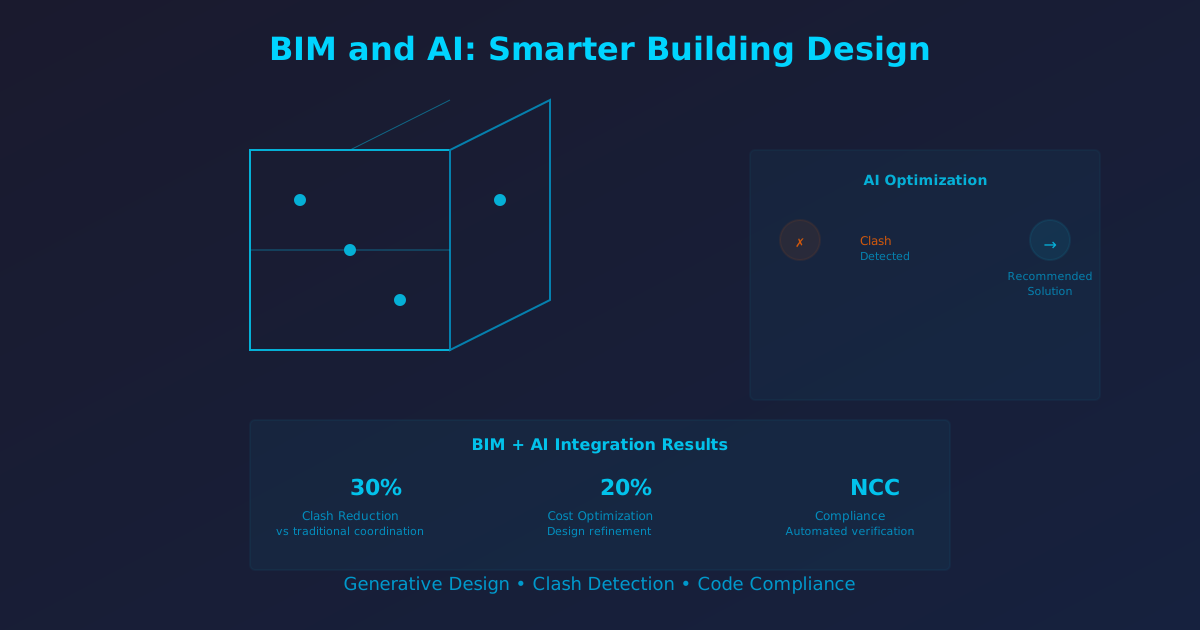
- Design optimization: 20-30% cost reduction through automated design refinement
- Clash elimination: 30-40% reduction in construction-stage design conflicts
- Compliance assurance: Automated National Construction Code (NCC) compliance verification
- Performance optimization: Energy performance, structural efficiency, and facility management improvements
This guide explores how BIM and AI work together to create smarter buildings, with practical implementation guidance for Australian construction teams.
Why BIM Alone Isn’t Enough
Building Information Models are comprehensive, but model complexity creates challenges:
Design Verification Challenge
A 20-storey commercial building might contain:
- 50,000+ distinct components (structural, mechanical, electrical, architectural)
- Millions of geometric relationships and dependencies
- Thousands of design constraints and code requirements
- Hundreds of optimization opportunities (material efficiency, structural effectiveness, constructability)
Manual review of this complexity is incomplete. Traditional design reviews identify obvious conflicts (pipes hitting beams, ducts blocking access) but miss:
- Subtle constructability issues (sequencing that creates conflicts during construction)
- Optimization opportunities (using less material while maintaining performance)
- Performance inefficiencies (designs that work but are suboptimal)
- Compliance risks (design approaches that might violate codes)
Code Compliance Uncertainty
The National Construction Code (NCC) is comprehensive and complex:
- Prescriptive requirements (specific materials, methods, dimensions must be used)
- Performance requirements (building must achieve specific performance levels, approach is flexible)
- Deemed-to-satisfy provisions (specific design approaches known to satisfy performance requirements)
- Alternative compliance approaches
Compliance verification requires:
- Deep code knowledge
- Understanding of how design decisions affect compliance
- Verification that every design element meets relevant code sections
- Documentation for building approval and compliance auditing
Manual code compliance review is labour-intensive and error-prone. Designs sometimes receive building approval only to have issues discovered during construction or operation.
Performance Optimization Missed Opportunities
Buildings can meet functional and code requirements while being significantly suboptimal:
- Energy performance: Building might be compliant but consume 30-40% more energy than optimized design
- Structural efficiency: Using more material than necessary for structural performance
- Thermal comfort: Design creates comfort issues despite code compliance
- Lifecycle costs: Initial cost optimized without considering operating costs
Traditional design processes don’t systematically optimize across performance dimensions.
How AI Enhances BIM
AI algorithms analyze BIM models to address these challenges:
1. Automated Clash Detection and Resolution
Traditional clash detection:
– Models imported into coordination software
– Automated clash detection identifies conflicts (pipes through walls, ducts hitting structure, etc.)
– Conflicts manually resolved through design adjustment
– Manual process is labour-intensive and incomplete
AI-enhanced clash detection:
– AI analyzes BIM to identify not just direct clashes, but:
– Secondary conflicts: Changes to resolve primary clash cause new conflicts
– Sequencing conflicts: Elements can be constructed but sequencing is inefficient or impossible
– Access conflicts: Work area conflicts preventing simultaneous work by multiple trades
– Maintenance access: Future maintenance impossible without removing other building elements
– AI recommends solutions:
– Route alternatives for pipes/ducts
– Component repositioning
– Sequencing changes
– Design modifications
– Iterative optimization: AI runs thousands of resolution scenarios and recommends optimal solution
Results:
– Clash detection increases from ~85% (manual detection) to >98% (AI detection)
– Resolution efficiency improves dramatically (human time spent on iterations decreases)
– Sequencing conflicts (typically missed in manual detection) are identified and resolved
– Downstream construction issues prevented
2. Generative Design for Optimization
Generative design is AI-driven design optimization. Rather than humans designing building and then optimizing, AI proposes optimized designs:
How it works:
1. Define design inputs: Requirements (square metres, number of spaces), constraints (site boundaries, structural locations, building code constraints), performance targets (energy use, thermal comfort, construction budget)
2. Define optimization objectives: Minimize material usage, minimize energy consumption, minimize cost, maximize structural efficiency—or combinations
3. AI generates thousands of design solutions meeting requirements and constraints
4. AI evaluates each solution against objectives
5. AI presents optimal solutions to designers
Example application: Commercial office building design
- Inputs: 15,000m² floor area, requires 200 workstations, budget $50M, site footprint 3000m², energy target <80 MJ/m²
- AI optimization: Generate facade designs, internal layouts, HVAC configurations, structural systems that meet requirements
- Outputs: Multiple design options, each with different optimization characteristics (cost-optimal, energy-optimal, constructability-optimal)
- Results:
- 20-30% cost reduction (optimized material usage, structural efficiency)
- 25-35% energy performance improvement (optimized glazing, HVAC, orientation)
- Better constructability (AI-generated designs often more easily constructed)
Typical outcomes:
– Designers select from AI-optimized options, accelerating design process
– Performance significantly better than traditionally designed building
– Cost significantly lower while meeting all requirements
– Design quality improved through systematic optimization
3. Automated Code Compliance Verification
NCC compliance verification typically involves:
- Code interpretation (what does code require for this building type/use?)
- Design review against code (does design satisfy requirements?)
- Compliance documentation (proving design complies)
AI automating this process:
Code knowledge encoding:
– NCC requirements encoded as machine-readable rules
– Australian-specific modifications documented
– State variations captured (NCC varies by state)
Automated compliance checking:
– BIM analyzed against encoded rules
– Compliance deficiencies automatically identified
– Design elements generating compliance issues highlighted
– Remediation recommendations provided
Example: Fire safety compliance
NCC requires:
– Minimum egress width (varies by use and occupancy)
– Maximum travel distance to exits (varies by use type)
– Fire-rated separations between occupancy types
– Sprinkler coverage and water supply capacity
– Emergency lighting and wayfinding
AI compliance checking:
– Verifies exit widths meet code (calculated from occupancy load)
– Measures travel distances and compares to maxima
– Confirms fire-rated elements separate different occupancies
– Verifies sprinkler system design meets requirements
– Validates emergency lighting coverage
– Generates compliance report documenting all verified items
Results:
– Compliance verified before submission to building surveyor
– Issues identified and resolved in design phase (cheaper than during construction)
– Compliance documentation generated automatically
– Building approval timelines reduced
4. Energy Performance Optimization and Modelling
Building energy consumption is driven by:
- Building envelope: Insulation, glazing, thermal mass, infiltration
- HVAC system: Sizing, efficiency, controls
- Lighting: Illumination requirements, efficiency, controls
- Internal gains: Occupancy, equipment heat load
- Renewable generation: Solar PV, solar thermal, other sources
Optimizing across these dimensions is complex. Traditional energy modelling:
- Single design scenario modelled
- Performance issues discovered after design finalized
- Limited optimization opportunity (design changes require significant rework)
AI-driven energy optimization:
- Parametric modelling: Model captures relationships between design parameters (window-to-wall ratio, insulation, HVAC efficiency) and energy performance
- Scenario analysis: AI runs hundreds of scenarios evaluating energy impact of design changes
- Multi-objective optimization: Optimize for energy while maintaining cost, aesthetics, and functional requirements
- Real-time feedback: Energy performance evaluated as design evolves
Typical results:
– 25-35% improvement in energy performance vs traditional design
– Reduced peak load (HVAC sizing smaller, capital cost reduction)
– Reduced operating costs (lower energy consumption)
– Reduced embodied carbon (smaller HVAC, less insulation overspend)
Australian context: Energy efficiency improvements directly reduce running costs, important driver for building owners. NABERS ratings (Australia’s national building energy rating scheme) benefit from optimized performance.
5. Structural Optimization
Structural design is often conservative to account for uncertainty:
- Safety factors applied to loads
- Member sizing errs toward larger to ensure safety
- Result: Structures frequently heavier than necessary
AI structural optimization:
- Refined load analysis: More sophisticated load analysis reduces uncertainty
- Optimization algorithms: AI finds lightest structure meeting safety requirements and constraints
- Material efficiency: AI evaluates different materials (steel vs concrete, different grades) optimizing cost and weight
- Constructability: AI optimizes considering construction sequencing and methods
Typical results:
– 15-25% reduction in structural material usage
– 10-15% cost reduction
– Lighter structure (reduces foundation costs, improves earthquake performance)
– Better constructability
6. Facility Management and Handover Optimization
Buildings eventually transition from construction to operation. AI-optimized BIM improves this transition:
- Asset information: AI ensures all building elements documented in model with operational data (maintenance requirements, spare parts, service intervals)
- Systems integration: AI documents how building systems integrate, critical for operational understanding
- Performance baselines: AI establishes energy/water/waste baselines for operational benchmarking
- Maintenance planning: AI generates predictive maintenance schedules based on asset lifecycles
- Operational handover: Comprehensive digital documentation handed to building operator
Results:
– Faster handover (digital model replaces manual documentation)
– Better operational performance (operator has comprehensive information)
– Reduced operational issues (systems properly documented and understood)
– Improved lifecycle management (maintenance planning optimized)
Real-World Results: Australian BIM + AI Projects
Case Study 1: Tier-1 Contractor – Mixed-Use Development
A tier-1 contractor implemented AI-enhanced BIM on a $320M mixed-use development (office, retail, residential, carpark).
Project Complexity:
– 45-storey building, 120,000m² gross floor area
– 400+ retail tenancies
– 600+ residential apartments
– 1,200-space carpark
– Complex MEP coordination (mechanical, electrical, plumbing)
– Complex structural system
BIM + AI Implementation:
– Traditional BIM coordination supplemented with AI clash detection
– AI generative design for structural system optimization
– Automated NCC compliance verification
– AI energy optimization for HVAC and lighting systems
Results:
– Clash detection: Manual detection identified 400 clashes; AI detection identified 1,200+ (including sequencing and secondary conflicts). Resolving additional clashes during design phase cost $800K; equivalent remediation during construction would have cost $6-8M+
– Structural optimization: AI-optimized structural system reduced material usage 18%, saving $4.2M
– Energy optimization: AI optimization improved energy efficiency 28%, enabling NABERS 5-star rating (vs typical 4-star). Operating cost reduction: $180K annually
– Code compliance: All NCC requirements verified automatically; zero compliance issues discovered during building approval (typical projects average 3-5 compliance issues requiring design revision)
– Design timeline: Reduced from 18 months (traditional process) to 14 months through automated analysis and optimization
– Total value: $10.2M+ (clash resolution prevention + structural savings + energy savings + schedule acceleration)
Case Study 2: Developer – Multi-Tower Commercial Precinct
A property developer used BIM + AI to optimize a multi-tower commercial precinct (3 towers, 280,000m² total).
Project Objectives:
– Optimize energy performance for NABERS ratings
– Ensure inter-tower coordination (shared facilities, utilities, egress)
– Maximize commercial flexibility (reconfigurable floor plates)
– Minimize cost without compromising quality
AI Application:
– Generative design for building massing and orientation
– AI facade optimization for solar performance and daylighting
– Automated inter-tower coordination checking
– Energy modelling for all three towers with optimization
Results:
– Building massing: AI-optimized orientation increased solar gain in winter (heating savings) while reducing summer heat load. Annual energy saving: $240K across three towers
– Facade design: AI optimization of window-to-wall ratio and shading achieved 5-star NABERS rating for all three towers
– Coordination: Inter-tower utilities automatically coordinated; zero conflicts during construction
– Flexibility: AI-optimized floor plates achieved maximum flexibility (column-free office floor space to support various layouts)
– Cost: Total cost 12% below budget through optimized design
– Development timeline: Reduced by 6 months through accelerated design optimization
Implementation Guide: BIM + AI for Australian Builders
Step 1: Project Assessment (Week 1-2)
Determine which projects benefit from BIM + AI and identify specific opportunities:
Assessment questions:
– Project complexity and size (larger, more complex projects see greater benefit)
– Budget scale (cost optimization ROI higher on larger budgets)
– Time constraints (schedule acceleration valuable if tight timeline)
– Specific challenges (energy targets, compliance risks, coordination complexity)
Typical candidates:
– Complex buildings (high-rise, mixed-use) see 2-3x ROI vs simple buildings
– Large-budget projects (>$50M) see clear ROI on optimization
– Projects with tight timelines benefit from schedule acceleration
– Projects with specific performance targets (energy, NABERS) benefit from energy optimization
Not suitable:
– Very simple projects (small buildings, straightforward design) have limited optimization opportunity
– Budget-constrained projects might not justify BIM + AI cost
– Projects on fixed tight schedules might not allow time for optimization analysis
Step 2: BIM Establishment (Week 2-4)
Ensure robust BIM foundation:
BIM requirements:
– Comprehensive geometric model (all building elements modeled)
– Data richness (elements have relevant properties: material, fire rating, operational data)
– Model coordination (all trades’ models integrated and clash-checked)
– Quality assurance (model validated before AI analysis)
Typical BIM maturity required:
– Level 2+ BIM (integrated multi-discipline models, clash detection)
– Certified BIM coordinators managing model quality
– Clear BIM standards and protocols
Timeline: If BIM not already established, allow 4-6 weeks to develop comprehensive coordinated model.
Step 3: AI Tool Selection and Configuration (Week 4-6)
Select and configure appropriate AI tools:
Available AI solutions:
– Clash detection + resolution: Multiple vendors (Solibri, Synchro, others) offer AI-enhanced coordination
– Generative design: Autodesk Forma, other vendors offer optimization tools
– Code compliance: AI tools verify against NCC (varies by state for specific requirements)
– Energy optimization: Building performance simulation + AI tools (Ladybug Tools, EnergyPlus with optimization)
– Structural optimization: Specialized tools for structural optimization
Configuration:
– Define optimization objectives and constraints
– Configure AI parameters (how aggressive to optimize, which design elements can change)
– Integrate with existing design tools and workflows
– Establish quality gates (human review points before accepting AI recommendations)
Step 4: AI Analysis and Optimization (Week 6-10)
Execute AI analysis and optimization:
Typical workflow:
1. Export BIM to AI tools
2. Define optimization scenarios (current design, cost-optimized variant, energy-optimized variant, performance-optimized variant)
3. Run AI analysis (24-48 hours typically for large models)
4. Review results and recommendations
5. Incorporate preferred optimizations into design
6. Iterate (refine constraints, re-optimize)
Timeline: First complete optimization cycle typically 2-3 weeks; iterations faster.
Key decision points:
– Which optimization recommendations to accept
– How aggressive to optimize (vs. maintaining design intent)
– Trade-offs between objectives (cost vs performance vs schedule)
Step 5: Compliance Verification and Sign-Off (Week 10-12)
Verify compliance and prepare for approval:
Compliance checking:
– Automated NCC compliance verification
– Manual review by code expert
– Remediation of any identified issues
– Documentation of compliance basis
Sign-off process:
– Design team approval of optimized design
– Client/owner approval
– Building surveyor pre-submission review (optional but recommended)
Documentation:
– Final BIM model with all optimizations incorporated
– AI analysis results and recommendations
– Compliance verification documentation
– Performance projections (energy, structural, thermal)
Step 6: Handover and Implementation (Week 12+)
Transition optimized design to detailed design and construction:
Detailed design:
– Architectural, structural, MEP teams develop optimized design into contract documents
– Specifications reflect optimizations (material selections, equipment sizing, etc.)
– Construction sequences planned based on AI-identified sequencing optimizations
Construction:
– Clash resolution strategies implemented (AI recommendations inform construction sequencing)
– Energy and performance optimization details incorporated
– Handover documentation (facility management manuals) based on AI-enhanced BIM
Key Decision Points
Design Flexibility vs. Optimization Aggressiveness
AI can optimize aggressively (changing major design characteristics) or conservatively (refining within established design intent). More aggressive optimization achieves greater savings but requires more significant design changes.
Conservative approach: Refine design within established parameters (±10-15% change)
– Advantage: Lower design risk, maintains design intent
– Disadvantage: Smaller savings
– Best for: Projects where design direction established and client committed
Aggressive approach: Optimize broadly across all design parameters (±30-50% change)
– Advantage: Greater savings (cost, energy, performance)
– Disadvantage: More design rework, potential client concerns
– Best for: Early design phases when design direction not finalized
Hybrid approach: Optimize specific high-impact areas aggressively while refining others conservatively
– Best practice for most projects
Single vs. Multiple Optimization Objectives
Building optimization can focus on:
- Cost optimization: Minimize construction cost
- Energy optimization: Minimize operating energy costs
- Performance optimization: Optimize structural efficiency, thermal comfort, etc.
- Schedule optimization: Minimize construction timeline
- Multi-objective optimization: Balance multiple objectives
Single-objective is simpler and identifies extreme solutions. Multi-objective is more realistic (buildings must balance cost, performance, schedule, aesthetics).
Most projects benefit from multi-objective optimization with clear prioritization (e.g., “optimize cost first, then energy”).
Frequently Asked Questions
Q1: What if the design is already finalized?
BIM + AI still provides value even with finalized design. Clash detection identifies issues before construction, energy modelling identifies performance characteristics, compliance verification ensures approval. Savings are lower than optimizing early-stage design, but still meaningful. Best practice: apply BIM + AI early in design process for maximum benefit.
Q2: Can we retrofit BIM + AI to existing designs?
Yes, though benefits are reduced. Retrofitting BIM + AI to completed design typically identifies optimization opportunities that would have been valuable earlier (energy improvements, structural refinements, compliance clarifications) but are too late to implement without major rework. Better approach: apply to detailed design stage when changes are still feasible.
Q3: How much does BIM + AI cost?
Costs vary significantly:
– BIM setup and coordination: $200-500K typical (depends on project complexity, existing BIM maturity)
– AI analysis tools: $50-150K (software and professional services)
– Total project cost: typically 1-2% of construction budget
– Savings typically 8-15% of cost: ROI highly positive on large projects
Q4: What if we don’t have in-house BIM expertise?
BIM + AI requires specialized expertise. Options:
– Hire specialized BIM consultants to manage process
– Work with design teams already experienced in BIM
– Outsource to BIM service providers (increasingly available in Australia)
– Many architectural and engineering firms now offer BIM + AI services
Q5: Does this work for retrofit/renovation projects?
Yes, though approach differs from new construction. Retrofit projects use BIM + AI to:
– Model existing building (from surveys, existing documentation)
– Design retrofit interventions
– Verify interference between new work and existing building
– Plan sequencing for occupied buildings
– Optimize for energy/performance improvements
Benefits similar to new construction but approach tailored to retrofit context.
Moving Forward
Building Information Modelling combined with AI represents the future of building design and construction in Australia. The most sophisticated designers and builders already recognize this shift.
BIM alone provides valuable coordination and visualization. BIM + AI provides optimization and intelligence that transforms building quality and performance.
Projects delivered with BIM + AI consistently achieve:
– 15-30% cost reduction through optimization
– 25-35% energy performance improvement
– 30-40% reduction in coordination conflicts
– Faster design and approval timelines
The competitive advantage belongs to teams deploying BIM + AI systematically.
[Build Smarter with BIM and AI] — Our BIM + AI specialists will help you integrate AI optimization into your design process. We’ll assess your current BIM maturity, identify highest-value optimization opportunities, and guide implementation. Better design starts with intelligent analysis and optimization.
Anitech AI has delivered BIM + AI optimization on 25+ Australian building projects, delivering $50M+ in aggregate cost and performance improvements. Our BIM + AI specialists understand Australian building standards, NCC requirements, and practical design challenges.
Further Reading
- AI Automation Australia — Complete Guide
- AI Automation in Construction: The Australian Builder’s Guide (2025) — Industry Guide
- AI Cost Estimation for Construction: More Accurate Bids, Fewer Budget Blowouts
- AI Subcontractor Management: Smarter Procurement and Performance Tracking
- AI Progress Monitoring on Construction Sites: Computer Vision for Project Managers
- AI Environmental Compliance for Construction: Automated Monitoring and Reporting