
The Turnover Crisis: Australia’s Most Expensive HR Problem
Employee turnover is the most economically damaging HR challenge facing Australian businesses. The costs are staggering:
Cost of Turnover: When an employee leaves, the company loses:
– Direct costs: Recruitment fees (15-25% of salary), background checks, onboarding
– Productivity loss: New hire takes 3-6 months to reach full productivity
– Knowledge loss: Undocumented expertise and relationships
– Team disruption: Remaining team must cover workload; morale often suffers
– Client/customer impact: Continuity may be affected
Total cost: Typically 1.5-2x annual salary. For a $60,000 employee, turnover costs $90,000-120,000. For a $200,000 executive, turnover costs $300,000-400,000.
Scale of the problem: Australian voluntary turnover averages 15-20% annually. For a company with 1,000 employees, that’s 150-200 departures per year, costing $13.5-40M annually.
Yet most companies are reactive. They’re shocked when good people leave. They conduct exit interviews after the fact. By then, it’s too late.
This is where AI-powered attrition prediction transforms strategy from reactive to proactive.
How AI Predicts Employee Attrition
Machine learning identifies patterns that precede departure:
Key Attrition Signals
Engagement Indicators:
– Performance ratings declining over past quarters
– Engagement survey scores dropping
– Collaboration patterns changing (talking to fewer colleagues, attending fewer meetings)
– Email/communication patterns shifting (less internal communication, more external)
– Training/development engagement declining
Compensation and Market Signals:
– Salary lagging market rates for role/location
– Recent external hires in same role earning more
– Frequent requests for raises/promotions without actioning
– Researching external job market (detected via LinkedIn activity if integrated)
Behavioural Changes:
– Taking more personal days
– Calling in sick more frequently
– Arriving late/leaving early (suggesting reduced commitment)
– Formal complaints or conflict with management
– Reduced discretionary effort (doing minimum required, not more)
Tenure and Life Stage:
– Reaching milestone tenures where people often evaluate staying (1 year, 3 years, 5 years)
– Recent major life events (marriage, baby, home purchase) indicating lifestyle changes
– New qualifications suggesting career shift aspirations
Role and Growth Signals:
– Skill level exceeding role requirements (underutilised)
– No clear path to promotion
– Stagnant role (same responsibilities for 2+ years)
– Lack of development opportunities
Team and Management:
– Management change (employees often leave after management transition)
– Team conflict or restructuring
– Manager leaving (flight of his/her team often follows)
– Poor relationship with manager (detected via feedback)
Machine Learning Model
AI combines these signals into a “flight risk score” (0-100):
– Score 80-100: 60-70% probability of departure in next 6 months
– Score 60-80: 30-40% probability
– Score 40-60: 10-20% probability
– Score 0-40: <10% probability
This allows HR to prioritise retention efforts toward highest-risk employees.
Real-World Australian Results
Based on implementations across major Australian employers:
Before AI Attrition Prediction
- Annual voluntary turnover: 18%
- Turnover detected: Reactive (after departure)
- Retention interventions: Minimal and ad-hoc
- Cost of turnover: $15-30M+ annually (major organisations)
After AI Attrition Prediction
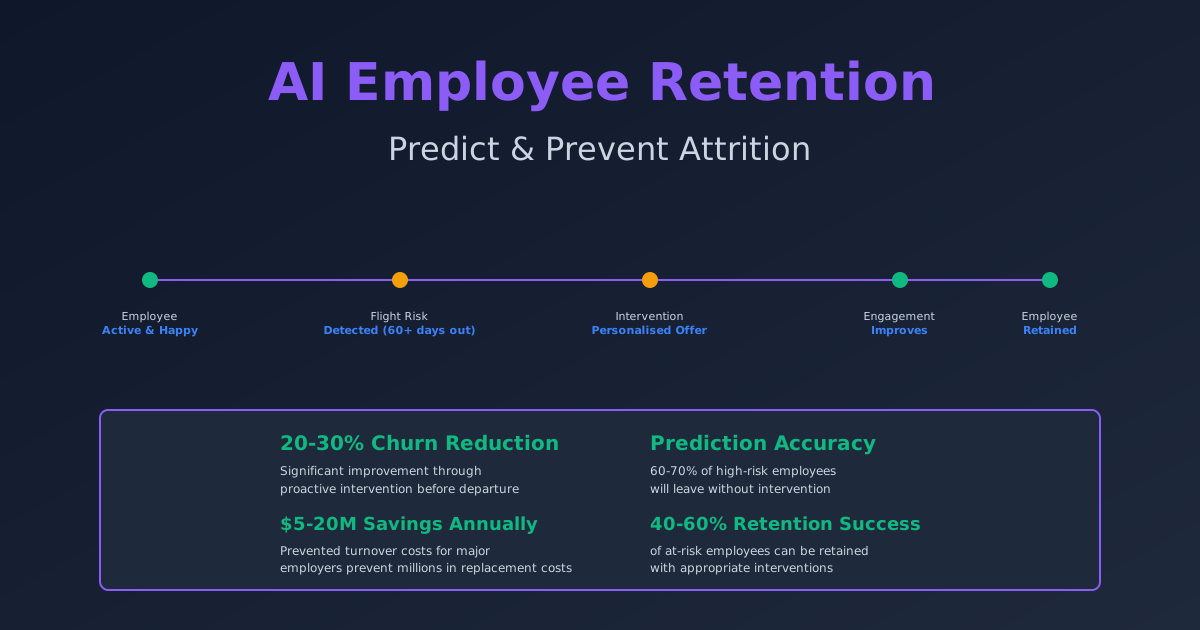
- Annual voluntary turnover: 12-14% (30-35% reduction)
- Turnover predicted: 60-90 days before departure
- Retention interventions: Targeted, proactive
- Cost of turnover: $10-20M+ annually
Specific Metrics
- High-risk employees retained: 40-60% of those identified as flight risk
- Time saved in recruitment: 2,000+ hours annually (fewer hires needed)
- Improved business continuity: Fewer critical role departures
- Improved employee satisfaction: Employees feel valued and supported when retention efforts occur
Retention Intervention Playbooks: From Prediction to Action
Once an employee is identified as high-risk, what happens next?
For Engagement-Based Attrition Risk
Signal: Performance declining, engagement scores dropping, reduced collaboration
Intervention:
1. Career conversation: Manager initiates discussion about career goals and aspirations
2. Development plan: Create personalised development plan addressing skill gaps
3. Expanded responsibilities: Give stretch projects matching career interests
4. Mentorship: Connect with senior mentor in area of interest
5. Training: Enrol in courses supporting career development
6. Follow-up: Monthly check-ins tracking progress
Outcome: Employee feels supported, sees path to growth, engagement typically improves
For Compensation-Based Attrition Risk
Signal: Salary lagging market, frequent raise requests, researching external roles
Intervention:
1. Market analysis: Verify whether pay is indeed below market
2. Compensation review: Adjust salary if warranted
3. Equity consideration: Stock options or bonuses to increase total compensation
4. Career progression: Path to higher-paying role
5. Flexibility: Remote work options, flexible hours (often valued more than money)
Outcome: Employee feels valued, financial concerns addressed
For Role/Growth-Based Attrition Risk
Signal: Overqualified, no promotional path, stagnant role
Intervention:
1. Internal mobility: Identify lateral roles offering new challenges
2. Promotion: If eligible, accelerate promotion timeline
3. Project leadership: Lead strategic initiatives within current role
4. Cross-training: Learn adjacent skills and roles
5. External representation: Speaking opportunities, industry involvement
6. Expanded scope: Increase responsibilities without title change
Outcome: Employee has renewed engagement and growth
For Management-Based Attrition Risk
Signal: Poor relationship with manager, conflicts, reduced communication
Intervention:
1. Manager coaching: If fixable, coach manager on relationship
2. Team change: Move employee to different team under better manager
3. Escalation path: Opportunity to work on projects with different leaders
4. Mediation: If conflict, facilitate professional resolution
Outcome: Either relationship improves or employee finds better fit
Privacy and Fairness Considerations
Attrition prediction requires analysing employee data, raising privacy and fairness concerns:
Privacy Act Compliance:
– Be transparent: Employees should know how their data is used
– Minimise data: Don’t collect unnecessary personal information
– Security: Protect employee data rigorously
– Access: Employees should access their attrition score and challenge predictions
Fairness:
– Don’t discriminate: Ensure predictions don’t discriminate against protected groups (age, gender, ethnicity)
– Avoid retaliation: Cannot penalise employees for being identified as flight risk
– Transparency in interventions: Ensure retention offers aren’t arbitrary
– Equity: Ensure retention interventions are equitable (not everyone gets the same offer)
Best Practice: Be explicit with employees about attrition monitoring. Frame it positively: “We use data to identify people who might be unhappy and offer support.” Allow employees to opt out if desired.
Implementation Path
Phase 1: Assessment (Weeks 1-4)
- Understand current turnover: Who’s leaving? Why? When?
- Collect data: Employee performance, engagement surveys, compensation, career paths, etc.
- Identify patterns: What precedes departures? What distinguishes who stays from who leaves?
- Define success: What turnover reduction is realistic and valuable?
Phase 2: Model Development (Weeks 4-12)
- Feature engineering: Transform raw data into predictive signals
- Model training: Train attrition prediction models on historical data
- Backtesting: Test model on historical employees; verify it would have predicted departures
- Fairness audit: Ensure predictions don’t discriminate
Phase 3: Pilot Interventions (Weeks 12-20)
- Identify high-risk cohort: Take employees scoring >70 on flight risk
- Test interventions: Offer retention interventions; track acceptance and outcomes
- Measure impact: Do interventions actually prevent departures?
- Refine: Adjust interventions based on pilot results
Phase 4: Full Deployment (Weeks 20-32)
- Full rollout: Apply attrition prediction across entire workforce
- Intervention system: Automate identification of high-risk employees and recommended interventions
- Manager workflows: Equip managers with data and tools to have retention conversations
- Monitoring: Track attrition trends; measure impact of interventions
Overcoming Implementation Challenges
Challenge 1: Data Quality
Problem: Employee data is often inconsistent or incomplete.
Solution: Invest in data quality processes. Most data quality issues resolve once systems are properly integrated.
Challenge 2: Manager Adoption
Problem: Managers may resist retention conversations or feel it’s manipulative.
Solution: Frame as supporting employees, not manipulating them. Provide scripts and guidance. Show evidence that interventions improve employee satisfaction.
Challenge 3: Fairness Risk
Problem: Attrition prediction could discriminate against protected groups.
Solution: Regular fairness audits. Ensure equal treatment. Document fairness testing for compliance.
Challenge 4: False Positives
Problem: Some employees flagged as flight risk won’t actually leave.
Solution: Combine AI scoring with manager judgment. Use score as flag for conversation, not definitive prediction.
Cost and ROI
Implementation Investment
- Data integration and preparation: $30k-60k
- Model development: $40k-80k
- Intervention platform: $20k-50k
- Training and change management: $10k
- Total first year: $100k-200k
Ongoing Operating Costs
- Model maintenance and retraining: $20k-40k annually
- Intervention administration: $30k-50k annually
- Total annual: $50k-90k
Benefits Realisation
For a 1,000-employee company with 18% annual turnover (180 departures):
If AI reduces turnover to 14% (achieving 35-40 fewer departures):
– Turnover cost per employee: $100k (average)
– Departures prevented: 40 per year
– Cost savings: $4M annually
Minus intervention costs: $70k annually
Net benefit: $3.93M annually
ROI: 3,930%
What’s Next: Future Attrition Prediction Evolution
Burnout Prediction: AI predicting not just who will leave, but who’s at risk of burnout or mental health issues, enabling preventive support.
Career Path Optimisation: AI recommending career moves and projects that maximise engagement and retention.
Succession Planning: AI identifying who can backfill critical roles, enabling proactive development.
Predictive Wellness: AI identifying employees at risk of health issues or life challenges, offering support.
Conclusion: Attrition Prediction as Essential HR Capability
For Australian businesses, attrition prediction transforms retention from reactive response to proactive strategy. Companies that implement it will retain more talent, reduce costs, and maintain continuity.
FAQ: Attrition Prediction Questions
Q1: Is attrition prediction too invasive?
A: Only if poorly positioned. Frame it positively: “We want to support people who might be unhappy.” Be transparent about data use. Give employees access to their scores and ability to challenge predictions. Most employees appreciate it.
Q2: What if an employee doesn’t want to be retained?
A: That’s valid. Sometimes departures are healthy (person ready for new challenge). The goal isn’t to force retention, but to give people opportunity to address issues. If someone’s genuinely ready to leave, respect that.
Q3: Will retention interventions work?
A: 40-60% of people identified as flight risk can be retained with appropriate interventions. Some are already decided to leave; interventions won’t change that. But many are unhappy partly due to addressable issues. Those people can often be saved.
Q4: How do we ensure fairness in retention offers?
A: Transparent criteria. Everyone with same risk profile should receive similar intervention. Avoid bias (e.g., offering retention bonus to some but not others without clear rationale). Document decisions. Regular fairness audits.
Q5: What if a manager doesn’t act on attrition predictions?
A: Make it a performance metric. Managers who proactively address attrition in their teams should be recognised and rewarded. Those who ignore it should be coached. Over time, proactive attrition management becomes part of culture.
CTA: Reduce Employee Turnover with AI
How much is employee turnover costing you? If you’re losing people you want to keep, you’re leaving millions on the table.
Anitech AI helps Australian businesses implement attrition prediction, reducing voluntary turnover by 20-30%.
We provide:
– Attrition assessment and trend analysis
– Predictive model development using your HR data
– Retention intervention strategy and execution
– Manager training on retention conversations
– Ongoing monitoring and optimisation
Ready to stop losing people?
Schedule a confidential attrition assessment with Anitech AI.
Internal Links
- AI Automation for HR and Recruitment: The Australian HR Leader’s Guide
- AI Resume Screening and Candidate Matching for Australian Recruiters
- AI Employee Onboarding Automation
- AI Payroll and Workforce Management Automation
- AI Automation Guide for Australian Businesses
Further Reading
- AI Automation Australia — Complete Guide
- AI Automation for HR and Recruitment: The Australian HR Leader’s Guide (2025) — Industry Guide
- AI Resume Screening and Candidate Matching for Australian Recruiters: Find Your Best Hire Faster
- AI Employee Onboarding Automation: How Australian Employers Are Getting New Hires Productive Faster
- AI Performance Management: Objective, Continuous and Data-Driven Reviews
- AI Learning and Development: Personalised Upskilling at Scale