
The Australian HR Crisis: Skills Shortage Meets Operational Complexity
Australian Human Resources teams face an unprecedented perfect storm. The dynamics are well-documented but the implications are profound:
Skills Shortage Crisis: Australian unemployment sits at historic lows (3.2-3.5%), but skilled worker shortages are acute. Tech talent, healthcare professionals, trades people—all are in desperately short supply. Competing for these scarce resources means higher recruitment costs and longer hiring cycles.
Cost of Turnover: For Australian companies, voluntary turnover costs 1.5-2x annual salary when accounting for:
– Recruitment and onboarding costs for replacement
– Productivity loss during transition
– Institutional knowledge loss
– Team morale disruption
For a professional earning $80,000, turnover costs the company $120,000-160,000. For a tech manager earning $150,000, turnover costs $225,000-300,000.
Compliance Complexity: Australian HR operates within an increasingly complex regulatory framework:
– Fair Work Act and Modern Awards (with 120+ individual awards)
– Super Guarantee obligations
– Workplace Health & Safety requirements
– Privacy Act restrictions on employee data
– Anti-discrimination laws
– Payroll tax compliance
A single mistake—misclassifying an employee’s award level, miscalculating leave entitlements, or mishandling redundancy—can result in litigation, regulatory fines, or reputational damage.
Hybrid Work Complexity: Post-pandemic hybrid work has created new HR challenges: Managing flexible schedules, maintaining team cohesion, monitoring productivity without surveillance, ensuring fair treatment across co-located vs. remote workers.
Labour Market Tightness: When unemployment is low and skills are scarce, employees have leverage. They can switch jobs easily, negotiate better terms, and leave if dissatisfied. This puts enormous pressure on retention.
These pressures are forcing Australian HR teams to do more with less—precisely when more strategic work is needed most. This is where artificial intelligence enters.
Seven AI Use Cases Delivering Value for Australian HR
1. AI Resume Screening and Candidate Matching
Modern recruitment involves processing hundreds of applications for each role—an impossibly time-consuming task for human recruiters. AI solves this by automatically screening resumes, extracting key information, and ranking candidates by fit.
Key capabilities:
– Natural language processing of resume content
– Skill extraction and matching against job requirements
– Experience level assessment
– Red flag identification (e.g., frequent job changes)
– Integration with job boards (SEEK, LinkedIn, Indeed) to auto-source candidates
– ATS (Applicant Tracking System) integration
Australian context:
– Removes geographic bias (candidates assessed on qualifications, not location)
– Identifies candidates from non-traditional backgrounds
– Speeds hiring cycle from 6-8 weeks to 2-3 weeks
Results:
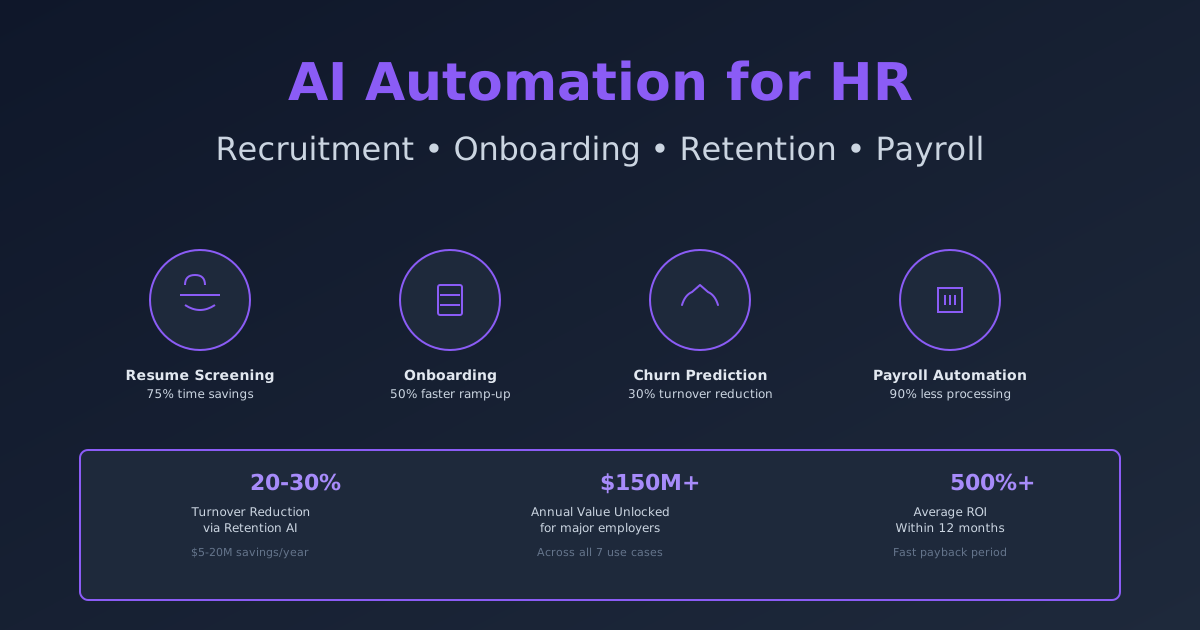
– 75% reduction in screening time
– 60% improvement in hiring manager satisfaction
– Time-to-hire reduced from 45 days to 15-20 days
– Quality of hire improved (better matching = better retention)
2. AI Employee Onboarding Automation
Effective onboarding is critical for new hire success. Yet most Australian organisations rely on paper processes, inconsistent checklists, and overworked HR staff to manage onboarding. This creates poor experience for new employees and delayed time-to-productivity.
AI systems automate:
– Document collection and verification (ID, tax file number, bank account for salary)
– IT provisioning (creating accounts, setting up laptop, configuring tools)
– Learning path personalisation (training tailored to role and experience level)
– Compliance training tracking (mandatory training completion)
– Buddy/mentor matching (assigning experienced employee to new hire)
– Check-in scheduling (30-day, 60-day, 90-day progress assessments)
Australian context:
– Ensures Fair Work compliance (proper documentation, award application)
– Automated tracking of training completion (mandatory WH&S training)
– Support for hybrid onboarding (remote and in-office employees)
Results:
– 50% faster time-to-productivity (60 days vs. 120 days)
– 25% improvement in 12-month new hire retention
– Improved new hire satisfaction (better experience)
– Reduced administrative burden on HR team
3. AI Employee Retention and Attrition Prediction
Before an employee leaves, they typically show warning signs: reduced engagement, changed behaviour, performance decline, or conversations with other employers. Machine learning identifies these signals and enables proactive retention.
Key capabilities:
– Engagement scoring (based on performance, feedback, communication)
– Flight risk prediction (likelihood of departure in next 3-6 months)
– Intervention recommendation (what might prevent departure)
– Retention campaign tracking (which interventions work best)
– Churn cohort analysis (identifying groups of departing employees)
Australian context:
– Privacy Act compliance (careful handling of employee data)
– Fair Work implications (cannot retaliate against employees considering departure)
– Modern Awards complexity (understanding remuneration relative to award)
Results:
– 20-30% reduction in voluntary turnover
– 3-5 month increase in average employee tenure
– $5-20M annual savings (depending on company size and turnover cost)
– Improved retention of high-value employees
4. AI Payroll and Workforce Management Automation
Payroll is both critical and complex in Australia. One mistake—miscalculating leave entitlements under Modern Awards, failing to apply correct superannuation, missing STP (Single Touch Payroll) deadlines—creates liability. Yet most organisations manage payroll through manual spreadsheets and error-prone processes.
AI automates:
– Timesheet processing and rostering
– Leave calculation (annual leave, sick leave, long service leave under applicable award)
– Superannuation calculations and STP reporting
– Tax withholding (PAYG)
– Award interpretation and proper classification
– Demand-based scheduling (predicting staffing needs and creating optimal rosters)
Australian context:
– Modern Awards complexity (120+ awards with different rules)
– Superannuation guarantee compliance (must pay 11.5% into super, increasing to 12%)
– STP compliance (Australian Taxation Office mandates single touch payroll)
– Penalty rate calculations (complexity for retail, hospitality, healthcare workers)
– Fair Work compliance (record-keeping, leave documentation)
Results:
– 90% reduction in payroll processing time
– 95% reduction in payroll errors
– 100% STP compliance
– 30% reduction in compliance audit risk
– Improved worker satisfaction (correct, on-time pay)
5. AI Skills Gap Analysis and Learning Path Personalisation
Most Australian companies don’t have clear visibility into their workforce’s skills, nor do they systematically address skill gaps. This creates problems when roles need to be filled or when business direction changes.
AI systems:
– Catalogue employee skills (both from formal training and work experience)
– Identify skill gaps relative to current role requirements and future business needs
– Recommend personalised learning paths (which training courses each employee needs)
– Track learning completion and knowledge acquisition
– Predict future skill demands based on business strategy
Australian context:
– Supports apprenticeship and traineeship integration
– Aligns with professional development requirements (doctors, lawyers, accountants have mandatory CPD)
– Enables succession planning (identifying who can backfill critical roles)
Results:
– 40-50% improvement in promotion-from-within success rate
– Reduced dependency on external hiring for advancement
– Improved employee engagement (clear career pathways)
– Better preparedness for business changes
6. AI Performance Management and Feedback
Traditional annual performance reviews are increasingly recognised as ineffective. Employees receive feedback only once yearly, making it difficult to improve. Managers struggle to document performance objectively. AI enables continuous performance feedback:
- Real-time performance tracking (based on objectives, project completion, peer feedback)
- Continuous feedback mechanisms (not just annual review)
- Objective performance assessment (reducing manager bias)
- Peer feedback aggregation (structured 360-degree feedback)
- Performance prediction (who will underperform next quarter)
Australian context:
– Fair Work considerations (clear documentation for performance management)
– Avoiding potential claims of unfair dismissal
– Supporting flexible work (assessing performance regardless of work location)
Results:
– Improved employee development
– Better managers (data-driven feedback)
– Reduced unfair dismissal claims (documentation)
– Earlier identification of performance issues (enabling support)
7. AI Workforce Planning and Headcount Forecasting
Effective HR requires understanding future workforce needs. Will the company need to hire more people? In which functions? When? What skills will be needed? Traditional workforce planning is static; AI enables dynamic forecasting.
- Demand forecasting (predicting headcount needs by department/role)
- Turnover prediction (understanding when roles will become vacant)
- Skill gap forecasting (what skills will be needed in 6-12 months)
- Compensation benchmarking (what should roles pay to compete)
- Succession planning (who can fill critical roles when they become vacant)
Australian context:
– Modern Awards compliance (understanding cost of different classification levels)
– Skills shortage navigation (where to find scarce skills)
– Visa sponsorship planning (if recruiting internationally)
Results:
– Reduced recruitment costs (proactive planning enables faster hiring)
– Better retention (fewer unexpected departures due to career stagnation)
– Improved hiring decisions (hiring for future needs, not just current gaps)
– More competitive compensation (better benchmarking)
Fair Work Act and Privacy Act Considerations: The Regulatory Framework
Australian HR technology must operate within several legal frameworks:
Fair Work Act Implications
Employment Classification: AI systems must correctly classify employees (full-time, part-time, casual) and apply correct Modern Awards. Misclassification creates liability.
Unfair Dismissal: AI cannot make termination decisions autonomously. Termination must involve human judgment and follow Fair Work procedures. However, AI can surface performance data that informs termination decisions.
Record-Keeping: Fair Work requires detailed records of employee information, pay, leave, and disputes. AI systems must maintain audit trails.
Flexibility: The Fair Work Act increasingly requires flexible work arrangements. AI systems must support flexible scheduling without reducing employee rights.
Privacy Act and Australian Privacy Principles
Consent and Transparency: Australian Privacy Principles require that employees know how their data is used. If HR uses AI to predict flight risk, employees should understand this.
Data Minimisation: Collect only necessary employee data. Don’t collect sensitive information (health, political views) unless essential.
Data Security: Employee data is sensitive. AI systems must be secure and protect against breaches.
Correction and Access: Employees have rights to access and correct their personal information. Automated decisions (e.g., “AI says you’re likely to leave”) should be explainable and correctable.
Best Practice: Design HR AI systems with privacy by default. Minimise data collection, be transparent about data use, ensure employees can challenge automated decisions.
Bias in Recruitment AI: The Legal Minefield
A critical concern with recruitment AI is bias. Poorly designed systems can perpetuate discrimination against protected groups (women, people from different cultural backgrounds, older workers, etc.), violating Australian anti-discrimination laws.
How Bias Enters AI Systems:
- Historical Bias: If past hiring favoured certain groups, AI trained on that data will learn to favour those groups
- Data Bias: If training data underrepresents certain groups, models perform worse for those groups
- Algorithmic Bias: Some algorithms inherently bias toward certain patterns
- Proxy Bias: Using seemingly neutral factors (location, university, work history gaps) that correlate with protected characteristics
Example: An AI trained on past hiring data discovers that resumes from people with names suggesting non-Anglo backgrounds get rejected more often. The system learns to weight names lower, perpetuating discrimination.
Legal Risk: Using biased AI in hiring could violate:
– Age Discrimination Act 2004
– Disability Discrimination Act 1992
– Racial Discrimination Act 1975
– Sex Discrimination Act 1984
– Fair Work Act (unfair dismissal, discrimination provisions)
Best Practices:
1. Audit recruitment AI regularly for bias
2. Test with diverse candidate pools
3. Ensure women, people from diverse backgrounds, people with disabilities are represented in training data
4. Use explainable AI (can you explain why a candidate was rejected?)
5. Maintain human oversight of final hiring decisions
6. Document testing and bias monitoring
ROI Benchmarks: What Australian Companies Can Expect
Resume Screening and Candidate Matching
- Investment: $200k-500k (software, implementation, training)
- Annual Benefit: $500k-2M (faster hiring, better quality)
- ROI: 200-700% annually
- Payback Period: 3-6 months
Employee Onboarding Automation
- Investment: $150k-400k
- Annual Benefit: $400k-1.5M (reduced time-to-productivity, improved retention)
- ROI: 200-600% annually
- Payback Period: 3-6 months
Employee Retention Prediction
- Investment: $300k-700k
- Annual Benefit: $2M-20M (prevented churn, reduced acquisition)
- ROI: 300-2000% annually (varies greatly by company size)
- Payback Period: 2-8 months
Payroll and Workforce Management Automation
- Investment: $400k-1M
- Annual Benefit: $1M-5M (labour savings, error reduction, compliance)
- ROI: 150-750% annually
- Payback Period: 3-9 months
Performance Management AI
- Investment: $200k-500k
- Annual Benefit: $300k-1M (better management, reduced liability)
- ROI: 100-300% annually
- Payback Period: 6-18 months
Implementation Guide: From Strategy to Operational AI HR
Phase 1: Assessment and Roadmap (Weeks 1-8)
- Audit current HR operations: Identify pain points, manual processes, cost centres
- Assess AI readiness: Do you have quality HR data? Systems infrastructure? Team skills?
- Prioritise use cases: Which AI opportunities deliver highest ROI?
- Compliance review: Ensure planned AI implementations comply with Fair Work Act and Privacy Act
- Build business case: Calculate expected benefits and timeline
Phase 2: Pilot Implementation (Weeks 8-24)
- Select pilot use case: Choose highest-ROI, lower-complexity opportunity
- Data preparation: Clean and integrate HR data from HRIS (human resources information system)
- AI system setup: Implement AI solution (resume screening, onboarding, etc.)
- Integration: Connect to existing HR systems (ATS, HRIS, payroll)
- Pilot testing: Small group trial; measure results against baseline
- Iteration: Refine based on pilot results
Phase 3: Scale and Expansion (Months 6-18)
- Full deployment: Scale winning use case across entire organisation
- Add adjacent use cases: Layer in related capabilities
- Change management: Train HR and management teams on using AI
- Governance: Create policies for AI usage, monitoring, compliance
Phase 4: Continuous Optimisation (Ongoing)
- Monitor effectiveness: Track metrics (time-to-hire, retention, compliance)
- Audit for bias: Regularly test AI systems for discrimination
- Retrain models: Update with new HR data quarterly
- Expand scope: Add new AI capabilities as team capability grows
Addressing Key Implementation Challenges
Challenge 1: Data Quality
Problem: HR data is often fragmented across legacy systems, incomplete, or inaccurate.
Solution: Invest in data integration and quality processes. Modern HRIS systems (Workday, SuccessFactors) make this easier.
Challenge 2: Change Management
Problem: HR teams are conservative; they’re uncomfortable with AI making decisions affecting people.
Solution: Start with AI providing recommendations (not decisions). Gradually transition to automated decisions as trust builds.
Challenge 3: Bias Risk
Problem: Poorly designed recruitment AI can discriminate against protected groups.
Solution: Audit all recruitment AI for bias. Maintain human oversight. Document testing. Be transparent about AI limitations.
Challenge 4: Privacy and Trust
Problem: Employees may distrust AI systems that monitor performance or predict flight risk.
Solution: Be transparent. Explain what data is used and why. Ensure employees can understand and challenge automated decisions.
What’s Next: Future of AI in Australian HR
Predictive Health and Wellbeing: AI will identify employees at risk of burnout or health issues, enabling proactive support.
Autonomous Onboarding: Fully automated onboarding experiences personalised to each new hire’s role and background.
Salary Equity Analysis: AI will identify pay gaps by gender, ethnicity, or other factors, enabling correction.
Skills Marketplace: AI-powered internal skills marketplace, enabling employees to find projects matching their skills and development goals.
AI-Powered Negotiation Support: AI assisting in salary negotiations, performance discussions, providing data on fair outcomes.
Conclusion: AI as Enabler of Strategic HR
For Australian HR leaders, AI is no longer a peripheral technology—it’s becoming essential infrastructure. Companies that deploy AI-driven HR will acquire talent faster, retain people more effectively, operate more compliantly, and give HR teams time for strategic work.
Those that don’t will see competitors gaining advantage through superior talent management.
FAQ: HR AI Implementation Questions
Q1: Will AI in HR eliminate HR jobs?
A: AI will reduce HR headcount by 15-25% through automation of routine work (payroll processing, benefits administration, candidate screening). However, it frees HR to focus on strategic work: culture, leadership development, organisational design, employee experience. HR roles will shift toward higher-value strategic functions. Most organisations experience attrition rather than layoffs.
Q2: How do we ensure AI doesn’t discriminate in recruitment?
A: Audit recruitment AI regularly for bias across protected groups. Test with diverse candidates. Ensure training data represents all groups. Use explainable AI. Maintain human review of final hiring decisions. Document testing and bias monitoring. Consider working with external experts to validate fairness.
Q3: What about privacy when using AI to predict employee attrition?
A: Australian Privacy Act requires that employees know how their data is used. Be transparent: “We use AI to identify at-risk employees and offer support.” Allow employees to opt out if desired. Don’t use sensitive data (health, political views) unless essential. Ensure data is secure. Give employees access to automated decisions affecting them and ability to challenge them.
Q4: How long does it take to see ROI from HR AI?
A: Payback period varies by use case. Resume screening: 3-6 months. Payroll automation: 3-9 months. Retention prediction: 2-8 months. Most HR AI implementations show positive ROI within 6-12 months.
Q5: Can small Australian businesses benefit from HR AI, or is it only for large corporations?
A: Both can benefit, but at different scales. Large corporations may build custom AI; smaller businesses can adopt configurable, off-the-shelf solutions. For small businesses, outsourced HR AI (via providers) is often most cost-effective. ROI for small businesses is often higher because efficiency improvements have outsized impact on margins.
CTA: Transform HR with AI
Is your HR team spending too much time on routine work and not enough on strategic initiatives? Are you losing talented people to competitors? Struggling with compliance complexity?
Anitech AI helps Australian HR leaders transform operations through AI, delivering faster hiring, better retention, and compliance assurance.
We partner with you to:
– Assess your HR AI readiness and identify high-ROI opportunities
– Implement AI solutions tailored to Australian Fair Work Act, Privacy Act, and Modern Awards
– Train HR teams to manage and optimise AI systems
– Ensure fairness and compliance throughout
Ready to modernise HR and unlock strategic value?
Schedule a confidential HR AI consultation with Anitech AI.
Internal Links
- AI Resume Screening and Candidate Matching for Australian Recruiters
- AI Employee Onboarding Automation
- AI Employee Retention and Attrition Prediction
- AI Payroll and Workforce Management Automation
- AI Automation Guide for Australian Businesses
Further Reading
- AI Automation Australia — Complete Guide
- AI Resume Screening and Candidate Matching for Australian Recruiters: Find Your Best Hire Faster
- AI Employee Onboarding Automation: How Australian Employers Are Getting New Hires Productive Faster
- AI Employee Retention and Attrition Prediction for Australian Businesses
- AI Performance Management: Objective, Continuous and Data-Driven Reviews