
The Onboarding Crisis: First Impressions That Create or Destroy Retention
The first 90 days of employment are critical. New employees who have positive onboarding experiences are 2.5x more likely to stay with the organisation, perform better, and contribute to positive culture. Those who have poor onboarding experiences are likely to churn within 12-18 months—a disaster given the cost of replacement.
Yet most Australian organisations approach onboarding haphazardly:
- HR emails inconsistent document checklists
- New hire waits days for IT to provision laptop
- Scattered training resources (old documents, outdated videos, trainer availability)
- No structured buddy matching
- Minimal check-in process
- New hire feels lost and unsupported
For a company hiring 100 people per year, fixing onboarding is a massive opportunity. A 10% improvement in new hire retention at 12 months saves $3-5M annually in turnover costs.
This is where AI-driven onboarding automation delivers enormous value.
How AI Improves Onboarding
1. Automated Document Collection and Verification
Before: New hire is emailed a checklist of 15 documents to collect and return: tax file number declaration, superannuation details, bank account for salary, emergency contacts, etc. Documents trickle in over 2-3 weeks. HR staff manually verify each document.
With AI: Automated workflow collects documents from new hire via secure portal:
– System requests documents with clear instructions
– New hire uploads documents
– AI validates completeness and accuracy (checking TFN format, account details structure)
– Documents are automatically stored in secure repository
– HR is notified of any missing or invalid documents for follow-up
Result: Document collection completes within 24-48 hours, not weeks. HR staff is freed from follow-up.
2. IT Provisioning Automation
Before: New hire starts on Day 1 without laptop. IT is backlogged with requests. Laptop finally arrives on Day 3-4. Email account created on Day 2. VPN access even later. New hire is unable to work productively for first week.
With AI: Onboarding workflow triggers IT provisioning automatically:
– Day before hire start: Equipment order placed, configured with correct software/settings
– Day of hire: Equipment is ready, accounts are created, access is provisioned
– New hire Day 1: Has laptop, email, VPN access, team communication tools
– New hire is productive from Day 1, not Day 5-7
Result: New hire has all IT access within 24 hours. Productivity gap eliminated.
3. Personalised Learning Paths
Before: All new hires attend same generic onboarding training regardless of role. A tech hire sits through marketing training. A sales person sits through engineering onboarding. Training is generic and unhelpful.
With AI: Learning paths are personalised to role, experience level, and development needs:
– Finance hire gets training on financial systems, processes, and internal controls
– Tech hire gets technical training on tools, infrastructure, and architecture
– Executive hire gets leadership and cultural training
– Each person learns what’s relevant to their role
Result: Training is relevant and engaging. Time-to-productivity improves significantly.
4. Automated Compliance Training Tracking
Before: New hire must complete mandatory compliance training (WH&S, code of conduct, anti-bullying, privacy). HR manually reminds people. Completion tracking is scattered across spreadsheets. Non-compliance creates audit risk.
With AI: Automated tracking ensures completion:
– System assigns courses based on role
– Completion is tracked automatically
– Reminders are sent if not completed
– HR dashboard shows real-time compliance status
– Reports generated automatically for audits
Result: 100% compliance tracking. Reduced audit risk. HR effort minimised.
5. Smart Buddy/Mentor Matching
Before: New hire is randomly assigned to a buddy. Buddy is unprepared. Relationship doesn’t develop. Buddy feels burdened. New hire feels unsupported.
With AI: Matching is intelligent:
– AI analyses personality profiles (both new hire and potential buddies)
– AI considers role fit (someone who’s been in the role >1 year, performing well)
– AI considers proximity (same team/location if possible)
– System notifies selected buddy, provides guidance, sets expectations
Result: Better buddy-new hire relationships. Improved support and integration.
6. Structured Check-ins and Feedback
Before: New hire has minimal touchpoints with manager in first 90 days. No structured feedback or check-ins. Problems go unnoticed until performance review.
With AI: Automated check-in scheduling:
– Day 1: Welcome and orientation check-in
– Week 2: How’s your setup going? Any blockers?
– Week 4: How are you settling in? What’s going well/not well?
– Week 8: Progress assessment
– Day 90: Formal review
Result: Regular touchpoints ensure issues are caught early. New hire feels supported. Manager has structured framework.
Real-World Australian Results
Based on implementations across major Australian employers:
Before AI Onboarding
- Time-to-productivity: 120-150 days
- 12-month new hire turnover: 25-35%
- First-month satisfaction: 55-65%
- Compliance training completion: 75-85%
After AI Onboarding
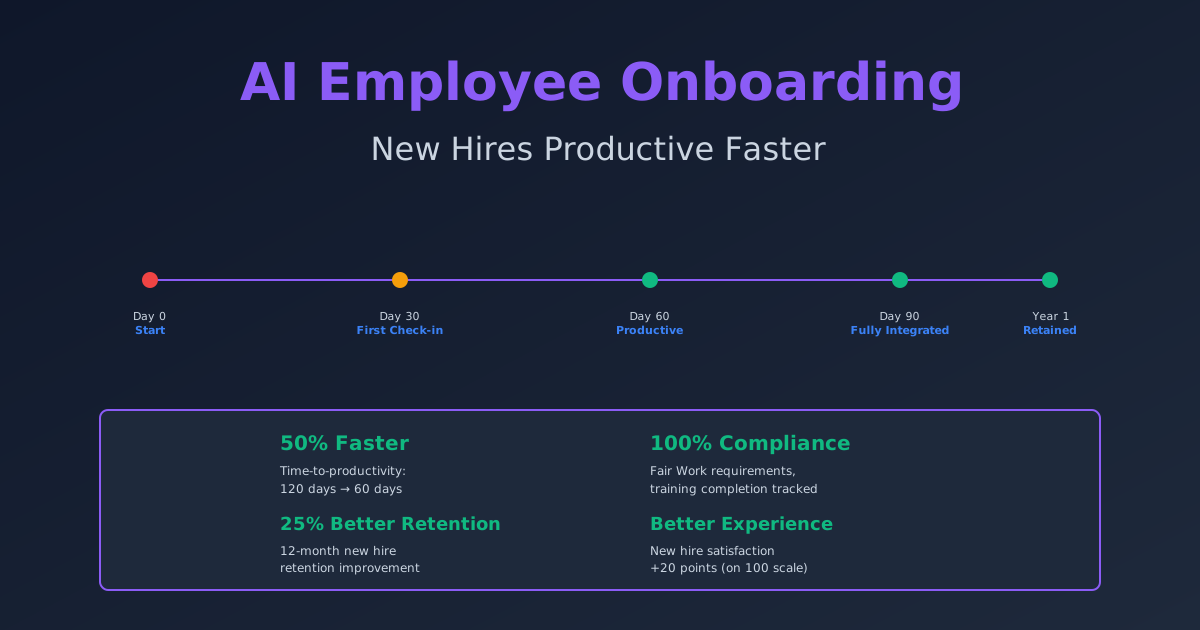
- Time-to-productivity: 60-75 days (50% improvement)
- 12-month new hire turnover: 18-25% (25-30% reduction)
- First-month satisfaction: 75-85%
- Compliance training completion: 98-100%
Specific Metrics
- Document collection time: 14 days → 2 days
- IT provisioning time: 5-7 days → 1 day
- Compliance training completion: 21 days → 3 days
- New hire satisfaction score: +20 points (on 100-point scale)
- Manager assessment of readiness at Day 90: 60% ready → 85% ready
Fair Work Compliance Considerations
Australian onboarding must comply with Fair Work Act requirements:
1. Employment Contract: New hire must receive contract within appropriate timeframe. AI systems can generate and send contracts automatically, creating audit trail.
2. Modern Awards: If role is covered by a Modern Award (retail, hospitality, healthcare, etc.), new hire must understand their award level, pay, leave entitlements. AI can provide award-specific information personalised to the role.
3. Leave Entitlements: Must be documented clearly. Annual leave, sick leave, long service leave, compassionate leave, family & domestic violence leave. AI can calculate and present clearly.
4. Superannuation: Must set up within required timeframes (usually by 31st day of employment). AI can track and ensure compliance.
5. Right of Entry: If role is covered by union, union has right of entry. AI can ensure information is provided and processes are documented.
6. Flexible Work: Fair Work increasingly requires flexible work arrangements. Onboarding can document agreed arrangements.
Implementation Path: From Current to AI-Automated Onboarding
Phase 1: Assessment (Weeks 1-3)
- Document current process: How is onboarding currently done? What documents are collected? What training is mandatory?
- Identify pain points: Where is time wasted? Where do new hires struggle?
- Measure baseline: Time-to-productivity, satisfaction, compliance, retention
- Plan automation: Which processes to automate first?
Phase 2: Setup and Integration (Weeks 3-8)
- Choose platform: Workday, SuccessFactors, or specialist onboarding tools (LeapFrog, Cornerstone)
- Configure workflows: Document collection, IT provisioning, learning paths, check-ins
- Integrate with backend: Connect to HRIS, learning management system, IT systems
- Create content: Prepare role-specific training, learning paths, documents
Phase 3: Pilot (Weeks 8-14)
- Run pilot with new cohort: Use new automated process with next 10-20 new hires
- Measure baseline: Time-to-productivity, satisfaction, compliance
- Gather feedback: What worked? What didn’t? What needs adjustment?
- Iterate: Refine workflows based on pilot
Phase 4: Full Deployment (Weeks 14-20)
- Full rollout: Use automated onboarding for all new hires
- Manager training: How to use system, what to expect
- Monitor metrics: Continuous tracking of productivity, satisfaction, retention
- Optimise: Monthly review and refinement based on outcomes
Overcoming Implementation Challenges
Challenge 1: Integration Complexity
Problem: Onboarding involves many systems (HR, IT, learning, payroll). Integration is complex.
Solution: Choose modern platforms designed for integration. Most modern HRIS/onboarding systems have APIs for integration. Budget 6-8 weeks for full integration.
Challenge 2: Content Creation
Problem: Creating role-specific learning paths and training materials is time-consuming.
Solution: Start with generic paths. Layer in role-specific content gradually. Reuse existing training materials where possible. Leverage AI to generate content summaries.
Challenge 3: Manager Adoption
Problem: Managers may ignore structured check-ins or feel constrained by AI-scheduled touchpoints.
Solution: Frame check-ins as tools to help managers, not constraints. Provide data showing improved outcomes from structured check-ins. Make system easy to use.
Cost and ROI
Implementation Investment
- Platform: $20k-60k annually (depending on size)
- Implementation and integration: $30k-80k (one-time)
- Content creation: $20k-50k (one-time)
- Training: $10k (one-time)
- Total first year: $80k-200k
Ongoing Operating Costs
- Platform subscription: $20k-60k annually
- Maintenance and updates: $10k-20k annually
- Total annual: $30k-80k
Benefits Realisation
For an organisation hiring 100 new people per year:
Productivity improvement: Time-to-productivity improves from 120 days to 70 days. That’s 50 days × 100 new hires × $150/day productivity = $750k in avoided lost productivity
Retention improvement: 12-month turnover reduces from 30% to 20%. That’s 10 people retained annually × $80k turnover cost per person = $800k in prevented turnover costs
Compliance: Avoided audit risk and potential non-compliance penalties = estimated $100k+ annually
HR efficiency: Time freed from administrative work = $50k+ annually in labour savings
Total annual benefit: $1.7M+
ROI: 850%+ annually (after year 1)
What’s Next: Future Onboarding Evolution
Metaverse Onboarding: Virtual reality onboarding experiences for remote new hires, creating immersive experiences.
Personalised Learning: AI continuously personalises learning based on how new hire is progressing, not just pre-set paths.
Peer Learning Networks: AI connecting new hires with peers to learn from each other, building cohort bonds.
Continuous Onboarding: Rather than 90-day onboarding, AI supports continuous development and learning throughout employment.
Conclusion: Onboarding as Strategic Advantage
For Australian employers, AI-automated onboarding transforms a necessary administrative function into a strategic competitive advantage. Companies that implement it will retain more talent, get new hires productive faster, and build stronger cultural integration.
FAQ: Onboarding Questions
Q1: Will AI onboarding feel impersonal to new hires?
A: Only if poorly designed. Good AI onboarding is personalised—learning paths match roles, check-ins are timely and relevant, buddy matching is thoughtful. New hires report better experiences (fewer lost days waiting for IT, clearer training) than with traditional onboarding.
Q2: How do we ensure AI doesn’t miss important context?
A: AI handles routine processes; managers handle context. AI gets documents collected and IT set up. Managers provide role-specific context, strategic vision, culture introduction. Best-in-class onboarding combines AI efficiency with human relationship.
Q3: What about remote onboarding? Does AI work?
A: AI works better for remote onboarding than in-person. You can’t physically hand over equipment or do in-person training anyway. Virtual workflows, document collection, automated learning—all translate naturally to remote. Some organisations struggle with buddy matching for remote workers; thoughtful pairing mitigates this.
Q4: How long does it take to see ROI?
A: Quick wins appear within first 2-3 months (improved IT provisioning time, faster document collection). Retention improvements take 12 months to fully measure. Most organisations see positive ROI within 6-9 months.
Q5: Can small Australian businesses benefit?
A: Yes. Even if hiring 5-10 people per year, automation saves time and improves outcomes. Modern platforms have pricing models for smaller companies. ROI is often higher for small businesses because efficiency improvements have outsized impact.
CTA: Automate Onboarding with AI
Are your new hires spending their first week waiting for IT provisioning, hunting for training materials, and feeling lost? That’s costing you retention and productivity.
Anitech AI helps Australian employers implement AI-automated onboarding, getting new hires productive 50% faster.
We provide:
– Onboarding process assessment and optimisation
– Platform selection and implementation
– Workflow design and automation
– Manager training and change management
Ready to improve new hire experience and retention?
Schedule a confidential onboarding assessment with Anitech AI.
Internal Links
- AI Automation for HR and Recruitment: The Australian HR Leader’s Guide
- AI Resume Screening and Candidate Matching for Australian Recruiters
- AI Employee Retention and Attrition Prediction
- AI Payroll and Workforce Management Automation
- AI Automation Guide for Australian Businesses
Further Reading
- AI Automation Australia — Complete Guide
- AI Automation for HR and Recruitment: The Australian HR Leader’s Guide (2025) — Industry Guide
- AI Resume Screening and Candidate Matching for Australian Recruiters: Find Your Best Hire Faster
- AI Employee Retention and Attrition Prediction for Australian Businesses
- AI Performance Management: Objective, Continuous and Data-Driven Reviews
- AI Learning and Development: Personalised Upskilling at Scale