
Operations: Where AI Agents Transform Cost Structure
Operations is the backbone of every business. It’s also the most expensive, most complex, and most vulnerable to disruption.
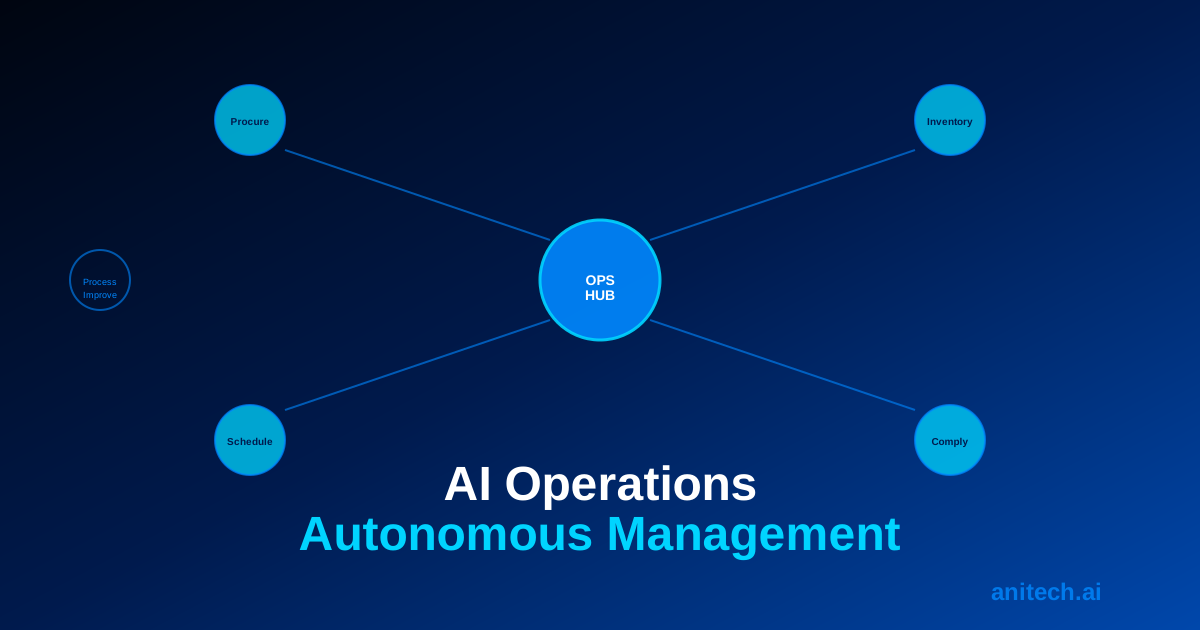
Operational teams manage:
– Supply chains: Sourcing, procurement, vendor management, logistics
– Inventory: Stock levels, reordering, warehouse management, asset tracking
– Scheduling: Resource allocation, capacity planning, maintenance windows
– Compliance: Monitoring adherence to policies, regulations, safety standards
– Process improvement: Identifying bottlenecks, optimising workflows, eliminating waste
All of this is data-driven, rule-based, and ripe for AI automation.
When you deploy AI agents across operations, your cost structure transforms. Routine work that humans did moves to agents. Humans focus on exception-handling, relationship management, and strategic optimisation.
The result: 25-40% cost reduction, improved quality, better compliance, and faster decision-making.
AI Agents Across Operational Functions
Procurement Agent: Automated Sourcing and Vendor Management
Mission: Manage procurement end-to-end. Identify needs, source vendors, negotiate terms, process orders, track deliveries.
Process:
1. Demand Recognition
The agent monitors inventory levels, production schedules, and supplier contracts. When stock is running low or requirements are anticipated:
– Identifies the item needed
– Checks current stock
– Forecasts usage based on demand trends
– Determines optimal order timing and quantity
2. Vendor Sourcing
The agent queries approved vendor lists and market data:
– Checks historical supplier performance (quality, delivery, price)
– Identifies alternatives
– Requests quotes from multiple vendors automatically
– Analyzes offers against criteria: price, quality, delivery time, payment terms, track record
3. Decision and Approval Routing
The agent recommends vendor selection and routes for approval:
– Under $5K: Agent approves autonomously
– $5K-$50K: Routes to procurement manager for approval
– Over $50K: Routes to CFO for approval
4. Order Execution
Once approved, the agent:
– Generates purchase order
– Sends to vendor (email, EDI, API)
– Logs order in accounting system
– Schedules follow-up for expected delivery
5. Delivery Tracking and Issue Resolution
The agent monitors:
– Delivery date vs. expected date
– Quality of delivered goods
– Discrepancies (quantity, damage, wrong items)
– Payment vs. invoice reconciliation
If issues arise: partial delivery → escalate with mitigation plan. Wrong items → initiate return with replacement. Late delivery → contact vendor for expedited shipping.
Outcome: Procurement that took 30-45 minutes per order (human) now takes 2-3 minutes (agent). Errors drop 60%. Vendor relationships improve due to consistency.
Inventory Agent: Optimising Stock Across Locations
Mission: Maintain optimal inventory levels across all locations. Too much = cash tied up and spoilage. Too little = stock-outs and lost sales.
Capabilities:
Demand Forecasting
The agent analyses:
– Historical sales patterns (seasonal, trending, cyclical)
– Current pipeline (known upcoming orders)
– Market signals (competitor activity, customer announcements)
– External factors (economic data, supply chain disruptions)
It forecasts demand for next 4-12 weeks with increasing accuracy as it learns.
Stock Level Optimization
For each item, the agent calculates:
– Current stock
– Anticipated demand
– Lead time from suppliers
– Cost of carrying stock
– Cost of stock-outs
It determines: Reorder at X units. Target stock Y units. Don’t exceed Z units.
Automated Reordering
When stock hits reorder threshold, the agent:
– Triggers purchase order (coordinating with Procurement Agent)
– Adjusts timing based on lead time
– Consolidates orders to reduce freight costs
– Coordinates across locations to balance inventory
Warehouse Optimization
The agent:
– Monitors warehouse utilisation
– Identifies slow-moving inventory
– Recommends markdowns or donations
– Optimises location assignment (fastest-moving items near packing area)
Outcome: Inventory turns improve 20-30%. Stock-outs drop 50-70%. Cash tied up in inventory decreases 15-25%. Obsolescence drops 40-60%.
Scheduling Agent: Coordinating Complex Resource Allocation
Mission: Optimise scheduling across your business—equipment, people, facilities, timelines.
Challenges the agent handles:
1. Meeting Scheduling
When a meeting is requested:
– Check all participants’ availability
– Identify optimal time across time zones
– Book appropriate room and equipment
– Send confirmation with context
– Adjust if conflicts emerge
2. Resource Allocation for Projects
When a project needs resources:
– Analyse skills required vs. team capabilities
– Check capacity (who’s overloaded, who has bandwidth)
– Match skills to needs
– Manage constraints (project deadlines, skill gaps)
– Recommend allocation to project manager
– Adjust as scope or timeline changes
3. Equipment and Facility Management
The agent:
– Schedules maintenance windows
– Books conference rooms, equipment
– Coordinates facility changes
– Manages parking, office space allocation
4. Workforce Scheduling
In shift-based operations:
– Forecasts demand for hours
– Checks staff availability
– Generates schedules meeting all constraints
– Handles time-off requests and adjustments
– Handles call-outs with contingency plans
Complexity Example: A hospital needs to schedule 200 staff across shifts, specialties, compliance rules (no one over 60 hours/week), and coverage requirements. Manual scheduling takes 2 weeks, has errors, and causes disputes. An agent handles it in 2 hours, optimises utilisation, and improves staff satisfaction.
Outcome: Scheduling that took days takes hours. Utilisation improves 15-20%. Schedule conflicts drop dramatically. Staff satisfaction improves.
Compliance and Audit Agent: Continuous Policy Monitoring
Mission: Monitor adherence to policies, regulations, and standards. Flag violations before they become problems.
Capabilities:
Policy Monitoring
The agent knows all your policies:
– Expense policies (what can be reimbursed, approval thresholds)
– Data access policies (who can access sensitive data)
– Procurement policies (how to buy, from approved vendors)
– Safety policies (procedures, training requirements)
– Environmental policies (waste management, energy use)
Continuously monitors: Are policies being followed?
Expense Compliance
Example: An employee submits a $2,000 expense claim.
– Agent checks policy: entertainment expenses capped at $150/person
– This claim is 13 times the limit
– Agent flags for review: “This exceeds policy by 1,300%. Recommend denial or VP approval.”
Catches issues before reimbursement.
Data Access Auditing
The agent:
– Monitors who accesses what data
– Flags unusual patterns (person from finance accessing customer data)
– Checks compliance with data governance policies
– Alerts security team to potential breaches
Regulatory Compliance
For regulated industries (finance, healthcare, legal):
– Monitors regulatory changes
– Assesses impact on your business
– Recommends actions to stay compliant
– Maintains audit trail of compliance efforts
Outcome: Policy violations caught immediately. Audit-readiness improves. Compliance costs drop. Risk exposure decreases.
Process Improvement Agent: Continuous Optimisation
Mission: Identify bottlenecks, inefficiencies, and improvement opportunities. Recommend optimisations.
How it works:
1. Process Monitoring
The agent observes operations:
– Tracks how long each step takes
– Records where work waits (bottlenecks)
– Identifies rework and exceptions
– Measures quality metrics
2. Pattern Analysis
– Where do delays consistently occur?
– Which steps have highest error rates?
– Which decisions require escalation most often?
– What variability exists in similar processes?
3. Optimisation Recommendation
“Invoices wait 3 days for approval, on average. 80% of delays happen at accounting review. Recommend: Give accounting agent authority to approve invoices under $5K. Escalate above $5K. This could reduce approval time from 3 days to 2 hours.”
4. Testing and Learning
The agent proposes changes, measures impact:
– Implement recommended change
– Measure: Did it work? Did it reduce time? Did it improve quality?
– If successful: Keep change, expand to other processes
– If unsuccessful: Try different approach
Outcome: Continuous improvement becomes automatic. Processes improve 3-5% per month. Cost savings compound. Quality continuously improves.
Implementation: Building Your Operational Agent Network
Phase 1: Establish Foundations (Months 1-2)
1. Operational Audit
Map your key processes:
– Procurement (how do you buy?)
– Inventory (how do you manage stock?)
– Scheduling (how do you allocate resources?)
– Compliance (what policies must you follow?)
Identify pain points: Where do delays happen? Where are errors common? Where is cost highest?
2. Data Integration
Connect your systems:
– ERP system (inventory, procurement, accounting)
– HR system (scheduling, capacity, availability)
– Project management system (timelines, resource allocation)
– Compliance and audit systems
Agents need access to all operational data to be effective.
3. Define Governance
Clarify what agents decide autonomously vs. what requires approval:
– Procurement under $5K: Autonomous. Above $5K: Approval required.
– Inventory reorders: Autonomous (following defined thresholds)
– Staff scheduling: Recommended by agent, approved by manager
– Compliance violations: Flag immediately, escalate to compliance team
Phase 2: Deploy Procurement and Inventory Agents (Months 3-4)
Start with high-impact, structured processes:
– Procurement Agent: Automate routine sourcing and ordering
– Inventory Agent: Optimise stock levels
Measure impact:
– Procurement: Cost per order, error rate, vendor performance
– Inventory: Turns, stock-out rate, cash tied up
Phase 3: Deploy Scheduling and Compliance Agents (Months 5-6)
Expand to operations management:
– Scheduling Agent: Coordinate resource allocation
– Compliance Agent: Monitor policy adherence
Phase 4: Continuous Improvement (Months 6+)
Process Improvement Agent continuously identifies optimisation opportunities. Implement improvements systematically.
As you gain confidence, expand agent autonomy. What started as “agent recommends, human approves” can move to “agent decides autonomously” as accuracy proves itself.
Real-World Example: Manufacturing Operations
Before: 200-person operations team. Manual processes. 60-day order cycle. 25% of time spent on paperwork/approvals.
Operations breakdown:
– Procurement: 30 people (sourcing, vendor management, order processing)
– Inventory: 25 people (stock management, reordering, warehouse)
– Scheduling: 15 people (production scheduling, resource allocation)
– Compliance: 20 people (policy monitoring, audit)
– Administration: 110 people (data entry, coordination, approvals)
After AI Agent Deployment (6 months):
Staffing Changes:
– Procurement: 30 → 12 people (agents handle routine sourcing, team focuses on vendor relationships and negotiations)
– Inventory: 25 → 10 people (agents optimise stock, team focuses on optimisation and exceptions)
– Scheduling: 15 → 8 people (agents create schedules, team focuses on complex constraints and changes)
– Compliance: 20 → 10 people (agents monitor, team focuses on exceptions and improvement)
– Administration: 110 → 40 people (agents handle routine work, team focuses on high-value coordination)
Total: 200 → 80 people for same operations volume. 120-person reduction.
Cost Impact:
– Salary savings: 60% reduction = $3-4M annually
– Process efficiency: 30% improvement = $1-2M in productivity gains
– Quality improvement: 25% error reduction = $500K+ in rework elimination
– Speed improvement: 40-day order cycle → 20-day = faster cash flow, happier customers
Total Cost Reduction: 35-40% of operations cost
Staff Transition:
– Not all 120 people are laid off
– Most are redeployed to higher-value work: vendor relationship management, supply chain strategy, process innovation
– Some move to other departments
– Some natural attrition absorbs changes
Cultural Impact:
– Operations team is happier (doing strategic work, not paperwork)
– Quality improves (fewer human errors)
– Customer satisfaction improves (faster order cycles)
– Staff who remain have improved career trajectory
Measuring Operational Agent Performance
Efficiency Metrics
Cost Per Transaction
– Procurement cost per order
– Inventory carrying cost per unit
– Scheduling cost per schedule
– Compliance cost per policy check
Track before and after. Good agents reduce cost per transaction 60-75%.
Time Per Task
– Procurement processing time: 45 min → 3 min
– Inventory reorder cycle: 30 min → 5 min
– Schedule generation: 4 hours → 30 min
Throughput
– How many orders processed per day?
– How many inventory adjustments?
– How many schedules managed?
Good agents increase throughput 3-5x.
Quality Metrics
Error Rate
– Procurement errors (wrong items, duplicates, policy violations)
– Inventory errors (miscount, obsolescence)
– Scheduling errors (double-booked, missing coverage)
– Compliance violations
Good agents reduce errors 60-80%.
Exception Rate
– Percentage of decisions requiring human escalation
– As agents learn, this should decrease over time
Rework Rate
– How often does work need to be redone?
– Good agents eliminate rework almost entirely
Business Impact Metrics
Cost Reduction
– Operational cost as % of revenue (should decrease)
– Labor costs for operations (should decrease significantly)
– Cost of poor quality (should decrease)
Speed Improvement
– Order-to-delivery cycle
– Approval timelines
– Inventory turn rate
Quality Improvement
– Customer satisfaction
– On-time delivery rate
– Quality defect rate
Track all these. They justify investment and guide optimisation.
Challenges and Solutions
Challenge: Agents make decisions humans disagree with
Solution: Start with human-in-the-loop (agent recommends, human approves). Monitor decisions. As accuracy builds confidence, move to autonomous decision-making. Regular review sessions where humans and agents align on approach.
Challenge: Legacy systems don’t integrate well with agents
Solution: Build API adapters or data export/import processes. This is one-time work with lasting benefits. The cost is worth the value.
Challenge: Staff worry about automation eliminating jobs
Solution: Be transparent about transformation. Most people won’t lose jobs—they’ll change roles. Provide training for new responsibilities. People who remain often have better careers (more strategic work, less routine).
Challenge: Agents make errors in edge cases
Solution: Implement escalation for unusual situations. Define thresholds: “If this is unusual, escalate to human.” Build feedback loops so agents learn.
The Future: Autonomous Operations
Today’s agents automate routine operational work. Tomorrow’s will increasingly manage complete operational functions autonomously, with humans guiding strategy and handling exceptions.
For Australian businesses, this transformation is beginning now. Early adopters will gain sustainable cost and efficiency advantages.
Next Steps: AI Agents for Operations
If operations is a cost center you’re trying to optimise:
- Audit your operational processes: Which consume most time/cost? Which have highest error rates?
- Assess automation potential: Which are routine and rule-based? Which require judgment?
- Evaluate integration needs: Can agents access your core systems?
- Build business case: What’s the cost reduction potential? What’s the timeline to payoff?
- Design implementation roadmap: Which process first? What’s realistic? What’s required?
Ready to deploy AI agents across your operations?
Talk to Anitech AI. We’ve deployed operational agents across Australian enterprises—manufacturing, logistics, professional services, finance. We understand your processes, your systems, your constraints. We build agents that cut costs while improving quality.
Contact us to discuss AI agents for your operations.
Related Articles
- AI Agents for Business Australia: The Complete Guide to Agentic Automation
- AI Agent Workflows: Designing End-to-End Automated Business Processes
- Multi-Agent AI Systems: Orchestrating Teams of AI for Complex Business Workflows
- AI Agents for Sales and Marketing: Autonomous Lead Generation and Nurturing
Further Reading
- AI Automation Australia — Complete Guide
- AI Agents for Business Australia: The Complete Guide to Agentic Automation — Industry Guide
- Autonomous AI Agents: How Businesses Are Delegating Complex Tasks to AI
- Multi-Agent AI Systems: Orchestrating Teams of AI for Complex Business Workflows
- AI Agent Workflows: Designing End-to-End Automated Business Processes
- AI Agents for Sales and Marketing: Autonomous Lead Generation and Nurturing