
Beyond Single Agents: The Power of Multi-Agent Systems
A single AI agent is powerful. It can process data, make decisions, execute tasks, and solve problems better than any human working alone.
But most complex business challenges require more than one perspective. They need specialisation, parallel processing, and coordination.
A multi-agent system is a network of specialised AI agents, each with distinct capabilities, that work together to solve problems too complex for any single agent.
Think of it like a business team. Your lead generation specialist doesn’t do content creation. Your operations manager doesn’t handle legal reviews. Your sales team doesn’t schedule production. Each specialist focuses on their domain. Collectively, they accomplish far more than any individual could.
Multi-agent systems work the same way. And they offer advantages that single agents simply cannot achieve.
Multi-Agent Architecture: How Specialised Agents Collaborate
Core Components
Specialised Agents
Each agent is optimised for a specific domain. A lead generation agent understands prospect signals, qualification criteria, and outreach best practices. A content agent understands persuasion, personalisation, and engagement. A scheduling agent understands calendar constraints, time zones, and availability. Each is trained and configured for its role.
Coordination Layer
Agents don’t operate in silos. A coordination layer routes work, manages handoffs, maintains state, and ensures agents work together coherently.
When the lead generation agent identifies a hot prospect, the coordination layer signals the content agent. The content agent generates personalised outreach. The scheduling agent monitors responses and coordinates meetings.
Shared Context and Memory
All agents access shared information: customer data, interaction history, campaign state, business rules. This prevents duplicate work, ensures consistency, and enables intelligent handoffs.
Inter-Agent Communication
Agents communicate with each other. Agent A signals Agent B: “I’ve identified a qualified lead. Please take it from here.” Agent B responds: “Processing. I’ve completed outreach. Awaiting response.” Agent C notices the response and takes next action.
This communication is structured, logged, and traceable—essential for complex workflows.
Real-World Multi-Agent Ecosystem: Sales Pipeline Automation
Consider a complete sales automation system:
Lead Generation and Qualification
Prospect Research Agent
Continuously scans market intelligence, LinkedIn data, company announcements, and intent signals. Identifies companies matching your ideal customer profile. Passes qualified prospects to the next agent.
Lead Scoring Agent
Assesses each prospect against your criteria: company size, industry, revenue, growth rate, decision-making timeline, product fit. Assigns confidence scores. Routes hot leads to outreach, cold leads to nurture campaigns.
Outreach and Engagement
Content Generation Agent
For each prospect, analyses prior interaction, industry role, company context. Generates personalised email subject lines, body copy, and call-to-action designed to resonate with that specific prospect.
Outreach Coordination Agent
Manages the cadence of outreach: initial email, follow-ups, channel selection (email, LinkedIn, phone). Adapts based on prospect behaviour. “No response after 5 days? Send follow-up. Still no response after 3 weeks? Move to nurture track.”
Meeting Scheduling and Preparation
Calendar Agent
Receives positive prospect signals. Identifies meeting slots where both parties are available. Coordinates across time zones. Books meetings. Sends confirmations with context.
Sales Enablement Agent
Prepares battlecards for scheduled calls: prospect company overview, competitive landscape, relevant product features, typical pain points for that industry, previous customer case studies from similar companies.
Follow-Up and Optimisation
Engagement Tracking Agent
Monitors what happens after outreach: email opens, link clicks, meeting attendance, call outcomes. Provides real-time feedback on what’s working.
Performance Analysis Agent
Analyses campaign results: which outreach messages generate responses? Which prospects convert to customers? Which sales reps close at highest rates? Recommends optimisations.
Feedback Loop Agent
Communicates findings to all agents. Prospect Research Agent refines targeting. Content Agent adjusts messaging. Sales Enablement Agent updates battlecards. The system continuously improves.
The Outcome
Instead of sales team members spending 20+ hours weekly on prospect research, content creation, scheduling, and preparation, agents handle this entirely.
Sales team focuses on conversations—the only part that truly requires human judgment and relationship-building.
Lead quality improves 40-50%. Sales team productivity increases 3x. Sales cycle accelerates. Revenue increases.
Orchestration Patterns: How Multi-Agent Systems Work
Sequential Handoff Pattern
Work flows through agents in sequence. Agent 1 completes its work, passes results to Agent 2. Agent 2 continues from there.
Example: Invoice processing
1. Invoice receipt agent ingests invoice → 2. Data extraction agent extracts key data → 3. Validation agent checks compliance → 4. Approval routing agent determines approval chain → 5. Payment scheduling agent schedules payment
Suitable for: Linear workflows where steps must happen in order.
Parallel Processing Pattern
Multiple agents work on the same problem simultaneously, each contributing their perspective.
Example: Contract analysis
1. Legal compliance agent reviews contract against regulatory requirements
2. Commercial terms agent analyses pricing, payment terms, deliverables
3. Risk agent identifies potential risks and liabilities
4. Integration agent assesses technical compatibility
5. Consolidation agent combines all analyses into comprehensive review
These agents work in parallel, dramatically reducing analysis time. Results are combined for comprehensive perspective.
Suitable for: Complex problems requiring multiple expert viewpoints.
Hierarchical Pattern
Agents operate in layers. Higher-level agents break down strategic goals. Lower-level agents execute tactics.
Example: Strategic customer retention
1. Strategic agent identifies that churn is driven by support response time and product gaps
2. Tactical agent 1 implements process improvements to support response time
3. Tactical agent 2 manages product feedback routing and prioritisation
4. Execution agents implement specific solutions
5. Monitoring agent tracks impact and recommends further optimisation
Suitable for: Complex strategic problems with multiple implementation layers.
Hub-and-Spoke Pattern
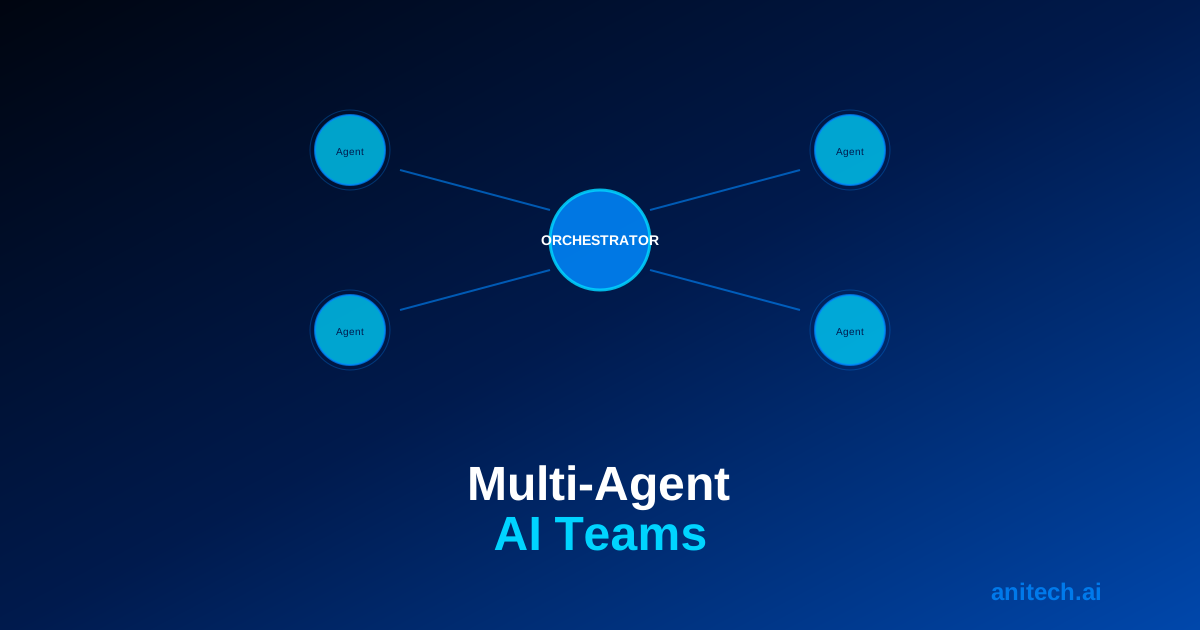
One coordinating agent manages multiple specialist agents.
Example: Customer support
1. Hub agent (triage) receives incoming support requests
2. It routes to appropriate specialist agent: technical support agent, billing support agent, feature request agent
3. Specialist agent handles the issue
4. Specialist agent returns results to hub agent
5. Hub agent monitors customer satisfaction, escalates if needed
Suitable for: Problems requiring multiple specialists with a central coordinator.
Building Effective Multi-Agent Systems
Design Principle 1: Clear Specialisation
Each agent has a specific, well-defined role. It’s not a generalist trying to do everything. It’s a specialist excelling at one thing.
- Lead generation agent doesn’t do sales
- Content agent doesn’t do scheduling
- Analysis agent doesn’t make strategic decisions
This focus improves performance dramatically. Specialised agents are more accurate, faster, and more reliable than generalists.
Design Principle 2: Structured Handoffs
When one agent completes work and passes it to the next, the handoff is explicit and structured.
Agent A doesn’t vaguely “send data” to Agent B. It formats the data explicitly: “Here’s the qualified prospect. ID: P-12345. Company: Acme Corp. Revenue: $50M. Decision timeline: Q3. Suggested approach: emphasise cost reduction benefits.”
Agent B receives this structured information and continues from exactly where Agent A left off.
Design Principle 3: Shared Context
All agents access common information: customer data, interaction history, system state, business rules.
This prevents: duplicate work, conflicting actions, lost information, inconsistent decisions.
It enables: efficient handoffs, intelligent routing, coordinated action, learning across agents.
Design Principle 4: Transparent Communication
Agents communicate through logs and structured messages, not hidden internal state.
When Agent A hands off to Agent B, everything that Agent B needs to know is explicitly communicated. When Agent B completes work, it logs what it did and why.
This transparency enables:
– Audit trails (understand any outcome)
– Human oversight (humans know what’s happening)
– Debugging (identify where things went wrong)
– Learning (agents improve based on clear feedback)
Design Principle 5: Graceful Degradation
What happens if one agent fails? The system continues operating.
If your scheduling agent goes down, leads can still be generated and contacted. The scheduling step is delayed but the workflow doesn’t stop entirely.
This requires: clear dependencies, alternative pathways, human escalation for critical functions.
Governance in Multi-Agent Systems
As agents coordinate and make decisions across your business, governance becomes critical.
Define Decision Authorities
For each agent (or agent pair), clarify what they decide:
- Lead Generation Agent: Decides whether to route to sales or nurture track
- Content Agent: Decides how to personalise outreach
- Scheduling Agent: Decides which time slots to propose
- Approval Routing Agent: Decides who reviews invoices based on amount
And what they DON’T decide:
– Strategic decisions (pricing changes, major partnerships)
– Personnel matters (hiring, compensation)
– Significant financial commitments
– Legal commitments
Implement Escalation Logic
When something is outside an agent’s authority or presents unusual circumstances, escalate to humans.
Rules like:
– “If prospect company is competitor, escalate to VP Sales”
– “If invoice exceeds budget by >20%, escalate to finance director”
– “If customer sentiment is negative, escalate to customer success manager”
Monitor Agent Interactions
Track how agents interact:
– Which handoffs happen most frequently?
– Where do bottlenecks occur?
– Which agent pairs work well together?
– Which combinations generate errors?
This reveals optimisation opportunities: perhaps agents need better coordination. Perhaps agent responsibilities need adjustment.
Audit Agent Decisions
Regularly review decisions agents made:
– Did lead scoring align with actual conversion?
– Did outreach content resonate with prospects?
– Did escalation thresholds make sense?
– Were there unexpected patterns or issues?
Use audit findings to refine agent logic, adjust thresholds, and improve system performance.
Implementation Roadmap for Multi-Agent Systems
Phase 1: Establish Single Agent Mastery (Months 1-3)
Deploy and optimise individual agents:
– One lead generation agent
– One invoice processing agent
– One customer support triage agent
Get each working excellently before adding multi-agent complexity.
Phase 2: Build Coordination Infrastructure (Months 3-4)
Create the systems agents need to communicate:
– Message queue for agent-to-agent communication
– Shared data stores agents can access
– Logging systems tracking all agent actions
– Monitoring dashboards showing agent activity
Phase 3: Deploy Initial Multi-Agent Workflow (Months 4-6)
Implement your first complete multi-agent workflow. Start simple: 3-4 agents in sequence (e.g., lead generation → content → scheduling → follow-up).
Work through coordination challenges. Refine handoff processes. Build confidence.
Phase 4: Expand and Optimise (Months 6-12)
Deploy additional agents. Build more sophisticated orchestration: parallel agents, hierarchical decisions, hub-and-spoke patterns.
Optimise based on performance data: are agents communicating effectively? Are handoffs smooth? Are escalations appropriate?
Measuring Multi-Agent System Performance
Workflow Metrics
Throughput: How many workflows complete daily/weekly/monthly?
Cycle Time: How long from workflow start to completion?
Error Rate: What percentage of workflows have issues or require rework?
Escalation Rate: How frequently do workflows require human intervention?
Agent-Specific Metrics
For each agent, track:
– Accuracy: How often does the agent make correct decisions?
– Completeness: Does the agent gather all necessary information?
– Speed: How fast does the agent complete its work?
– Reliability: How consistently does the agent perform?
Business Impact Metrics
Cost Reduction: How much have operational costs decreased?
Speed Improvement: How much faster are processes than before?
Quality Improvement: How much have errors decreased? Have customer satisfaction improved?
Capacity Increase: How much additional volume can you handle without additional staff?
Track all these metrics continuously. They guide system refinement and demonstrate business value.
Common Challenges in Multi-Agent Systems
Challenge: Agents make conflicting decisions
Solution: Establish clear decision authorities so agents never conflict. Use hierarchical coordination when decisions interact.
Challenge: Handoff failures between agents
Solution: Implement structured handoff protocols. Each handoff includes explicit context. Receiving agent acknowledges receipt.
Challenge: Agent performance varies wildly
Solution: Monitor individual agent accuracy. Identify root causes (poor configuration, inadequate data, misaligned objectives). Refine systematically.
Challenge: Scaling is complex
Solution: Start simple. Add agents one at a time. Refine coordination. Once one workflow works well, replicate the pattern to other domains.
The Future: Autonomous Multi-Agent Ecosystems
Today’s multi-agent systems are carefully orchestrated. Tomorrow’s will be more autonomous—agents will self-organise, adapt to changing conditions, and continuously optimise their collaboration.
You’re building the foundation for that future now.
Next Steps
If your business faces complex workflows requiring multiple skillsets:
- Map your workflow: What steps does it have? What skillsets does each require?
- Identify agent specialisations: What would each agent do best?
- Design coordination: How would agents hand off? What information must be shared?
- Build business case: What would improvements in speed, cost, and quality be worth?
- Develop implementation roadmap: What’s the sequence? What’s realistic? What’s the timeline?
Ready to deploy multi-agent systems in your business?
Talk to Anitech AI. We’ve architected and deployed multi-agent systems across Australian enterprises. We understand orchestration, handoffs, governance, and continuous optimisation. We build systems that work, scale, and adapt.
Contact us to discuss multi-agent systems for your business.
Related Articles
- AI Agents for Business Australia: The Complete Guide to Agentic Automation
- Autonomous AI Agents: How Businesses Are Delegating Complex Tasks to AI
- AI Agent Workflows: Designing End-to-End Automated Business Processes
- AI Agents for Sales and Marketing: Autonomous Lead Generation and Nurturing
Further Reading
- AI Automation Australia — Complete Guide
- AI Agents for Business Australia: The Complete Guide to Agentic Automation — Industry Guide
- Autonomous AI Agents: How Businesses Are Delegating Complex Tasks to AI
- AI Agent Workflows: Designing End-to-End Automated Business Processes
- AI Agents for Sales and Marketing: Autonomous Lead Generation and Nurturing
- AI Agents for Operations: Autonomous Process Management Across Your Business