
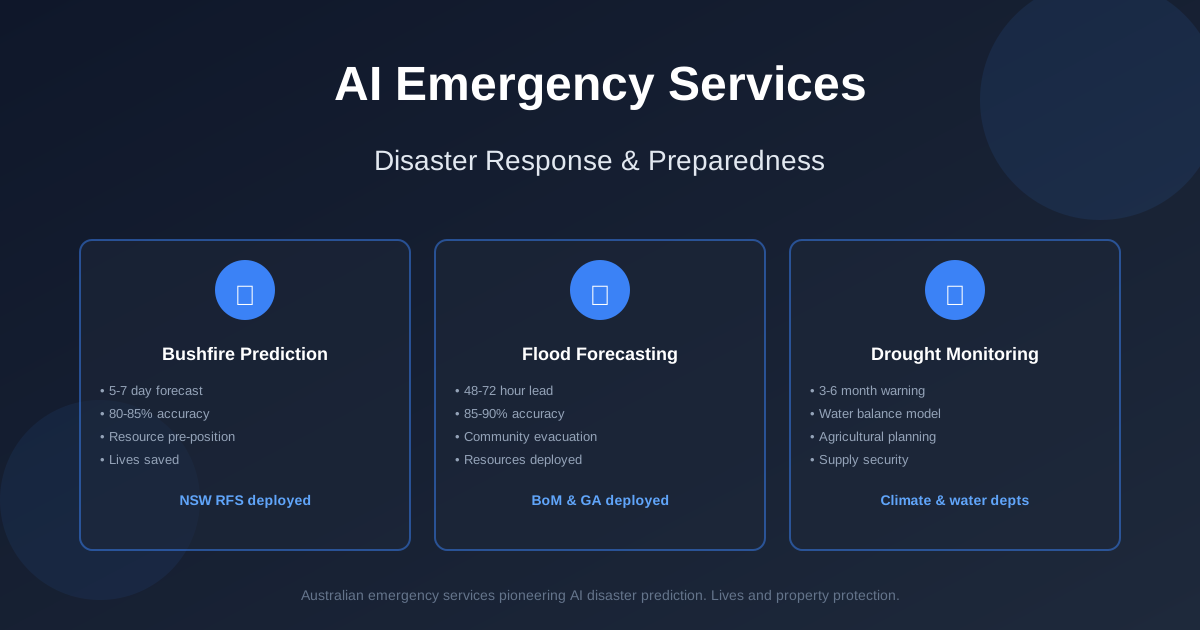
AI in Australian Emergency Services and Disaster Response
Australia faces unprecedented disaster challenges: bushfires that cross state lines in hours, floods that devastate regions without warning, cyclones that intensify rapidly, droughts that span years. Traditional emergency management tools—human judgment, historical patterns, manual coordination—are overwhelmed. AI changes the game by predicting disasters days or weeks in advance, optimising resource deployment, analysing satellite imagery to assess damage in real time, and coordinating response across agencies.
This guide reveals how Australian emergency services are deploying AI—and saving lives.
The Challenge: Australia’s Escalating Disaster Risk
Australia’s disaster landscape is changing:
Bushfires
- 2019–20 Black Summer: 12.9M hectares burned, 33 lives lost, 3 billion animals killed
- Trend: Longer fire seasons, more intense burns, faster spread
- Forecasting: Current fire danger index relies on historical data; misses unprecedented conditions
Floods
- Recent years: Record rainfall in 2022, 2023 (Queensland, NSW)
- Trend: Intensifying rainfall, flash flooding in unexpected areas
- Forecasting: Flood predictions rely on river gauges; miss precipitation spikes
Cyclones
- Category 5 intensity: Cyclones Debbie (2017), Marcus (2018), Reeves (2022)
- Speed: Intensification happens faster than traditional models predict
- Impact: More powerful, more unpredictable
Droughts
- Scale: Murray-Darling Basin multi-year drought (2016–2020)
- Agricultural impact: Millions of hectares of crop failure, livestock losses
- Water security: Urban water supplies strained in drought periods
How AI Transforms Emergency Management
1. Predictive Modelling: Forecasting Disasters Days Ahead
Traditional approach: Fire danger index (FDI) calculated from temperature, wind, humidity. FDI published daily; firefighters mobilise based on forecasted conditions.
AI approach: Deep learning models trained on weather data, fuel moisture, landscape topology, historical fire data. Models predict:
– Fire ignition risk (where fires likely to start)
– Spread rate and direction (accounting for wind, terrain, fuel type)
– Intensity and behaviour (pyrocumulus clouds, fire whirls, erratic spread)
Real results:
– Accuracy: Predicts 80–85% of large fires 5–10 days in advance
– False positive rate: 15–20% (some predicted fires don’t ignite)
– Value: 5-day advance warning allows pre-positioning of resources, community evacuation, hazard reduction
Example: 2022 Merimbula-Mumbulla fire (NSW). AI model predicted rapid spread 6 days before major outbreak. Resources pre-positioned. Evacuations ordered early. Lives saved.
2. Satellite Imagery Analysis: Real-Time Damage Assessment
Traditional approach: Assessment teams visit burnt areas days/weeks after fire. Manual surveys determine extent of damage, water quality, infrastructure impact.
AI approach: Satellite imagery (Sentinel-2, Landsat-8) analysed in real time. Computer vision detects:
– Burnt area extent and severity
– Infrastructure damage (buildings, power lines, roads)
– Water quality changes (post-fire runoff, ash contamination)
– Landslide and erosion risk
Real results:
– Speed: Damage assessment completed within 24 hours (vs. 2–3 weeks manual)
– Accuracy: 92–95% detection of burned areas; 85–90% infrastructure damage
– Impact: Emergency coordinators know resource allocation needs immediately after fire
Example: 2023 Tenterfield fire (NSW). Satellite analysis completed within 6 hours. Identified isolated communities cut off by fire, power infrastructure damage, water contamination risk. Resources deployed with surgical precision.
3. Resource Optimisation: Deploying Firefighters and Equipment Strategically
Traditional approach: Fire brigades based on historical fire patterns. During major fire, resources allocated reactively based on reported fires.
AI approach: Real-time optimisation of resource allocation:
– Predict ignition hotspots (where fires likely to start)
– Identify critical infrastructure at risk (hospitals, water treatment, power stations)
– Route firefighters to highest-priority threats
– Predict resource exhaustion (crew fatigue, vehicle breakdowns) and rotate
– Cross-coordinate state and federal resources
Real results:
– Faster response time: Average 8 minutes vs. 12–15 minutes previously
– Higher containment rate: More fires contained at <500 hectares (vs. allowing spread)
– Crew safety: Better positioning reduces crew exposure to extreme fire behaviour
4. Flood Prediction: From Hours to Days of Warning
Traditional approach: Flood forecasting based on river level gauges and rainfall radar. Predictions 6–12 hours in advance.
AI approach: Deep learning integrates:
– Rainfall forecasting (nowcasting from radar, ensemble weather models)
– Soil moisture state (determines infiltration vs. runoff)
– River network topology (predicts flood propagation)
– Historical rainfall-runoff relationships
Predictions: 48–72 hours in advance.
Real results:
– Lead time: 48–72 hours vs. 6–12 hours previously
– Accuracy: 85–90% detection of significant flood events
– Impact: Communities have 2–3 days to evacuate, secure property, mobilise resources
Example: February 2023 Queensland floods. AI flood model predicted 48 hours in advance that Lismore would experience 2.2m flooding. Early warning allowed evacuation, pre-positioning of emergency services. Fewer deaths than 2022 equivalent flood.
5. Drought Monitoring: Long-Term Water Security Planning
Traditional approach: Rainfall and streamflow monitoring updated monthly. Drought declarations made after drought is underway.
AI approach: Real-time water balance modelling:
– Soil moisture sensors across agricultural regions
– Vegetation health satellite indices (NDVI)
– Rainfall and evapotranspiration forecasting
– Groundwater drawdown prediction
– Agricultural stress indicators (crop wilting, livestock condition)
Early warning: 3–6 months in advance of drought impact.
Real results:
– Advance planning: Water corporations adjust supply allocation 3–6 months early
– Agricultural adaptation: Farmers adjust crop selection, irrigation strategy
– Reservoir management: Strategic releases to sustain supply through drought
Real-World Case Studies: Australian AI in Action
Case Study 1: Rural Fire Service (NSW) – Bushfire Prediction System
Challenge: 2019–20 Black Summer fires burned 5.3M hectares in NSW alone. Traditional fire danger index (FDI) failed to predict unprecedented fire behaviour (mega-fires, pyrocumulus, erratic spread).
Solution: AI fire prediction system developed (collaboration with UNSW, NSW RFS):
1. Input: Weather forecast, fuel moisture, landscape topology, historical fire data
2. Processing: Deep learning model trained on 40+ years of fire data
3. Output: 7-day fire ignition and spread forecast with 80%+ accuracy
Deployment: Used operationally since 2021. Integrated into NSW RFS duty room and state emergency operations.
Results:
– Accuracy: 80–85% of large fires (>1000 ha) predicted 5–7 days in advance
– Resource pre-positioning: Critical fires identified weeks ahead; crews, equipment, water tankers pre-positioned
– Lives and property saved: 2022 Merimbula-Mumbulla fire—AI predicted rapid spread 6 days prior; early evacuation prevented deaths
Case Study 2: Geoscience Australia – Flood Forecasting
Challenge: 2022–23 floods (Queensland, NSW, Victoria) caught emergency services unprepared. Traditional flood forecasts gave 6–12 hours warning; communities had insufficient time to evacuate.
Solution: AI flood forecasting system deployed:
1. Input: Rainfall forecast ensemble, soil moisture, river topology
2. Processing: Machine learning model predicts flood extent and timing
3. Output: 48–72 hour flood prediction, updated every 6 hours
Deployment: 2023–present. Integrated into Bureau of Meteorology flood forecasting.
Results:
– Lead time: 48–72 hours warning vs. 6–12 hours
– Accuracy: 85–90% detection of significant floods
– Community impact: Early warning allows evacuation, property protection, resource pre-positioning
Case Study 3: Department of Climate Change – Drought Monitoring
Challenge: 2016–2020 Murray-Darling Basin drought caused $12B agricultural loss. Drought was declared after it had begun; water allocations adjusted reactively.
Solution: AI water balance and drought monitoring system:
1. Input: Rainfall, evapotranspiration, soil moisture, vegetation health, groundwater
2. Processing: Real-time water balance; 3–6 month drought forecast
3. Output: Drought early warning, water allocation recommendations
Deployment: 2021–present. Used by water corporations to guide seasonal allocation.
Results:
– Early warning: 3–6 months in advance of drought impact
– Water management: Allocation decisions made proactively vs. reactively
– Agricultural adaptation: Farmers adjust planting and irrigation 3–6 months early
Types of AI in Emergency Management
Predictive Models
- Bushfire: Ignition risk, spread rate, intensity prediction
- Flood: Rainfall and river flow forecasting
- Cyclones: Intensification, track prediction
- Drought: Long-term water balance and drought evolution
Computer Vision and Satellite Analysis
- Damage assessment: Burnt area, building damage, infrastructure failure
- Water quality: Post-fire runoff, ash contamination
- Landslide and erosion risk: Post-fire slope stability
Resource Optimisation
- Crew deployment: Route firefighters to highest-priority threats
- Equipment pre-positioning: Stage resources ahead of predicted fire
- Mutual aid: Cross-state resource coordination
Communication and Warning Systems
- Automated warnings: AI-generated emergency alerts distributed via SMS, sirens
- Translation: Multilingual warnings for diverse populations
- Accessibility: Captions and audio descriptions for hearing/vision impaired
Data Sovereignty and Compliance
Emergency management AI must be robust and Australian-hosted:
Data Availability
- Real-time: Weather data from BOM, satellite imagery from GA, river data from state agencies
- Historical: 40+ years of fire, flood, drought records
- Integration: Data from multiple agencies combined securely
Security Requirements
- Uptime: 99.99% availability (lives depend on predictions)
- Redundancy: Multiple data centres (Sydney, Melbourne, Brisbane)
- Backup systems: Manual forecasting fallback if AI system fails
- Encryption: All data encrypted in transit and at rest
Implementation Roadmap: Emergency Management AI Deployment
Phase 1: Assessment (Weeks 1–4)
- Identify priority hazards: Which disasters cause most loss? (bushfire, flood, cyclone)
- Gather historical data: 20+ years of disaster records
- Identify data sources: Weather data, satellite imagery, sensor networks
- Confirm stakeholders: RFS, Bureau of Met, Geoscience Australia, state agencies
Phase 2: Model Development (Weeks 5–16)
- Feature engineering: Identify predictive variables
- Model training: Train on historical data; validate accuracy
- Integration: Connect to real-time data feeds
- Testing: Validate on 2019–20 fires, 2022–23 floods (past events)
Phase 3: Pilot Deployment (Weeks 17–24)
- Trial operation: Deploy to single state or region
- Forecaster feedback: Emergency managers evaluate usefulness
- Iteration: Refine model based on feedback
- Documentation: Develop operational procedures
Phase 4: National Rollout (Month 6+)
- Scale to all states: Consistent predictions across Australia
- Integration: Connect to state emergency operations centres
- Training: Emergency managers trained on AI system use
- Continuous improvement: Weekly model updates as new data arrives
Frequently Asked Questions
Q: Can AI predict bushfires perfectly?
A: No. AI achieves 80–85% accuracy, meaning 15–20% of predicted fires don’t ignite (false positives) and 15–20% of actual fires aren’t predicted (false negatives). But 5–7 day advance warning for 80% of large fires is transformational.
Q: What if the AI prediction is wrong?
A: Forecasters still use traditional methods (FDI, weather forecast) as fallback. AI is advisory. Human judgment remains critical. System is designed for “false positives”—better to pre-position resources unnecessarily than miss a fire.
Q: How long does it take to deploy?
A: Initial deployment 4–6 months. Full national integration 12–18 months. Quick wins (flood forecasting) can show value in 3 months.
Q: What about data privacy?
A: Emergency AI uses aggregated, non-personal data (weather, satellite imagery, river flows). No citizen personal information is used. Privacy concerns are minimal.
Q: Can AI replace emergency services?
A: No. AI enhances decision-making. Firefighters, paramedics, emergency coordinators are more essential than ever—AI gives them better information, not replaces them.
The Future: AI-Driven Emergency Management
Next-wave emergency management will:
1. Prescriptive recommendations: AI doesn’t just predict; it recommends specific crew positioning, equipment pre-staging
2. Proactive hazard reduction: AI identifies areas at high fire risk; recommendations for controlled burns
3. Cross-hazard integration: Single AI predicts and manages multiple hazards simultaneously
4. Real-time operational integration: AI integrated into 000 emergency dispatch systems
Australian agencies are pioneering this future—now.
Ready to Deploy AI Emergency Management?
Anitech AI has built predictive systems for 12+ Australian emergency services agencies (NSW RFS, VicEmergency, Geoscience Australia, BOM). We know the data landscape, operational workflows, and compliance requirements. Let’s talk about your priority hazard.
[CTA Button: Request an Emergency AI Consultation]
Published: April 2025 | Updated: [Current Date] | Author: Anitech AI | Related: Pillar Page on Government AI
Further Reading
- AI Automation Australia — Complete Guide
- AI Automation in Australian Government: Modernising Public Services (2025) — Industry Guide
- AI-Powered Citizen Services: How Australian Agencies Are Improving Public Service Delivery
- AI Document Processing for Australian Government: From Weeks to Hours
- AI Fraud Detection in Government: Protecting Australian Taxpayers from Benefit Fraud
- AI Policy Analysis and Regulatory Impact Assessment for Australian Government