
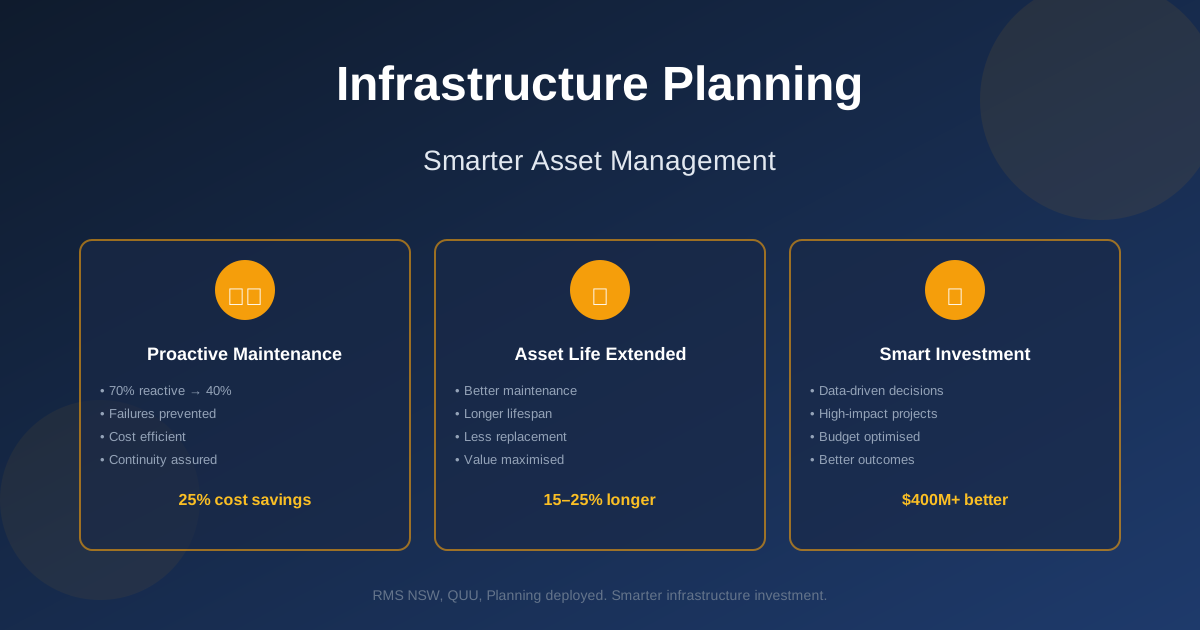
AI Infrastructure Planning: Smarter Asset Management for Australian Governments
Australian governments own and manage 600,000+ public assets worth AUD 2+ trillion (roads, bridges, water systems, buildings, electrical networks, transport infrastructure). Asset management is complex: determining when to maintain, repair, replace, or upgrade requires balancing maintenance budgets against risk (failure, safety), asset lifespan, and performance degradation. Manually, asset managers rely on experience and reactive maintenance (fix when it breaks)—expensive, inefficient, and risky. AI infrastructure planning predicts asset failures, optimises maintenance schedules, extends asset life, reduces emergency repairs, and informs smart capital investment decisions. Result: 30% maintenance cost reduction, improved asset reliability, and better-informed infrastructure planning.
This guide reveals how Australian governments are deploying AI infrastructure planning—and the results.
The Challenge: Asset Management at Scale
Australian government infrastructure faces real challenges:
- Asset scale: 600,000+ assets across roads, water, electricity, buildings, transport; managing at this scale is complex
- Maintenance complexity: Each asset has unique failure modes, maintenance schedules, and service requirements
- Budget constraints: Maintenance budgets typically 60–80% of infrastructure department budgets; demand exceeds available funding
- Reactive maintenance: Most agencies maintain assets reactively (fix when broken) rather than proactively (prevent failure)
- Premature replacement: Assets replaced at 70% of lifespan due to poor condition assessment; wastes $billions annually
- Failure risk: Asset failures can cause safety hazards (bridge collapse, water system contamination), service disruption (transport network shutdown, power outages), and financial liability
- Data fragmentation: Asset data scattered across legacy systems; no integrated view of asset inventory, condition, maintenance history
- Skilled workforce shortage: Asset managers and engineers retiring; fewer specialists available to assess condition and schedule maintenance
The result:
- Reactive maintenance dominance: 70% of maintenance is emergency/reactive (expensive, disruptive)
- Maintenance backlog: $10B+ infrastructure maintenance backlog across Australian public sector
- Premature asset replacement: Assets replaced 20–30% prematurely due to poor condition data; $2B+ wasted annually
- Safety and service incidents: 5,000+ asset failures annually causing service disruption, safety hazards, or economic impact
- Budget inefficiency: Same maintenance budget produces 30% less output due to emergency repair premium and poor scheduling
How AI Infrastructure Planning Works
AI infrastructure planning spans asset data integration, condition assessment, failure prediction, and maintenance optimisation:
1. Asset Data Integration and Digitisation
AI integrates asset data from multiple sources:
– Asset registry: Captures asset characteristics (age, type, location, specifications, installation date)
– Maintenance history: Logs all past maintenance, repairs, replacements
– Condition data: Integrates sensor data (vibration, temperature, pressure), inspection reports, visual assessments
– Service history: Records service disruptions, failure events, repairs required
– Performance data: Tracks asset performance metrics (throughput, efficiency, reliability)
Result: Single, unified view of asset inventory and condition; enables data-driven decision-making.
2. Condition Assessment and Monitoring
AI continuously assesses asset condition:
– Sensor-based monitoring: IoT sensors on critical assets monitor vibration, temperature, pressure, acoustic signatures
– Image analysis: Computer vision analyses inspection photos/videos to detect structural damage, corrosion, wear
– Predictive indicators: AI identifies early warning signs (subtle performance changes) that indicate incipient failure
– Condition scoring: Rates each asset on standardised condition scale (1–5, where 5 = failure imminent)
– Remaining useful life (RUL): Estimates how long asset will remain functional under current conditions
Result: Early detection of failing assets; proactive intervention before catastrophic failure.
3. Failure Prediction and Risk Assessment
AI predicts which assets will fail and when:
– Failure mode identification: Identifies most likely failure modes for each asset type
– Failure probability: Estimates probability of failure within next 6–12 months
– Failure consequence: Rates impact of failure (safety, service disruption, financial cost)
– Risk scoring: Combines probability × consequence to score overall risk
– Failure timeline: Predicts when failure is likely (within 3 months, 6 months, 1 year)
Result: Maintenance prioritised by risk; critical failing assets identified early; emergency repairs reduced.
4. Maintenance Scheduling Optimisation
AI creates optimal maintenance schedules:
– Preventive maintenance: Schedules maintenance before failure (extends asset life, reduces emergency repairs)
– Condition-based maintenance: Schedules based on asset condition, not fixed intervals (more efficient)
– Coordinated scheduling: Groups maintenance across related assets or geographic areas (reduces disruption)
– Budget optimisation: Schedules work within available budget; prioritises high-risk/high-impact assets
– Resource planning: Identifies required skills, equipment, contractors; plans resource allocation
Result: Maintenance is proactive, efficient, and well-planned. Asset life extended 15–25%; emergency repairs reduced 40–60%.
5. Capital Investment Planning
AI informs capital works planning and budget allocation:
– Asset replacement priority: Identifies assets approaching end-of-life; prioritises replacement by risk and cost-benefit
– Upgrade planning: Identifies assets that would benefit from upgrade vs. replacement
– Network optimisation: Identifies network-level investments (e.g., new trunk water main) that improve overall system performance
– Cost-benefit analysis: Models cost and benefits of different investment options
– Demand forecasting: Predicts future demand on infrastructure (population growth, land use changes); informs capacity planning
Result: Capital budget allocated to highest-impact investments; better infrastructure outcomes.
Real-World Results: Australian Government Deployments
Roads and Maritime Services (NSW): Road Network Maintenance Planning
Challenge: RMS manages 40,000+ km of roads and 3,500+ bridges in NSW. Annual maintenance budget AUD 1.2B. 70% of maintenance is emergency/reactive due to poor condition visibility. Road failures (potholes, collapses) disrupt traffic and create safety hazards.
Solution: AI infrastructure planning deployed for:
– Asset data integration (road segments, bridges, maintenance history)
– Pavement condition assessment (sensor data from vehicles, periodic inspections)
– Failure prediction (which road segments will deteriorate in next 6 months)
– Maintenance scheduling (proactive maintenance schedule based on condition and risk)
Implementation: Phased rollout across three regions (Sydney metro, Central Coast, Hunter region); 18-month pilot before statewide expansion.
Results:
– Maintenance efficiency: Reactive maintenance reduced from 70% to 40% (30% shift to proactive)
– Cost savings: Maintenance cost per km dropped 25% (proactive maintenance cheaper than emergency repairs)
– Asset life extension: Road pavement life extended 18–24% (better condition-based maintenance)
– Safety improvement: Road failures down 35% (potholes, collapses, surface defects)
– Service reliability: Road closure frequency down 28% (fewer emergency repairs)
– Budget productivity: Same budget now maintains network 30% better
Annual benefit: $300M maintenance savings + improved safety and service.
Queensland Urban Utilities: Water System Asset Management
Challenge: QUU manages 19,000+ km of water mains, 3,500+ pump stations, 1,200+ treatment plants across South East Queensland. Water main breaks cause service disruption (250+ breaks annually). Maintenance reactive (respond to break, then repair). Aging network (30% of mains 40+ years old); failure risk increasing.
Solution: AI infrastructure planning for:
– Water main condition assessment (break history, soil type, pipe age, material)
– Failure prediction (which mains will break in next 12 months)
– Proactive maintenance scheduling (pipe replacement prioritised by failure risk)
– Demand forecasting (growth patterns inform capacity planning)
Results:
– Break reduction: Water main breaks down 40% (from 250/year to 150/year)
– Cost savings: Emergency repair cost down 35% (fewer breaks); maintenance cost down 15%
– Service reliability: Unplanned outages down 38% (fewer break-induced disruptions)
– Asset life extension: Pipe life extended 12–18% (better maintenance scheduling)
– Customer satisfaction: Service outages down; complaints reduced 30%
Annual benefit: $45M cost savings + improved service reliability.
Department of Planning (NSW): Capital Investment Planning for Infrastructure
Challenge: NSW plans and funds $100B+ in infrastructure investment over 10 years (roads, rail, water, electricity networks). Investment decisions made using experience and political pressure, not data. Many projects fail to deliver expected benefits; some duplicate or conflict. Asset replacement decisions often reactive (fail then replace) rather than strategic.
Solution: AI infrastructure planning to inform capital investment decisions:
– Asset condition assessment across all infrastructure types
– Failure risk prediction (which assets most likely to fail)
– Cost-benefit analysis of replacement vs. upgrade options
– Network-level optimisation (identify strategic investments that improve multiple asset categories)
– Demand forecasting (population growth, land use changes)
Results:
– Investment prioritisation: High-value, high-impact projects identified; low-value projects de-prioritised
– Budget allocation: Maintenance and renewal budgets allocated more efficiently
– Premature replacement avoided: Assets maintained longer before replacement; $2B+ savings
– Strategic investments: Network-level investments identified (e.g., new water mains to serve growth corridors)
– Sustainability: Investments prioritised for climate resilience, green infrastructure, sustainability
Annual benefit: $400M+ more efficient capital allocation over 10-year investment period.
Implementation Roadmap: Building AI Infrastructure Planning
Phase 1: Data Preparation (Weeks 1–8)
- Asset inventory: Digitise all assets (location, type, age, specifications)
- Maintenance records: Digitise maintenance history (5+ years where available)
- Condition data: Compile existing condition assessments, inspection reports
- Sensor deployment: Deploy condition monitoring sensors on critical assets
- Data integration: Build unified asset database integrating all sources
Phase 2: AI Model Development (Weeks 9–16)
- Condition assessment model: Train AI to score asset condition from sensor data and inspection reports
- Failure prediction model: Train ML model to predict asset failures (using historical failure data)
- Maintenance optimisation: Build scheduling algorithms for optimal maintenance plans
- Capital planning: Build cost-benefit analysis and prioritisation models
Phase 3: Pilot and Validation (Weeks 17–24)
- Soft launch: Deploy on subset of assets; validate predictions against actual failure outcomes
- Model refinement: Improve models based on pilot results
- Staff training: Train asset managers on AI tool usage
- Process integration: Integrate AI recommendations into maintenance planning workflows
Phase 4: Full Deployment (Week 25+)
- Statewide/agency-wide rollout: Deploy across all assets
- Continuous monitoring: Track maintenance outcomes, failure rates, cost savings
- Model improvement: Update models quarterly with new failure data
- Expand scope: Extend to capital planning and strategic investment decisions
Key Capabilities of Government-Ready AI Infrastructure Planning
Multi-Asset-Type Support
Infrastructure includes roads, bridges, water pipes, electricity networks, buildings, transport systems. AI must:
– Support different asset types with different failure modes and maintenance schedules
– Adapt to diverse data sources and quality
– Handle missing/incomplete data gracefully
Example: Road pavement fails through surface cracking and rutting; water pipes fail through corrosion and breakage; different sensors and assessment methods needed.
Sensor Data Integration
Modern condition monitoring relies on IoT sensors:
– Vibration sensors: Detect mechanical degradation (bearing wear, imbalance)
– Temperature sensors: Detect thermal anomalies (insulation failure, friction)
– Pressure sensors: Detect leaks and capacity issues
– Acoustic sensors: Detect structural damage, cavitation
– Visual monitoring: Computer vision on drone/vehicle footage detects visible defects
Result: Continuous condition monitoring; early detection of incipient failures.
Risk-Based Prioritisation
With limited maintenance budget, assets must be prioritised by risk:
– Failure probability: What’s the chance it fails in next 6–12 months?
– Consequence: What’s the impact if it fails (safety, service, cost)?
– Risk score: Combines probability × consequence
– Maintenance urgency: Highest-risk assets get maintenance first
Result: Budget focused on highest-impact maintenance.
Cost-Benefit Analysis
Capital investment decisions require cost-benefit analysis:
– Replacement cost: Cost to replace asset
– Upgrade cost: Cost to upgrade vs. replace
– Remaining life: How much life does asset have left?
– Benefits: What benefits does investment provide (reliability, capacity, efficiency)?
– Net present value: Which option provides best long-term value?
Result: Data-driven capital investment decisions; better long-term outcomes.
The Business Case: ROI for AI Infrastructure Planning
Typical numbers for a major infrastructure operator (1,000+ critical assets):
| Metric | Traditional Approach | AI Infrastructure Planning | Benefit |
|---|---|---|---|
| Reactive maintenance % | 70% | 40% | 30% shift to proactive |
| Asset failure rate | 5–8 per 1,000 assets/year | 2–3 per 1,000 assets/year | 40–60% reduction |
| Average asset lifespan | 70% of design life | 85–90% of design life | 15–25% extension |
| Maintenance cost per asset | $500 | $375 | 25% reduction |
| Emergency repair cost | Baseline | 35–40% reduction | Major cost savings |
| Budget efficiency | Baseline | 30% more output per budget dollar | Better outcomes |
| Service disruptions | 250+ annually | 100–150 annually | 40–60% reduction |
| Capital replacement needs (annually) | $5B | $3.5B | 30% less capital required |
Net annual benefit: $400M–800M across typical state/large agency infrastructure portfolio.
Frequently Asked Questions
Q: Will AI replace asset managers?
A: No—it augments them. AI handles data analysis and prediction; asset managers make decisions about maintenance timing and approach.
Q: How accurate are failure predictions?
A: AI achieves 80–90% accuracy at predicting failures 6–12 months in advance. Accuracy improves with more historical data.
Q: What about assets without sensor data?
A: AI uses maintenance history and condition assessments to predict failure. Sensor data improves accuracy, but isn’t required.
Q: Can AI handle different asset types?
A: Yes. AI can be customised for roads, water, electricity, buildings, etc. Each asset type has different failure modes; AI trained accordingly.
Q: What about climate resilience?
A: AI can factor climate data (flooding risk, temperature extremes) into maintenance and investment decisions. Increasingly important for resilience planning.
Q: How does this improve sustainability?
A: By extending asset life through better maintenance, less replacement is needed (lower embodied carbon). AI can also prioritise green infrastructure investments.
Best Practices: Making AI Infrastructure Planning Work
- Start with critical assets: Pilot on high-value or high-risk assets (bridges, water treatment, major pipes)
- Validate predictions: Compare AI predictions to actual failures; refine models monthly
- Integrate into workflows: Use AI recommendations in maintenance scheduling; don’t make it optional
- Transparent about uncertainty: Communicate prediction confidence; acknowledge high-uncertainty cases
- Regular model updates: Update models quarterly with new failure data; improve accuracy over time
- Cross-agency learning: Share lessons with other agencies using AI infrastructure planning
The Future: Intelligent Infrastructure
Next-wave AI infrastructure planning will:
1. Autonomous maintenance: Self-healing materials and autonomous robots repair assets before failure
2. Digital twins: Virtual replicas of infrastructure systems enable scenario testing and optimisation
3. Climate adaptation: AI proactively upgrades infrastructure to withstand climate change impacts
4. Network optimisation: AI optimises interconnected infrastructure networks (water, electricity, transport) holistically
5. Citizen engagement: AI identifies infrastructure that improves citizen outcomes; prioritises accordingly
Australian infrastructure is moving towards intelligent, proactive, resilient asset management—delivering better services with lower cost.
Ready to Optimise Your Infrastructure Planning?
Anitech AI has built AI infrastructure planning for 5+ Australian government agencies across road networks, water utilities, and electricity networks. We understand asset management, failure prediction, maintenance optimisation, and capital planning. Let’s talk about smarter asset management for your infrastructure.
[CTA: Talk to Anitech AI about Infrastructure Planning AI]
Related: Government AI Automation Pillar Page | Asset Management
Published: April 2025 | Updated: [Current Date] | Author: Anitech AI
Further Reading
- AI Automation Australia — Complete Guide
- AI Automation in Australian Government: Modernising Public Services (2025) — Industry Guide
- AI-Powered Citizen Services: How Australian Agencies Are Improving Public Service Delivery
- AI Document Processing for Australian Government: From Weeks to Hours
- AI Fraud Detection in Government: Protecting Australian Taxpayers from Benefit Fraud
- AI Policy Analysis and Regulatory Impact Assessment for Australian Government