
The Australian Telecommunications Landscape: Where AI Is Creating Competitive Advantage
Australia’s telecommunications sector stands at a transformative crossroads. The National Broadband Network (NBN) rollout has fundamentally reshaped how millions of Australians access connectivity, while 5G deployment accelerates across major urban centres. Yet beneath this infrastructure revolution lies a growing challenge: telcos must do more with less.
Telstra, Optus, TPG, Vodafone, and smaller regional Internet Service Providers (ISPs) collectively manage networks that support over 25 million mobile connections and broadband services. Managing this complexity—across network planning, customer service, fraud detection, and regulatory compliance—has become operationally exhausting and economically unsustainable using traditional methods.
This is where artificial intelligence enters. AI isn’t a future concept for Australian telcos; it’s an operational necessity reshaping how they compete, serve customers, and control costs.
The Economic Reality: Why Australian Telcos Are Turning to AI
The Australian telecommunications industry faces a perfect storm of pressures:
Network Complexity: The convergence of 5G, NBN, legacy 3G/4G infrastructure, and emerging technologies like network slicing creates an operational environment that defies manual optimisation. A single day’s network traffic generates terabytes of data that humans cannot feasibly analyse or act upon.
Customer Service Economics: Call centre costs consume 15-20% of operational budgets. A typical call costs $8-12 to handle, and 60% of inbound calls involve routine queries (billing, plan changes, outage reporting) that could be resolved by intelligent automation.
Churn as a Revenue Killer: Acquiring a new customer costs 5-7 times more than retaining an existing one. With switching regulations under the Telecommunications Act making it easier for customers to change providers, telcos lose approximately 15-20% of their customer base annually—representing billions of dollars in lost lifetime value.
Fraud and Revenue Leakage: International revenue share fraud (IRSF), subscription fraud, SIM swap attacks, and PBX hacking cost Australian telcos an estimated $200+ million annually. Traditional fraud detection systems operate on static rules and lag behind sophisticated attack vectors.
Regulatory Complexity: The Australian Communications and Media Authority (ACMA) requires compliance across spectrum management, consumer safeguards, and billing accuracy. Manual audit processes are resource-intensive and error-prone.
AI addresses each of these economic realities with measurable ROI.
Seven AI Use Cases Delivering Value for Australian Telcos
1. AI Network Optimisation and Self-Healing Networks
AI continuously monitors network performance across thousands of cell sites, routing nodes, and fibre termination points. Machine learning algorithms predict traffic congestion 15-30 minutes in advance and automatically rebalance load across network segments, preventing outages before they occur.
Key capabilities:
– Real-time traffic prediction and dynamic routing optimisation
– Spectrum management and intelligent frequency allocation
– Congestion prediction and preventive load balancing
– 5G network slicing optimisation (isolating network resources for enterprise, consumer, and IoT services)
– Self-healing network protocols that isolate failed components and restore service automatically
Australian telco results:
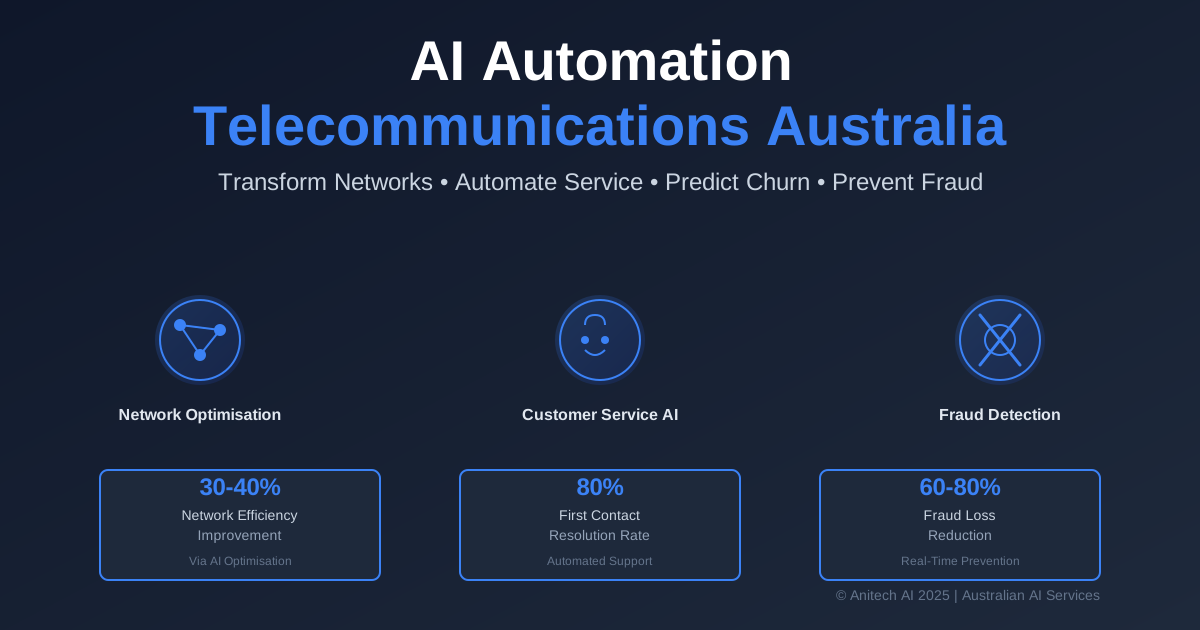
– 30-40% improvement in overall network efficiency
– 40-50% reduction in network incidents and customer-impacting outages
– 25% reduction in network operations staff required for real-time monitoring
– 15-20% improvement in spectrum utilisation
2. Predictive Network Maintenance
Rather than reacting to equipment failures, AI predicts them. Machine learning algorithms analyse equipment logs, performance metrics, and environmental data to identify components approaching failure state, enabling technicians to replace them during scheduled maintenance windows.
Key capabilities:
– Anomaly detection in equipment health signals
– Predictive failure identification 7-14 days in advance
– Maintenance scheduling optimisation
– Spare parts inventory optimisation
– Remote diagnostics and automated triage
Australian telco results:
– 35-45% reduction in emergency maintenance calls
– 50-60% reduction in unplanned network downtime
– 20-30% reduction in maintenance costs
– Improved network availability (99.95% → 99.98%)
3. AI Customer Service Automation
Conversational AI handles 60-80% of first-contact customer interactions without requiring human intervention. These systems understand natural language across voice, chat, email, and social media channels, resolve queries, and intelligently escalate complex issues.
Key capabilities:
– Natural language understanding across Australian English variants
– Omnichannel support (voice IVR, chatbots, messaging, social)
– Intelligent billing dispute resolution
– Outage detection and automated customer notification
– Plan change automation and self-service upgrades
– Technical troubleshooting workflows
Australian telco results:
– 75-85% first contact resolution for Tier-1 queries
– 40-50% reduction in call centre operating costs
– 30-40% improvement in customer satisfaction scores
– 5-7 second average resolution time for routine queries
4. AI Churn Prediction and Retention
Machine learning identifies customers at imminent risk of switching providers weeks before they actually leave. Telcos can then deploy targeted interventions—personalised offers, proactive service calls, loyalty rewards—to prevent defection.
Key capabilities:
– Multi-signal flight risk scoring (contract age, usage patterns, complaint history, competitive activity detection)
– Intervention recommendation engine
– Personalised offer generation
– Outcome tracking and intervention effectiveness measurement
– A/B testing of retention strategies
Australian telco results:
– 20-35% reduction in voluntary churn rate
– 15-25x ROI on retention campaign spend
– 10-15% improvement in customer lifetime value
– Accurate prediction of churn 30-60 days in advance
5. AI Fraud Detection and Revenue Assurance
AI detects fraudulent activity in real-time by identifying usage patterns that deviate from customer baselines. This catches SIM swap attacks, subscription fraud, and international revenue share fraud within minutes rather than weeks.
Key capabilities:
– Real-time usage anomaly detection
– SIM swap and identity fraud identification
– Subscription fraud (trial abuse, duplicate accounts) prevention
– International revenue share fraud detection
– Automated response workflows (account suspension, notification, investigation)
– Post-incident forensics and pattern learning
Australian telco results:
– 60-80% reduction in fraud losses
– Sub-second detection of fraudulent transactions
– 5-10 minute average incident response time
– ACMA compliance documentation and reporting
6. AI Workforce Optimisation for Network Operations
AI optimises shift scheduling, training deployment, and skill matching across network operations centres. This ensures that the right technicians with appropriate expertise are deployed to handle incidents, reducing mean time to resolution and improving service quality.
Key capabilities:
– Demand forecasting for network incidents
– Shift scheduling optimisation
– Skill-to-incident matching algorithms
– Training pathway recommendations
– Automated incident triage and assignment
Australian telco results:
– 20-25% improvement in mean time to resolution (MTTR)
– 15-20% reduction in network operations labour costs
– 30-40% improvement in first-time fix rate for technical issues
– Enhanced staff retention and job satisfaction
7. AI Network Planning and Capacity Forecasting
Machine learning predicts network capacity requirements across regions and demographic segments, enabling data-driven infrastructure investment decisions. This prevents over-provisioning in low-demand areas and under-provisioning in high-growth zones.
Key capabilities:
– Demand forecasting across regions and customer segments
– 5G rollout optimisation (site selection, equipment allocation)
– Fibre deployment planning (NBN complementarity analysis)
– Spectrum efficiency projections
– Capital expenditure optimisation
Australian telco results:
– 25-35% improvement in capital expenditure efficiency
– 40-50% reduction in stranded capacity
– 15-20% improvement in network planning accuracy
– 30-40% acceleration in new service rollout timelines
ACMA Regulatory Context: What Australian Telcos Must Know
The Australian Communications and Media Authority (ACMA) sets the regulatory framework within which all AI implementations must operate. Key considerations include:
Spectrum Management: ACMA manages spectrum allocation and licensing. AI systems that optimise spectrum usage must comply with licence conditions and frequency coordination rules. Any cross-border data flows related to spectrum management must respect ACMA oversight.
Consumer Safeguards: The Telecommunications Consumer Protections (TCP) Code, enforced by ACMA, requires that:
– Customers must be informed of material changes to services
– Billing accuracy is mandatory
– Customer data privacy is protected
– Service level targets are met or compensation provided
AI systems automating customer service must ensure TCP compliance. For example, when AI manages billing disputes, it must follow the same escalation and dispute resolution protocols that human agents follow.
Data Breach Notification: ACMA requires telecommunications providers to notify customers of data breaches affecting personal information. Any AI system processing customer data must include security measures appropriate to the data sensitivity level.
Switching and Number Portability: ACMA enforces rules enabling customers to switch providers and retain their phone numbers. AI systems must not create artificial barriers to switching or discriminate against customers attempting to port numbers.
Australian Data Sovereignty: While not formally mandated, ACMA encourages Australian telecommunications providers to store sensitive infrastructure and customer data within Australia. This affects where AI processing can occur and which cloud providers are acceptable.
Anitech AI’s telecommunications solutions are built with ACMA compliance as a foundational requirement, not an afterthought.
ROI Benchmarks: What Australian Telcos Can Realistically Expect
Based on implementations across the Australian market, here are realistic ROI benchmarks for AI across telecommunications:
Network Optimisation
- Investment: $2-5 million (implementation + 18 months of operation)
- Annual Benefit: $8-15 million (efficiency gains, prevented outages, reduced manual effort)
- ROI: 160-300% annually after year 2
- Payback Period: 4-8 months
Predictive Maintenance
- Investment: $1.5-3 million
- Annual Benefit: $4-8 million (reduced emergency maintenance, prevented downtime)
- ROI: 130-270% annually after year 2
- Payback Period: 5-10 months
Customer Service Automation
- Investment: $1-3 million (software + integration + training)
- Annual Benefit: $3-8 million (call centre cost reduction, improved satisfaction)
- ROI: 150-400% annually
- Payback Period: 3-6 months
Churn Prediction
- Investment: $800k-2 million
- Annual Benefit: $5-12 million (prevented churn, reduced acquisition costs)
- ROI: 300-800% annually after year 2
- Payback Period: 2-4 months
Fraud Detection
- Investment: $1-3 million
- Annual Benefit: $2-6 million (prevented fraud losses, regulatory compliance cost reduction)
- ROI: 100-300% annually
- Payback Period: 6-12 months
These benchmarks reflect mid-sized to large Australian telcos. Smaller ISPs and regional carriers may see different economics due to scale effects.
Implementation Guide: From Strategy to Operational AI
Successful AI implementation in telecommunications follows a proven path:
Phase 1: Assessment and Roadmap (Weeks 1-8)
Telcos should:
1. Audit current operations: Identify cost centres, manual processes, data availability, and technical infrastructure
2. Assess AI readiness: Evaluate data quality, integration capabilities, team skills
3. Prioritise use cases: Rank AI opportunities by ROI potential, implementation complexity, and strategic importance
4. Build business case: Calculate expected benefits, costs, timeline for top 3-5 use cases
5. Secure executive alignment: Ensure board-level support and budget approval
Phase 2: Pilot Implementation (Weeks 8-24)
Select one high-ROI, lower-complexity use case for initial deployment:
1. Secure data infrastructure: Ensure compliance with data governance, security, and privacy requirements
2. Prepare data: Clean, integrate, and label historical data for model training
3. Build and train models: Develop AI models using Australian telco-specific data
4. Create integration pathways: Connect AI systems to operational systems (network management, billing, CRM)
5. Establish monitoring: Build dashboards tracking model performance, business impact, compliance metrics
6. Run pilot: Deploy to limited customer/network segment; measure results against baseline
7. Iterate and improve: Refine models based on pilot performance; address integration issues
Phase 3: Scale and Expansion (Months 6-18)
Once pilot proves ROI:
1. Full deployment: Scale winning use case across entire operation
2. Add adjacent use cases: Layer in related AI capabilities (e.g., churn prediction + retention automation)
3. Integrate into workflows: Embed AI recommendations into human decision-making processes
4. Build internal capability: Train teams to manage, monitor, and optimise AI systems
5. Establish governance: Create policies for model updates, performance monitoring, compliance auditing
Phase 4: Continuous Optimisation (Ongoing)
- Monitor model drift: Track whether model performance degrades over time
- Retrain on new data: Update models monthly/quarterly with fresh operational data
- Expand use cases: Layer in additional AI opportunities as internal capability grows
- Measure business impact: Track ROI, customer impact, compliance metrics continuously
- Benchmark against peers: Compare performance metrics with industry standards
Addressing Key Implementation Challenges
Data Quality and Integration
Challenge: Australian telcos often have fragmented data across legacy billing systems, network management platforms, and customer relationship systems. Integrating this data is technically complex and time-consuming.
Solution: Invest in data integration infrastructure (modern data lakes/warehouses) that can ingest data from multiple sources, normalise it, and make it available to AI systems. This foundational investment enables faster AI deployment across multiple use cases.
Staff Skill Gaps
Challenge: Most Australian telco teams lack expertise in machine learning, data science, and AI operations.
Solution: Partner with specialised AI service providers (like Anitech AI) who bring deep telecommunications domain expertise and can augment internal teams. Simultaneously, invest in internal training to build AI literacy across technical and business teams.
Model Explainability and Trust
Challenge: Stakeholders (especially senior management and compliance teams) need to understand why AI systems make specific recommendations. Black-box AI is a regulatory and reputational risk.
Solution: Implement AI systems built on explainable models with clear decision pathways. Provide business users with dashboards showing model inputs, reasoning, and confidence levels. This transparency builds trust and enables faster adoption.
Change Management
Challenge: AI changes how teams work. Network operations centres accustomed to reactive incident response must shift to proactive monitoring. Customer service teams move from direct customer interaction to AI oversight. Staff resistance is natural.
Solution: Involve teams early in implementation. Focus messaging on how AI augments their capabilities rather than replacing them. Provide training and create clear career progression paths for staff adapting to new roles.
The Australian Competitive Landscape: Who’s Winning with AI
Telstra has invested heavily in AI-driven network optimisation and customer service automation, using it as a competitive differentiator. Optus has focused on customer data analytics and churn prediction following security challenges. TPG has leveraged AI for cost optimisation across merged operations (TPG and Vodafone). Smaller regional ISPs, however, often lack the capital and expertise to deploy sophisticated AI, creating a widening competitive gap.
This gap represents an opportunity. Regional carriers and mid-market ISPs that adopt targeted AI solutions can punch above their weight, delivering superior customer experience and operational efficiency.
What’s Next: AI and the Future of Australian Telecommunications
The next 18-24 months will see dramatic acceleration in AI adoption across Australian telcos. Key trends to watch:
- Autonomous Network Management: Fully autonomous networks that manage themselves with minimal human intervention
- Predictive Customer Engagement: AI that anticipates customer needs and proactively offers solutions
- AI-Driven Network Slicing: Intelligent allocation of 5G network resources based on real-time demand and revenue optimisation
- Edge AI: AI processing occurring at network edge (cell sites, fibre nodes) rather than centralised data centres, reducing latency and enabling real-time decisions
- Generative AI for Network Planning: Large language models trained on network data, industry standards, and regulatory requirements to automate network design and optimisation
Conclusion: AI as Competitive Necessity, Not Optional Technology
For Australian telecommunications providers, the question is no longer “Should we invest in AI?” but rather “How quickly can we implement AI to stay competitive?”
Telcos that act decisively in 2025—establishing AI-driven network optimisation, customer service automation, and churn prevention—will enter 2026 with significant competitive advantages: lower operational costs, superior customer experience, and higher profitability.
Those that delay will face margin pressure from more efficient competitors and increasing customer dissatisfaction.
Anitech AI partners with Australian telcos to navigate this transition, bringing domain expertise, proven methodologies, and technology solutions that drive rapid ROI while ensuring regulatory compliance and data sovereignty.
FAQ: Common Questions About AI in Australian Telecommunications
Q1: Will AI replace telco workers?
A: AI will transform roles rather than eliminate them. Routine work (network monitoring, billing inquiries, basic troubleshooting) will be automated, freeing teams to focus on higher-value activities: complex incident resolution, strategic network planning, enterprise customer management, and business development. Australian telcos report that AI adoption typically reduces headcount by 10-15% through attrition rather than layoffs, while shifting the skill mix toward technical roles.
Q2: How does ACMA regulate AI systems in telecommunications?
A: ACMA doesn’t currently regulate AI systems directly, but enforces regulations that AI systems must comply with. These include Consumer Safeguards (billing accuracy, service levels, dispute resolution), spectrum management rules, and data breach notification requirements. Telcos remain liable for AI decisions and outputs, so they must ensure AI systems operate within regulatory boundaries. Anitech AI builds compliance monitoring into all telecommunications solutions.
Q3: What’s the typical timeline from pilot to full deployment?
A: 12-18 months is typical for a large telco deploying a sophisticated use case like network optimisation. A simpler use case like customer service chatbots might be deployed in 4-6 months. The timeline depends on data readiness, integration complexity, regulatory approval processes, and change management requirements. Early pilots typically complete in 2-3 months.
Q4: How much data does an Australian telco need to train AI models?
A: It depends on the use case. Network optimisation models require 6-12 months of historical network data. Churn prediction models need 12-24 months of customer behaviour data. Fraud detection requires 6-12 months of transaction data including known fraud cases. Most large Australian telcos have sufficient historical data; the challenge is usually data quality and integration, not quantity.
Q5: Can smaller regional ISPs adopt AI, or is it only for Telstra/Optus/TPG?
A: Both can adopt AI, but at different scales. Large telcos may build custom AI models tailored to their specific network and customer base. Smaller ISPs can achieve fast ROI by adopting pre-built, configurable AI solutions (like those offered by Anitech AI) that work across different telecom environments. The ROI for smaller carriers is actually often higher because each percentage point of efficiency improvement has outsized impact on margins.
CTA: Transform Your Telecommunications Operations with AI
Australian telecommunications providers face unprecedented competitive pressure. The telcos that win in 2025-2026 will be those that leverage AI to optimise networks, automate customer service, and retain customers more effectively.
Anitech AI brings 200+ successful implementations and deep Australian telecommunications expertise to your transformation.
We partner with telcos to:
– Assess AI readiness and prioritise high-ROI opportunities
– Build and deploy AI models that drive measurable business impact
– Ensure ACMA compliance and Australian data sovereignty
– Train teams to manage and optimise AI systems long-term
Ready to explore how AI can transform your telco operations?
Schedule a confidential consultation with an Anitech AI telecommunications strategist.
Internal Links
- AI Network Optimisation for Australian Telecommunications
- AI Customer Service Automation for Australian Telcos
- AI Churn Prediction for Australian Telcos
- AI Fraud Detection for Australian Telcos
- AI Automation Guide for Australian Businesses
Further Reading
- AI Automation Australia — Complete Guide
- AI Network Optimisation for Australian Telecommunications: Self-Healing Networks That Perform
- AI Customer Service Automation for Australian Telcos: Resolving 80% of Calls Without a Human
- AI Churn Prediction for Australian Telcos: Retain Customers Before They Leave
- AI Network Fault Detection and Self-Healing Networks for Australian Telcos