
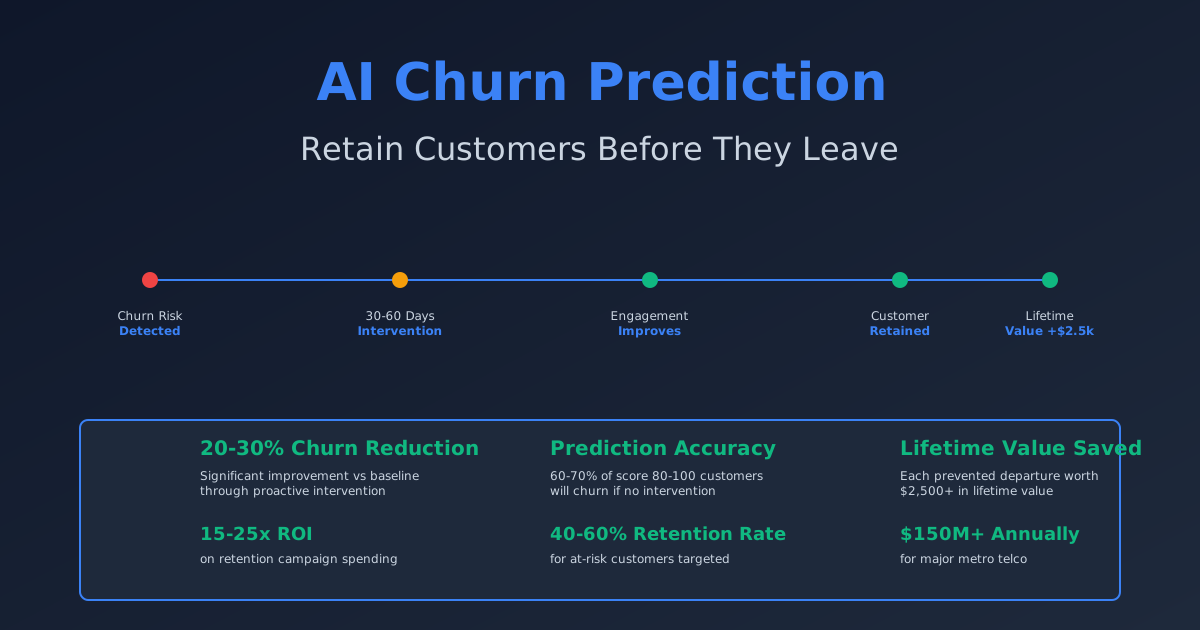
The Churn Crisis: Why Customer Retention Matters More Than Acquisition
For Australian telecommunications providers, customer churn is the financial equivalent of a slow-motion disaster. On its surface, 15-20% annual churn sounds almost acceptable. But the economics are devastating.
Consider a major Australian telco with 2 million customers:
The Churn Math:
– 2 million customers × 17% annual churn = 340,000 customer departures annually
– Average customer lifetime value: $2,500 per customer
– Lifetime value of churned customers: $850 million
– But that’s not the end. To maintain 2 million customers with 17% churn, the telco must acquire 340,000 new customers annually
– Customer acquisition cost: $150-250 per customer
– Total acquisition spend: $51-85 million annually
Compare to Retention:
– Cost to retain an at-risk customer: $30-50 per customer (through targeted offers, service improvements, loyalty rewards)
– If a telco can prevent just 20% of churn (68,000 customers annually) at a cost of $40 per customer:
– Retention cost: $2.7 million
– Lifetime value preserved: $170 million
– ROI: 6,200%
This is why churn prediction has become critical infrastructure for Australian telcos. Customer retention through prediction and proactive intervention generates returns that few other business initiatives can match.
How AI Predicts Churn: The Science Behind Customer Flight Risk
Churn prediction relies on identifying patterns that precede customer departure. Modern machine learning algorithms analyse hundreds of signals simultaneously:
Key Churn Signals
1. Contract and Tenure Signals
– Customers approaching contract expiry are 10-15x more likely to churn
– Customers with 6-12 months remaining on contracts show increasing flight risk
– Customers with very long tenure (3+ years) actually show lower churn (lock-in effect)
– Customers with “sticky” contracts (auto-renewal) have lower churn than those with expiring contracts
2. Usage Pattern Changes
– Sudden reduction in data usage often indicates customer switching to competitor (testing new network)
– Call volume changes (increasing calls to competitors’ voicemail systems detected via bill analysis)
– Night usage patterns changing (moving from heavy evening usage to minimal usage)
– Weekend usage dropping (weekend was primary usage period, now declining)
3. Complaint and Service Patterns
– Number of complaints in past 6 months is strong churn predictor
– Type of complaints matters: technical complaints (often fixable) are lower risk than billing complaints (often indicate price sensitivity)
– Service quality incidents affecting customer (dropped calls, slow speeds) correlate with churn
– Escalations to senior management indicate high frustration level
4. Billing and Payment Patterns
– Customers consistently on budget plans are more price-sensitive (higher churn risk)
– Customers negotiating price reductions are considering switching
– Late payment patterns (paying 10+ days late) indicate financial stress or engagement decline
– Customers with multiple disputes (particularly billing disputes) show 3-4x higher churn
5. Competitive Activity Signals
– Telcos can’t directly observe competitor interactions, but indirect signals help:
– Large increase in voicemail messages to competitors (detected via call pattern analysis)
– Online activity (visiting competitor websites from known customer IP addresses)
– Social media sentiment (what customers post about their service)
– Competitive offer redemption (if offered discount from competitor via email)
6. Demographic and Segmentation Signals
– New customers (first 3 months) have naturally higher churn; churn stabilises after 12 months
– Business customers (higher contract value) have different churn patterns than consumer
– Geographic location matters (urban vs. rural, competitive intensity varies by area)
– Age cohorts show different churn patterns
The Churn Prediction Model
Machine learning algorithms (typically random forests or gradient boosting algorithms) combine these hundreds of signals into a single “churn risk score” (0-100, where 100 = customer almost certainly churning within 30-90 days).
A typical model produces:
– Score 80-100: 60-70% of these customers will churn within 30-90 days if no intervention occurs
– Score 60-80: 30-40% churn probability; these customers are genuinely at-risk
– Score 40-60: 10-20% churn probability; these are medium-risk customers worth monitoring
– Score 0-40: <10% churn probability; low-risk, retention is not urgent
This scoring allows telcos to prioritize interventions toward highest-risk customers, maximizing ROI on retention spend.
Real-World Australian Telco Results
Based on churn prediction implementations across major Australian carriers:
Before vs. After Churn Prediction
Baseline (without churn prediction):
– Annual customer churn: 18%
– Churn by segment:
– New customers (0-3 months): 5-7% monthly churn (35-40% annual)
– Established customers (1-3 years): 1.2% monthly churn (14% annual)
– Long-term customers (3+ years): 0.7% monthly churn (8% annual)
With Churn Prediction and Targeted Retention:
– Annual customer churn: 12-15% (20-25% reduction)
– Churn by segment:
– New customers: 2-3% monthly churn (improved to 28-35% annual through targeted onboarding)
– Established customers: 0.8% monthly churn (10% annual)
– Long-term customers: 0.5% monthly churn (6% annual)
Financial Impact
For a 2 million customer telco with 18% baseline churn:
Without Churn Prediction:
– Annual departures: 360,000 customers
– Lifetime value lost: $900 million
– Acquisition cost to maintain base: $54-90 million
With Churn Prediction (achieving 15% churn):
– Annual departures: 300,000 customers
– Lifetime value lost: $750 million
– Improvement: $150 million in preserved lifetime value
– Intervention cost: ~$3-5 million (targeting 60,000 high-risk customers)
– Net benefit: $145-147 million annually
ROI: 3,000-4,500% annually
Intervention Playbooks: From Prediction to Action
Predicting churn is only half the battle. The critical next step is intelligent intervention—offering the right incentive to the right customer at the right time.
Intervention Framework
Step 1: Score customers (continuous, weekly updates)
Machine learning models score all customers based on hundreds of signals.
Step 2: Identify intervention candidates
Filter scores to identify:
– Customers with score >60 (genuinely at-risk)
– Customers with margin sufficient to support retention investment (unprofitable customers should churn)
– Customers not currently in retention campaigns (avoid redundancy)
– Customers in different life stages (new, established, long-term)
Step 3: Select optimal intervention
Different customers respond to different interventions:
For price-sensitive customers:
– Data plan upgrade: “You’re approaching your data limit. Upgrade to unlimited data for just $5/month extra”
– Promotional discount: “As a valued customer, here’s 20% off your plan for 3 months”
– Volume-based loyalty: “You’ve been a customer for 2 years. Here’s a $20/month discount through your anniversary date”
For service-dissatisfied customers:
– Service quality improvement: “We’re upgrading network speeds in your area. Here’s priority access to faster plans”
– Network coverage: “Your area now has 5G coverage. Try it free for 1 month”
– Technical support: “We’ve identified a coverage issue affecting you. Our technician will visit to optimise your setup”
For feature-seeking customers:
– New services: “You’re eligible for our new IoT connectivity service at 50% off for 6 months”
– Bundling: “Add home internet and save 15% on your bundled plan”
– Premium features: “You’re eligible for priority customer support (normally $5/month) free for 3 months”
For contract-expiring customers:
– Early renewal: “Your contract expires in 4 months. Renew early and lock in current pricing”
– Incentivised renewal: “Renew early and receive $50 credit toward device upgrade”
Step 4: Deliver intervention
Multi-channel delivery depending on customer preference:
– SMS: “Quick update—your plan expires in 90 days. Lock in current pricing [link]”
– Email: Personalised retention offer with customised content
– Voice call: High-value customers (score >80) receive proactive service calls
– In-app notification: If customer uses self-service app
– Social media: Targeted ads for high-value churn-risk customers
Step 5: Track outcomes
For each intervention:
– Did the customer accept the offer?
– What was the impact on churn probability (before vs. after)?
– What was the cost of retention vs. value preserved?
– What interventions are most effective for which customer segments?
Step 6: Optimise
Monthly analysis identifies:
– Which interventions drive highest ROI
– Which customer segments respond best to which offers
– What timing (30 days before expected churn, 60 days, 90 days) drives best response
This continuous optimisation means retention campaigns become more effective over time.
Churn Prediction Success Case Studies: Australian Telco Examples
Case 1: Major Metro Carrier—Contract Expiry Management
Challenge: Customers with expiring contracts show dramatic churn spike 30-90 days before expiry. The telco was reactive (waiting for customers to call) rather than proactive.
Solution: Churn prediction model identified all customers with <120 days until contract expiry. Ranked by churn risk. Delivered proactive offers 90 days before expiry.
Results:
– Churn in expiry window: 28% → 18% (36% reduction)
– Average retention offer cost: $35 per customer
– Customers retained: 9,600 per quarter
– Quarterly lifetime value preserved: $24 million
– Intervention cost: $336k per quarter
– Quarterly ROI: 7,000%
Case 2: Regional ISP—New Customer Retention
Challenge: 40% of new customers in first 3 months churned. Regional ISP couldn’t afford to lose that many customers. Acquisition cost was $200 per customer; if 40% churn, effective acquisition cost was $333 per retained customer.
Solution: Churn prediction model trained specifically on new customer behaviour. Identified that customers making 3+ support calls in first month, or reporting slow speeds, were likely to churn. Implemented proactive retention:
– Free network optimisation visit (technician checks setup)
– Free speed test and results explanation
– Plan feature education (showing what customer is eligible for)
– Loyalty credit ($10/month discount) for first year
Results:
– New customer churn (first 3 months): 40% → 15%
– Cohort retention improvement: 25 percentage points
– Retention spend per customer: $45
– ROI on retention spend: 4,500%
– Effective acquisition cost for retained customers: reduced from $333 to $235
Case 3: Business Customer Retention
Challenge: High-value business customers (ARPU $150+/month) were churning to competitors offering bundled services. Telco was losing 8-10 such customers monthly, representing $150k+ monthly revenue loss.
Solution: Churn prediction model flagged business customers showing:
– Increased calls to competitor service lines
– Requests for quote information
– Reduced usage despite growing business (indicating customer testing competitor network)
For these customers, telco deployed high-touch retention:
– Business account manager (direct relationship)
– Custom bundling (internet + voice + mobile + IoT)
– Quarterly business reviews
– Proactive network upgrades as business grows
Results:
– High-value customer churn: 8/month → 2/month
– Monthly revenue preserved: $90k
– Annual lifetime value preserved: $1.08 million
– Retention cost (account management): $150k annually
– Annual ROI: 620%
ACMA Telecommunications Switching Regulations Context
Churn prediction operates within the regulatory framework set by ACMA’s Consumer Safeguards and Switching Rules.
Key considerations:
1. Right to Switch: ACMA enforces number portability—customers can switch to competitors while retaining phone numbers. AI churn prediction cannot create barriers to switching. Telcos cannot:
– Require porting fees (outside ACMA limits)
– Lock customers into contracts without clear disclosure
– Penalise customers for leaving
2. Contract Transparency: Any renewal or contract modification offered as part of churn prevention must be clear. A customer accepting a retention offer must understand:
– New contract term length
– Pricing for duration of term
– Early termination fees (if applicable)
– Right to cancel
3. Billing Accuracy: Retention offers must generate accurate billing. If a telco offers “$10/month discount for 12 months,” the system must apply the discount consistently and charge correctly.
4. Consumer Safeguards: ACMA requires that customers receive accurate information and aren’t misled. Churn prediction models must not:
– Suggest customers are leaving when they aren’t
– Offer fake discounts (that don’t actually apply)
– Hide terms in fine print
5. Privacy: Churn prediction requires analysing customer usage data. Telcos must comply with Privacy Act and disclose to customers how their data is used. Models should not make decisions based on sensitive attributes (age, ethnicity, etc.).
Best practice: Design churn prediction to operate transparently. When retention offers are made, clearly explain the offer terms, duration, and any contract changes. Enable customers to easily opt out.
Implementation Path: From Baseline to Predictive Retention
Phase 1: Foundation (Weeks 1-8)
- Define churn: Clarify what “churn” means (voluntary departures only? Include disconnects for non-payment?)
- Prepare data: Collect 12-24 months of historical customer data including:
- Customer demographics and tenure
- Usage patterns (calls, data, SMS)
- Service quality and incidents
- Complaints and support interactions
- Billing and payment information
- Contract status
- Baseline measurement: Measure current churn rate by segment; understand seasonal patterns
- Business alignment: Define success metrics—what churn reduction target is realistic and valuable?
Phase 2: Model Development (Weeks 8-20)
- Feature engineering: Transform raw data into predictive signals (e.g., “change in usage” rather than raw usage number)
- Model training: Train churn prediction models on historical data
- Model validation: Test models on holdout data; measure prediction accuracy
- Identify intervention opportunities: For customers predicted to churn, analyse what would likely prevent churn
Phase 3: Pilot Interventions (Weeks 20-32)
- Select high-risk cohort: Take top 10-15% of predicted churn-risk customers
- Randomised testing: Split cohort into test (receives retention offer) and control (no offer). Measure impact
- Measure outcomes: Track whether retention interventions actually prevent churn
- Calculate ROI: Compare cost of retention offers to value of prevented churn
Phase 4: Scaling and Optimization (Months 8+)
- Full deployment: Expand to all high-churn-risk segments
- Multi-channel delivery: Deliver offers via SMS, email, voice, app notifications
- Continuous improvement: Monthly analysis of intervention effectiveness; adjust offers and targeting
- Segment optimization: Different interventions for different customer segments; personalise offers
Implementation Challenges and Solutions
Challenge 1: Data Quality and Integration
Problem: Customer data is fragmented across legacy systems (billing, network, CRM). Integrating and cleaning this data is time-consuming.
Solution: Invest in data integration infrastructure (data warehouse or lake). Most telcos find that 60-70% of their data quality issues disappear once data is properly integrated and validated.
Challenge 2: Causality vs. Correlation
Problem: A churn prediction model might identify that “customers who call support frequently churn more.” But is support calls causing churn (bad experience), or is it that customers experiencing problems call support and then churn? These require very different interventions.
Solution: Use causal inference techniques and randomised testing. In a pilot, give retention offers to half of at-risk customers and not to the other half. This reveals true causal impact.
Challenge 3: Offer Fatigue
Problem: If telco bombards customers with retention offers, customers become numb and offers lose effectiveness.
Solution: Limit offers to high-risk customers. Throttle offers frequency (no more than 1 per customer per 90 days unless they’ve explicitly re-engaged). Track offer acceptance rates and adjust strategy if rates decline.
Challenge 4: Fairness and Discrimination Risk
Problem: Churn prediction models can inadvertently discriminate. For example, if the model discovers that customers in low-income postcodes churn more, it might deprioritise retention spending for those customers (even though they’re just as valuable).
Solution: Regularly audit models for fairness. Ensure retention offers are not systematically withheld from protected groups. Consider fairness constraints in model training to prevent discrimination.
Cost and ROI: The Business Case
Implementation Investment
- Data integration and preparation: $400k-800k
- Model development: $300-600k
- Intervention platform and tools: $500k-1M
- Testing and pilots: $200-400k
- Total: $1.4-2.8M
Ongoing Operating Costs
- Model maintenance and retraining: $200-400k annually
- Retention offer costs: $3-5M annually (for major telco with 2M customers)
- Platform and tools: $300-500k annually
- Total: $3.5-5.9M annually
Benefits Realisation
Churn reduction: 20-30% reduction in customer churn
For a 2M customer telco with $2,500 average customer lifetime value and 18% baseline churn:
– Baseline churn: 360,000 customers = $900M lifetime value lost annually
– Improved churn (15%): 300,000 customers = $750M lost
– Lifetime value preserved: $150M annually
Acquisition cost reduction: With lower churn, need fewer new customer acquisitions. Typical acquisition cost $150-250, so reducing churn by 60,000 customers saves $9-15M annually.
Improved profitability: Retained customers have higher lifetime value and lower service costs (they’re already integrated into the network).
Total annual benefit: $150-180M (for major telco)
ROI: 2,500-5,000% annually (after year 2)
For smaller regional telcos (100k-500k customers), ROI is proportionally higher because the intervention costs stay relatively fixed.
What’s Next: The Future of Predictive Retention
Generative AI for Personalised Offers: Rather than choosing from pre-set retention offers, generative AI will create personalised, unique offers for each customer based on their specific situation and preferences.
Predictive Intervention Timing: AI will identify not just which customers will churn, but optimal timing for interventions (too early = customer not yet motivated; too late = customer already mentally left).
Cross-Telco Competitive Intelligence: AI will identify customers beginning to adopt competitors’ services (detected through indirect signals like changing usage patterns) and intervene before churn risk becomes imminent.
Lifetime Value Optimisation: Rather than churn prediction alone, AI will optimise for customer lifetime value—sometimes this means letting unprofitable customers churn, and investing retention spend on high-value customers.
Conclusion: Churn Prediction as Strategic Necessity
For Australian telecommunications providers, churn prediction has moved from “nice to have” to strategic necessity. The ROI is extraordinary—few business initiatives generate 2,500%+ returns consistently.
Telcos that deploy churn prediction in 2025 will dramatically improve profitability and customer relationships. Those that delay will see competitors pulling away on both metrics.
FAQ: Churn Prediction Questions
Q1: How far in advance can churn be predicted?
A: Accurate prediction typically occurs 30-90 days before actual churn. Very far in advance (6+ months), prediction accuracy drops significantly because customer circumstances change. Typical workflow: predict 60 days out, intervene 45 days out, measure results at 90 days.
Q2: What if a customer ignores retention offers?
A: That’s valuable information. A customer ignoring multiple offers is likely genuinely committed to switching. At that point, retention efforts should stop (no point throwing more money at someone already decided). The system learns that certain customer segments don’t respond to certain offer types.
Q3: How does churn prediction work for new customers who don’t have much history?
A: New customer churn is more difficult to predict with traditional models (limited historical data). But new customers do exhibit early behaviour patterns that predict churn. Early support calls, for example, correlate with churn risk. Models can be trained specifically for new customer segments using these early signals.
Q4: Could churn prediction manipulate customers unfairly?
A: Potentially yes—it’s important to design systems ethically. Avoid manipulative practices like fake scarcity offers, deliberately confusing pricing, or targetted unfair discounts. Instead, focus on genuine value—better service, fair pricing, improved network quality. Transparent, fair retention is both ethical and more effective long-term.
Q5: How often should churn models be retrained?
A: Monthly retraining is typical. Business conditions change (new competitors, new services, seasonal patterns), so models trained only once become less accurate over time. Monthly retraining, with quarterly review of model performance and fairness, keeps the system effective.
CTA: Reduce Churn with AI
Every customer that churns represents millions of dollars in lost lifetime value. Yet most Australian telcos wait until customers leave to realise there was a problem.
Anitech AI brings churn prediction and retention expertise that has helped Australian telcos reduce churn by 20-30%, preserving $150M+ annually per major carrier.
We help you:
– Build churn prediction models using your customer data
– Design intervention playbooks tailored to your customer segments
– Deploy multi-channel retention campaigns
– Measure and continuously optimize retention ROI
Ready to stop losing customers and start building lasting relationships?
Schedule a confidential customer retention strategy consultation with Anitech AI.
Internal Links
- AI Automation in Telecommunications: The Australian Telco Guide
- AI Customer Service Automation for Australian Telcos
- AI Network Optimisation for Australian Telecommunications
- AI Fraud Detection for Australian Telcos
- AI Automation Guide for Australian Businesses
Further Reading
- AI Automation Australia — Complete Guide
- AI Automation in Telecommunications: The Australian Telco Guide (2025) — Industry Guide
- AI Network Optimisation for Australian Telecommunications: Self-Healing Networks That Perform
- AI Customer Service Automation for Australian Telcos: Resolving 80% of Calls Without a Human
- AI Network Fault Detection and Self-Healing Networks for Australian Telcos
- AI Revenue Assurance for Telcos: Plugging Leakage, Boosting Margins