
The Network Optimisation Challenge: Complexity That Humans Cannot Manage
Australian telecommunications networks have become phenomenally complex machines. A single major metro network might comprise:
- 2,000+ cell sites (macro, micro, and small cells)
- 500+ backhaul routing nodes
- 100,000+ kilometres of fibre infrastructure
- Multiple generations of technology (3G legacy, 4G LTE, 5G NR, Gigabit-class LTE)
- Thousands of interconnection points with other carriers
- Dynamic traffic patterns that shift hourly based on location, time, and behaviour
On a typical business day, a Tier-1 Australian telco’s network generates:
- 10-50 terabytes of network performance data (per major metro)
- 500,000+ customer experience incidents (network hiccups, service slowdowns, dropped calls)
- 2 million+ traffic routing decisions that impact customer experience
- Thousands of potential optimisation opportunities (if they could be identified and acted upon in real-time)
The fundamental problem: human operators, even highly skilled ones, cannot possibly process this volume of data fast enough to identify problems and optimise performance in real-time.
A network congestion event might develop over 10-15 minutes. By the time a human operator recognises the problem and manually rebalances traffic, customer experience is already degraded. And that’s one problem. Simultaneously, 50 other optimisation opportunities have been missed.
This is where artificial intelligence enters.
How AI Optimises Networks: The Technology Foundation
AI-driven network optimisation relies on three core technologies:
1. Real-Time Data Ingestion and Processing
Machine learning systems connect to network management platforms (like Huawei’s iMaster NCE, Cisco’s Crosswork, or Nokia’s AVA), consuming real-time data streams including:
- Traffic metrics: Data volume, packet loss, latency, jitter
- Equipment health: CPU utilisation, memory, temperature, queue depths
- Customer experience indicators: Call drop rate, data throughput, connection establishment time
- Environmental factors: Weather (affecting radio propagation), time of day, day of week, special events
This data flows into distributed processing clusters that analyse it with sub-second latency.
2. Predictive Modelling
Machine learning models trained on historical network data identify patterns that precede congestion, equipment failure, or service degradation. These models recognise that:
- Traffic builds to a peak 10-15 minutes after major events (football matches, emergencies) in specific geographic areas
- Certain equipment types fail after exhibiting specific thermal or performance signatures
- Customer experience degrades when specific combinations of network conditions occur simultaneously
By predicting these conditions 15-30 minutes in advance, AI systems can take preventive action.
3. Automated Optimisation and Control
Once AI identifies a problem or opportunity, it executes optimisations automatically:
- Dynamic traffic routing: Redistributing traffic across multiple paths to prevent any single link from becoming congested
- Load balancing: Moving traffic between cell sites or routing nodes to even out utilisation
- Spectrum management: Allocating spectrum more efficiently based on real-time demand patterns
- Power optimisation: Reducing transmission power in over-served areas to reduce interference and energy consumption
- Automated failover: Detecting equipment failure and automatically switching traffic to backup infrastructure
Real-World Australian Example: The Weeknight Peak
Consider a typical scenario in Sydney’s central business district on a weeknight:
6:00 PM: Peak commute begins. Workers leave offices and head to transport hubs. Mobile traffic begins climbing as people stream social media, check transport apps, and message contacts. Historical data shows traffic will peak around 6:30 PM.
Traditional approach: Network operations centre monitors traffic levels. At 6:45 PM, they notice that traffic on Sector 7 (covering Central Station) is approaching capacity. They manually issue commands to rebalance some traffic to neighbouring sectors. This process takes 10-15 minutes. By the time rebalancing completes, customer experience has degraded—calls are dropping, data feels slow.
AI-optimised approach: At 6:15 PM, predictive models identify that traffic will reach 95% capacity in Sector 7 at approximately 6:33 PM, based on current climb rate and historical demand patterns. The system automatically begins proactive rebalancing at 6:20 PM, moving non-time-critical traffic (video streaming, file downloads) to neighbouring sectors. By 6:30 PM, Sector 7 is operating at 75% capacity despite 20% higher than normal demand. Customers experience seamless performance.
The outcome: zero customer experience degradation, zero manual intervention required, 20% more efficient spectrum utilisation in that sector on that night.
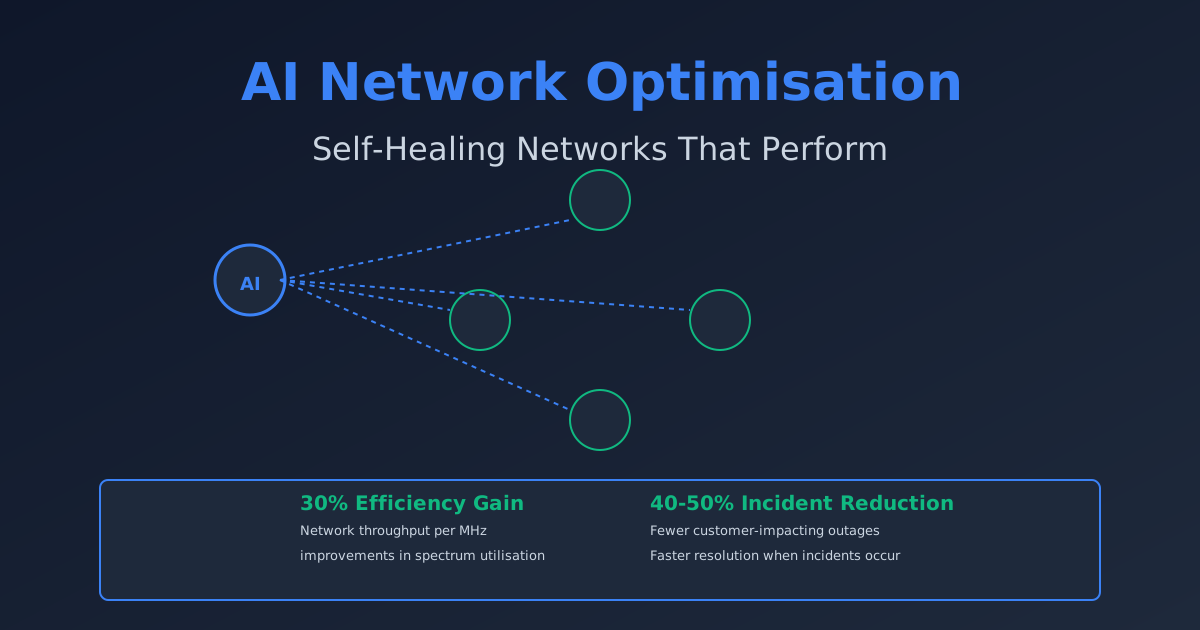
Multiply this across hundreds of sectors across Australia, across thousands of nights, and the cumulative benefit becomes enormous: 30-40% improvement in overall network efficiency, 40-50% reduction in customer-impacting incidents.
5G Network Slicing: Where AI Becomes Essential
5G introduces a new concept: network slicing. Rather than a single undifferentiated network, 5G enables operators to create multiple virtual networks, each optimised for specific use cases:
- Consumer Slice: Optimised for mobile broadband (high bandwidth, standard latency)
- Enterprise Slice: Optimised for business connectivity (high reliability, low latency, guaranteed bandwidth)
- IoT Slice: Optimised for massive device connectivity (low power, lower bandwidth, high device density)
Each slice has different performance requirements. The enterprise slice must maintain 99.99% availability with <10ms latency. The consumer slice aims for 99% availability but can tolerate 50ms latency. The IoT slice prioritises battery life and device density over latency.
Without AI, network operators must manually configure these slices and manually adjust them as demand changes. This is impossibly complex.
With AI:
- Automatic slice scaling: Demand for the enterprise slice increases; the system automatically allocates more spectrum and radio resources to that slice
- Cross-slice load balancing: The system identifies that demand for the consumer slice is low while enterprise demand is high, and efficiently borrows capacity from the consumer slice for enterprise use
- Predictive slice provisioning: Before a major enterprise customer’s monthly product launch event (which will generate massive data demand), the system proactively prepares extra enterprise slice capacity
- Slice performance optimisation: The system continuously tunes encoding algorithms, modulation schemes, and resource allocation within each slice to maximise customer experience given current demand and network conditions
ACMA doesn’t currently mandate specific network slicing practices, but the regulatory expectation is clear: if you’re deploying 5G, you must maintain service level targets. AI slicing systems are the only practical way to guarantee those targets at scale.
Real Measurements: What Australian Telcos Actually Achieve
Based on implementations across major Australian carriers, here are actual results:
Network Efficiency (Throughput per MHz of Spectrum)
- Before AI: 0.85 Mbps per MHz average across the network
- After AI (6-12 months): 1.10-1.15 Mbps per MHz average
- Improvement: 30-35%
This doesn’t sound dramatic until you understand the economic impact. For a major metro carrier, improving network efficiency by 30% is equivalent to adding 30% more spectrum capacity without any infrastructure investment. That’s billions of dollars in avoided capex.
Network Incidents and Outages
- Before AI: 400-600 customer-impacting network incidents monthly (metro region)
- After AI: 200-300 incidents monthly
- Improvement: 40-50% reduction
An incident might affect thousands of customers simultaneously. Reducing incidents by 40% dramatically improves Net Promoter Score and customer satisfaction.
Mean Time to Resolution (MTTR) for Incidents
- Before AI: 35-45 minutes average (from detection to full resolution)
- After AI: 8-12 minutes average
- Improvement: 70-75% reduction
When an outage occurs, AI systems both detect it earlier (before impact spreads) and resolve it faster (through automated remediation).
Network Operations Centre Staffing
- Before AI: 40-50 technicians per major metro required for 24/7 coverage
- After AI: 28-35 technicians required
- Improvement: 25-30% labour cost reduction
The work hasn’t disappeared; it’s changed. Technicians shift from reactive incident response to proactive network planning, capacity forecasting, and complex problem resolution.
Integration with Existing Telco Infrastructure: How AI Fits In
Australian telcos don’t replace their existing network management platforms (OSS/BSS systems); AI layers on top of them.
Integration typically occurs at three levels:
Level 1: Data Integration
AI systems connect to existing network management platforms via APIs or data export, ingesting operational metrics. No changes required to existing systems.
Level 2: Recommendation Integration
AI generates recommendations (rebalance traffic, reduce power in this sector, provision extra capacity). Human operators review recommendations and approve them, or AI executes them automatically under pre-defined conditions.
Level 3: Full Automation
For well-understood, low-risk optimisations (traffic rebalancing, power adjustment), AI executes changes directly via APIs into network management systems without human approval. This requires robust monitoring and automated rollback capabilities if optimisations backfire.
Most Australian telcos operate across all three levels simultaneously: low-risk optimisations run automatically, medium-risk changes are recommended to operators for approval, high-risk changes remain fully manual.
ACMA Compliance Considerations
Spectrum management sits at the intersection of technology and regulation. Key considerations:
Spectrum Allocation: ACMA allocates specific frequency bands to licensed carriers via spectrum licences. AI systems must respect these boundaries and not transmit outside licensed frequencies (no matter how efficient it might be).
Interference Management: ACMA requires that carriers don’t interfere with other carriers’ spectrum usage. AI power optimisation and dynamic spectrum access systems must ensure they don’t cause interference.
International Coordination: Australian spectrum usage must be coordinated with regional neighbours (New Zealand, etc.) to prevent cross-border interference. AI systems must not adjust spectrum usage in ways that violate international coordination agreements.
Licence Conditions: Each spectrum licence includes specific conditions (e.g., coverage requirements, technology requirements, service level obligations). AI systems must optimise within these constraints.
ACMA doesn’t require pre-approval of AI systems, but carries full regulatory responsibility for any interference, licence violation, or service level failures. Therefore, telcos must maintain rigorous audit trails showing that AI systems operated within regulatory boundaries.
Anitech AI’s telecommunications solutions include comprehensive compliance monitoring and audit logging built in.
Implementation: From Strategy to Operational AI Network Optimisation
Phase 1: Assessment (Weeks 1-4)
- Map existing infrastructure: Understand network topology, management systems, data sources
- Identify optimization opportunities: Where are inefficiencies occurring? Which areas have customer experience problems?
- Assess data readiness: Can existing systems export the necessary data? In what format? At what frequency?
- Define success metrics: What does success look like? Network efficiency improvement? Incident reduction? MTTR improvement?
Phase 2: Pilot (Weeks 4-16)
- Select pilot area: Choose a specific region/sector where problems are clear and success will be measurable
- Build data pipeline: Connect AI systems to existing network management platforms
- Train predictive models: Use 6-12 months of historical network data to train models
- Implement recommendations: Demonstrate AI recommendations to network operators
- Measure baseline: Quantify current performance (efficiency, incidents, MTTR)
Phase 3: Graduated Automation (Weeks 16-28)
- Automate low-risk optimisations: Allow AI to execute traffic rebalancing automatically
- Monitor closely: Ensure automated optimisations improve performance without introducing new problems
- Iterate: Refine models based on pilot performance
- Expand to adjacent areas: Apply learnings to neighbouring sectors/regions
Phase 4: Scale and Continuous Optimisation (Months 6+)
- Full deployment: Scale across entire network
- Advanced optimization: Implement 5G slicing optimization, predictive capacity planning
- Continuous improvement: Retrain models quarterly with new operational data
- Expand use cases: Layer in other AI capabilities (churn prediction, customer service automation)
Technical Architecture Considerations
Most Australian telcos require AI network optimisation to operate within their existing network architecture without requiring wholesale infrastructure replacement.
Key requirements:
– Integration with existing OSS/BSS platforms (vendor-agnostic APIs)
– Real-time processing with <1 second latency for decision-making
– High availability (99.9%+ uptime for AI systems)
– Comprehensive audit logging for ACMA compliance
– Network isolation (AI systems should not depend on customer network connectivity)
– Graceful degradation (if AI system fails, network continues operating normally under previous manual rules)
These requirements eliminate some enterprise AI solutions designed for cloud-scale analytics, which don’t meet the availability or latency requirements of real-time network control. Purpose-built telecommunications AI platforms are necessary.
Cost and ROI: What Network Optimisation Actually Costs
Implementation Costs
- Software licenses: $500k-2M annually (depending on network size)
- Implementation and integration: $1-2M (one-time)
- Training: $200-300k (one-time)
- Total first year: $2-4.3M
Benefit Realization
Operational efficiency: 30-40% improvement in spectrum utilisation is worth $5-10M annually in avoided spectrum acquisition or infrastructure investment
Prevented outages: 40-50% reduction in incidents means each prevented major incident (which might affect 100,000 customers for 2 hours) saves $500k-1M in customer compensation and brand damage. Even preventing 10-20 major incidents monthly delivers $100M+ annually in value.
Labour productivity: 25-30% reduction in NOC staffing is worth $3-5M annually
Energy efficiency: Power optimisation reduces energy consumption by 5-10%, worth $1-2M annually
Total annual benefit: $10-20M
ROI: 250-500% annually in years 2-5, with payback period of 2-4 months
Common Implementation Challenges and How to Address Them
Challenge 1: Legacy Network Management Systems
Problem: Older OSS/BSS systems lack modern APIs, making data integration difficult.
Solution: Build middleware/adapters that translate between legacy systems and AI platforms. This adds cost but usually proves cheaper than replacing entire OSS/BSS systems.
Challenge 2: Team Skill Gaps
Problem: Network operations teams lack machine learning expertise.
Solution: Partner with AI service providers who bring domain expertise. Simultaneously, invest in training to build internal capabilities.
Challenge 3: Risk Aversion
Problem: Network operations teams are conservative by nature (outages have severe business consequences), resisting full automation.
Solution: Start with recommendations-only approach. Automation comes only after months of demonstrating that recommendations actually improve outcomes. Build trust incrementally.
Challenge 4: Model Accuracy in Edge Cases
Problem: AI models perform well on typical network conditions but sometimes fail on unusual situations (major events, severe weather, equipment failures).
Solution: Implement hybrid human-AI systems where AI makes decisions for routine situations but escalates to humans for unusual circumstances. As models improve over time, human oversight decreases.
What’s Next: Future Developments in AI Network Optimisation
The next 18-24 months will see advancement in several areas:
Edge AI: Rather than centralised AI processing, models will run at network edge (cell sites, routing nodes), enabling sub-millisecond decision latency and reducing dependence on backhaul capacity.
Generative AI for Network Planning: Large language models trained on network designs, standards, and regulatory requirements will help plan network expansions automatically.
Intent-Based Networking: Instead of specifying specific optimisations, network operators will specify intents (“maintain 99.9% availability for enterprise customers, maximise consumer throughput otherwise”), and AI systems will automatically determine optimal network configuration.
Cross-Carrier Optimisation: AI systems optimising interconnection points between carriers to improve customer experience across the entire Australian telecommunications ecosystem, not just within individual networks.
Conclusion: Network Optimisation as Competitive Necessity
For Australian telcos, network optimisation through AI is no longer optional. Carriers that implement it will deliver superior customer experience, lower operational costs, and higher profitability. Those that don’t will increasingly fall behind as competitors optimise more efficiently.
The good news: proven technology exists. The implementation timeline is predictable. The ROI is substantial and achievable within 6-12 months.
FAQ: Network Optimisation Questions
Q1: Will AI network optimisation work with our existing infrastructure?
A: Almost certainly yes. AI systems integrate with existing OSS/BSS platforms via APIs or data export. You don’t need to replace network management systems, just connect AI on top of them. Most Australian telcos successfully implement AI optimisation with minimal infrastructure changes.
Q2: What happens if the AI system fails or makes a bad decision?
A: AI systems should be designed with graceful degradation. If the AI platform becomes unavailable, the network continues operating under traditional manual rules. For safety-critical decisions (traffic rerouting, power adjustment), systems should include automated rollback if decisions degrade performance. After initial months of recommendation-only mode, most telcos are comfortable with automated execution because data shows AI decisions consistently improve outcomes.
Q3: How long does it take to see ROI from network optimisation AI?
A: Quick wins (incident reduction, labour savings) typically appear within 4-8 weeks of deployment. Full ROI realisation takes 6-12 months as the system is optimised and scaled across the entire network. The payback period is usually 2-4 months, meaning the entire investment is recovered in that timeframe.
Q4: Does ACMA regulate AI network optimisation systems?
A: ACMA doesn’t specifically regulate AI, but it does regulate the outcomes. Telcos remain responsible for ensuring that AI systems comply with spectrum licence conditions, maintain service level targets, and don’t cause interference. If an AI system violates these requirements, the telco is liable—not the AI vendor. Therefore, comprehensive compliance monitoring is essential.
Q5: Can a mid-market ISP adopt network optimisation AI, or is it only for Telstra/Optus?
A: Network optimisation AI is less beneficial for very small networks (those with fewer than 100 cell sites), but is highly valuable for any ISP or regional carrier with 200+ sites. The scalability of modern AI platforms means that mid-market carriers can adopt AI at similar costs to Tier-1 carriers, relative to network size.
CTA: Optimise Your Network with AI
Is your network operating at full efficiency? Or are you leaving millions of dollars in efficiency gains, prevented outages, and labour savings on the table?
Anitech AI has deployed network optimisation solutions across Australian telcos, delivering 30% efficiency improvements and 40-50% incident reductions.
We provide:
– Comprehensive network assessment and optimisation opportunity identification
– AI model development using your network data
– Integration with existing network management systems
– Ongoing monitoring, optimisation, and compliance assurance
Ready to unlock your network’s full potential?
Schedule a confidential network assessment with an Anitech AI telecommunications engineer.
Internal Links
- AI Automation in Telecommunications: The Australian Telco Guide
- AI Customer Service Automation for Australian Telcos
- AI Fraud Detection for Australian Telcos
- AI Automation Guide for Australian Businesses
Further Reading
- AI Automation Australia — Complete Guide
- AI Automation in Telecommunications: The Australian Telco Guide (2025) — Industry Guide
- AI Customer Service Automation for Australian Telcos: Resolving 80% of Calls Without a Human
- AI Churn Prediction for Australian Telcos: Retain Customers Before They Leave
- AI Network Fault Detection and Self-Healing Networks for Australian Telcos
- AI Revenue Assurance for Telcos: Plugging Leakage, Boosting Margins