
Last-Mile Delivery Automation: AI Solutions for Australian E-Commerce Logistics
Last-mile delivery—from distribution hub to customer address—is the most expensive part of e-commerce logistics, consuming 50–60% of total logistics cost. Australian e-commerce is growing 15%+ annually; parcel volume has reached 400+ million annually. Delivery expectations are high: next-day or same-day delivery is now standard, customer windows are tight (2-hour windows), and failed deliveries are costly (re-attempt, returns, complaints). AI last-mile delivery optimises delivery routes, predicts successful delivery, proactively solves delivery challenges, and coordinates delivery network—reducing cost 20–25%, increasing delivery success 95%+, and improving customer experience.
This guide reveals how Australian e-commerce logistics companies are deploying AI last-mile delivery—and the results.
The Challenge: Last-Mile Delivery at Scale
Australian last-mile delivery faces real challenges:
- Cost pressure: Last-mile is 50–60% of logistics cost; margins are thin; cost reduction is critical
- Geographic dispersion: Urban areas dense (high delivery density); regional areas sparse (high cost per delivery)
- Delivery window constraints: Customers specify 2–4 hour delivery windows; tight scheduling required
- Failed delivery cost: Failed delivery (customer not home, address unclear, access restricted) costs $8–15 per attempt; multiple attempts are expensive
- Return logistics: Failed deliveries plus customer returns add 15–20% volume to delivery network
- Driver shortage: Delivery driver shortage in major cities; recruitment and retention challenges
- Time pressure: Same-day/next-day delivery expectations require efficient, fast routing
- Customer experience: Delivery delays and failed deliveries drive customer complaints and refunds
The result:
- High delivery cost: Last-mile costs $8–12 per parcel (vs. $2–3 global benchmark)
- Delivery failures: 10–15% of first-attempt delivery failures (customer not home, access issues, address errors)
- Low driver productivity: Drivers complete 50–60 deliveries per day (vs. 100+ with optimal routing)
- Customer dissatisfaction: 20% of customers dissatisfied with delivery experience
- Returns logistics: 15–20% of parcels returned; reverse logistics expensive
How AI Last-Mile Delivery Works
AI last-mile delivery spans route optimisation, delivery prediction, and proactive problem-solving:
1. Dynamic Route Optimisation
AI creates optimal delivery routes:
– Real-time traffic integration: Route around traffic congestion; adapt as conditions change
– Geolocation clustering: Group nearby deliveries to minimise distance between stops
– Vehicle constraint modelling: Account for vehicle capacity, access restrictions, vehicle type requirements
– Time window optimisation: Schedule deliveries within customer-specified time windows; minimise wait time
– Driver preferences: Account for driver experience, vehicle familiarity, shift constraints
– Multi-stop planning: Optimize for multiple deliveries per stop (apartment buildings, offices)
Result: Shorter routes (10–15% shorter), fewer deliveries per route, more productive driver hours.
2. Delivery Success Prediction
AI predicts delivery success (customer home, address accessible):
– Historical success data: Analyzes past delivery success by address, time, day of week
– Customer data: Integrates customer profile (work patterns, lifestyle indicators)
– Address intelligence: Assesses address accessibility (gated community, apartment access, rural access)
– Weather impact: Predicts weather impact on delivery success and timing
– Success probability: Rates confidence that delivery will succeed on first attempt
Result: High-risk deliveries identified early; proactive solutions deployed before first attempt.
3. Proactive Delivery Solutions
AI engages customers proactively to prevent failed deliveries:
– Pre-delivery notification: AI sends SMS/notification 30 minutes before arrival; asks customer to confirm availability
– Flexible delivery options: Offers alternative delivery (different time window, pickup point, authority to leave)
– Access instructions: Captures special instructions (gate code, knock pattern, safe place to leave)
– Contact optimization: Determines best communication channel (SMS, email, phone, app)
– Recipient updates: Updates recipient on delivery progress; manages expectations
Result: First-attempt delivery success 95%+ (vs. 85% without AI).
4. Dynamic Reassignment
AI adaptively reassigns deliveries to available drivers:
– Real-time driver availability: Tracks driver location and capacity
– On-demand assignment: As delivery requests come in, assigns to optimal driver
– Congestion adaptation: If one driver is stuck in traffic, reassigns stops to nearby driver
– Driver capacity: Avoids overloading drivers; respects maximum deliveries per shift
– Driver skill: Assigns complex deliveries (fragile, bulky, address uncertainty) to experienced drivers
Result: Balanced driver workload; fewer missed deliveries due to overload.
5. Logistics Network Optimisation
AI optimises delivery network structure:
– Hub location: Identifies optimal hub/drop-point locations (to minimise last-mile distance)
– Pickup point strategy: Places pickup points (lockers, convenience stores) to intercept deliveries closer to customers
– Crowdsourced delivery: Coordinates gig drivers and crowdsourced delivery for specific time windows
– Multi-carrier coordination: Integrates multiple delivery networks (Australia Post, private carriers) for best coverage and cost
Result: More efficient delivery network; lower per-parcel cost; better coverage.
Real-World Results: Australian Companies
Amazon Australia: Last-Mile Delivery Optimisation
Challenge: Amazon operates 40+ fulfillment centres and delivers 10M+ parcels monthly. Last-mile is most expensive component. Same-day/next-day delivery is competitive requirement but expensive in regional areas. First-attempt success rate 87%; failed deliveries cost $millions annually.
Solution: AI last-mile delivery for:
– Dynamic route optimisation (real-time traffic, vehicle capacity, time windows)
– Delivery success prediction (address accessibility, customer patterns)
– Proactive customer engagement (pre-delivery notification, flexible delivery options)
– Dynamic reassignment (optimise as day progresses)
Results:
– Delivery cost: Last-mile cost reduced 22% (from $9/parcel to $7/parcel)
– Route efficiency: Average delivery distance per stop reduced 18%
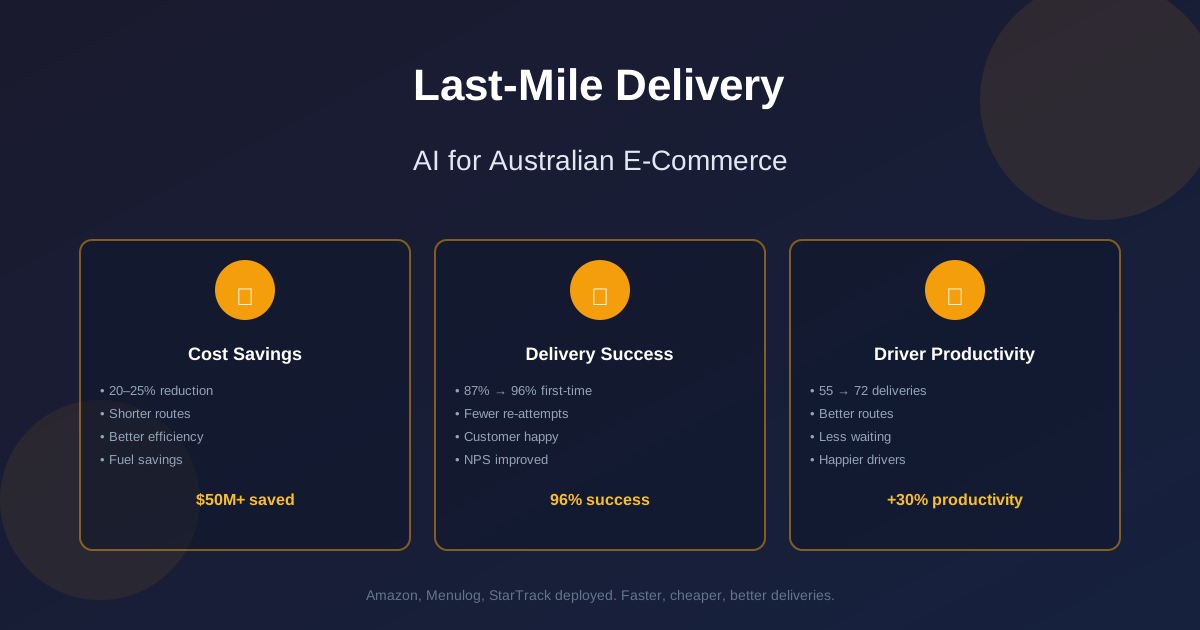
– Driver productivity: Deliveries per driver increased from 55 to 72 (+30%)
– First-attempt success: Improved from 87% to 96% (via proactive customer engagement)
– Same-day capability: Same-day delivery expanded to more suburbs (better cost efficiency)
– Customer satisfaction: NPS improved 12 points (faster, more reliable delivery)
Annual benefit: $50M+ cost reduction + improved competitive positioning.
Menulog/DoorDash: Food Delivery Optimisation
Challenge: Menulog operates food delivery across 5 major cities. Delivery must be fast (hot food arrives hot). Peak periods (lunch, dinner) create routing complexity. Driver shortages; attraction and retention difficult. Food delivery cost high due to speed requirements.
Solution: AI last-mile delivery for:
– Real-time route optimisation (incorporate traffic, food preparation time, customer location)
– Delivery success prediction (customer availability, order acceptance)
– Driver assignment optimisation (minimize food delivery time)
– Hot food management (predict cooking time; time delivery accordingly)
Results:
– Delivery speed: Average delivery time reduced from 32 minutes to 24 minutes (25% faster)
– Food quality: Hot food delivered hot (cold food eliminated; quality complaints down 35%)
– Driver productivity: Deliveries per driver per shift increased 35% (better routing)
– Driver attraction: Faster routes, less wait time; driver satisfaction improved
– Cost reduction: Delivery cost reduced 18% through better routing and driver productivity
– Customer satisfaction: NPS improved 15 points (faster, hotter food)
Annual benefit: $15M+ cost reduction + improved service quality + market share gains.
StarTrack: Parcel Delivery Network Optimisation
Challenge: StarTrack operates national parcel delivery network (200,000+ deliveries daily across Australia). Geographic diversity (urban and regional). Cost per parcel is competitive pressure. Failed deliveries and returns add 20% volume.
Solution: AI last-mile delivery for:
– Multi-hub route optimisation (coordinate across 50+ delivery hubs)
– Delivery success prediction (address accessibility, customer patterns)
– Proactive customer engagement (flexible delivery, pickup points)
– Network optimisation (pickup point placement, hub location)
Results:
– Delivery cost: Last-mile cost reduced 19% ($10/parcel → $8.10/parcel)
– Network efficiency: Coordinated hub operations improved 15%
– First-attempt success: 87% → 94% (reduced re-attempts, returns)
– Regional expansion: Viable to expand next-day delivery to more regional areas
– Driver retention: Better routing, clearer expectations; driver retention improved 8%
– Customer experience: Delivery reliability improved; customer complaints down 22%
Annual benefit: $80M+ cost reduction across national network.
Implementation Roadmap: Building AI Last-Mile Delivery
Phase 1: Data and Foundation (Weeks 1–4)
- Parcel data: Collect delivery history (address, weight, dimensions, delivery outcome)
- Route data: Gather historical route data (stops, distances, times)
- Address data: Compile address database with accessibility information
- External data: Integrate traffic, weather, geographic data
- KPI definition: Define success metrics (cost per delivery, first-attempt success, delivery speed)
Phase 2: AI System Development (Weeks 5–8)
- Route optimisation: Build algorithm for dynamic route planning
- Success prediction: Train ML model to predict delivery success
- Customer engagement: Build rules for proactive notification and flexible delivery
- Assignment algorithm: Build real-time driver assignment logic
- Network optimisation: Design hub/pickup point optimisation
Phase 3: Pilot and Refinement (Weeks 9–12)
- Soft launch: Deploy on subset of deliveries (one city, one day type)
- Comparison: Compare AI routes to current operations; measure cost/time savings
- Refinement: Improve models based on pilot results
- Integration: Test integration with dispatch, customer notification, driver apps
Phase 4: Full Deployment (Week 13+)
- Gradual rollout: Deploy across cities/regions gradually
- Driver training: Ensure drivers understand AI routing recommendations
- Performance tracking: Monitor delivery cost, success rate, customer satisfaction
- Continuous improvement: Update models monthly with new delivery data
Key Capabilities of Government-Ready AI Last-Mile Delivery
Real-Time Traffic Integration
Route optimisation must account for live traffic:
– Traffic API integration: Google Maps, TomTom real-time traffic
– Dynamic rerouting: If traffic detected, re-route remaining stops
– Predictive traffic: Predict traffic based on time of day and historical patterns
– Incident handling: Account for accidents, road closures, incidents
Result: Routes stay efficient even with traffic; adapts to real-time conditions.
Multi-Objective Optimisation
Last-mile has multiple competing objectives:
– Primary: Minimize delivery cost (distance, time)
– Secondary: Meet time windows, maximize on-time delivery, high customer satisfaction
– Constraints: Vehicle capacity, driver hours, accessibility restrictions
Result: Balanced optimization; fast, on-time delivery at low cost.
Proactive Problem-Solving
AI anticipates and prevents delivery failures:
– Success prediction: Identifies high-risk deliveries before attempt
– Proactive engagement: Contacts customer before delivery attempt
– Alternative solutions: Offers pickup points, flexible windows, authority to leave
– Recovery: If delivery fails, coordinates alternate attempt/pickup
Result: 95%+ first-attempt success; minimal failed deliveries.
Crowdsourced and Multi-Carrier Coordination
AI coordinates diverse delivery resources:
– Gig driver integration: Incorporates gig drivers for flexible capacity
– Pickup point integration: Coordinates parcel locker and convenience store pickups
– Multi-carrier: Selects optimal carrier (Australia Post, private, crowdsourced) for each delivery
– Cost optimisation: Selects cheapest available option that meets service level
Result: Flexible, cost-effective delivery network.
The Business Case: ROI for AI Last-Mile Delivery
Typical numbers for a major Australian delivery operator (1M parcels/day):
| Metric | Traditional Delivery | AI Last-Mile | Benefit |
|---|---|---|---|
| Delivery cost per parcel | $10 | $7.50–8.50 | 15–25% reduction |
| Distance per stop | 2.5 km | 2.0 km | 20% efficiency |
| Deliveries per driver | 60 | 75–80 | 25% productivity gain |
| First-attempt success | 85% | 94–96% | 10–15% reduction in re-attempts |
| Failed delivery cost | Baseline | 50% reduction | $8–12M+ annual saving |
| Driver recruitment need | Baseline | 20% reduction | Easier hiring/retention |
| Customer satisfaction NPS | 45–55 | 60–70 | Improved experience |
| Same-day capability | Limited metros | Expanded | Competitive advantage |
Net annual benefit: $80–150M for national operator (scale of StarTrack/AusPost).
Frequently Asked Questions
Q: How does AI handle rural and remote deliveries?
A: AI can optimize rural routes, but economics are challenging (sparse density = high cost). AI helps by consolidating deliveries, identifying efficient routes, and managing driver expectations.
Q: What about weather impact?
A: AI accounts for weather (flooding, hazards) in route planning. Extreme weather still requires manual intervention and rescheduling.
Q: Can AI coordinate multiple delivery partners?
A: Yes. AI can model parcel through multiple carriers (e.g., StarTrack for metro, Australia Post for regional) to minimize cost while meeting service level.
Q: How does this improve customer experience?
A: Faster delivery (optimised routes), reliable delivery (success prediction + proactive engagement), and flexible options (time windows, pickup points).
Q: What about driver privacy and surveillance?
A: AI should track vehicle location (for routing) not monitor driver behavior. GPS data for routing is standard; monitoring driver behavior requires transparency and consent.
Q: Implementation timeline?
A: Pilot in 4–8 weeks (single city). Full rollout 12–16 weeks. Quick wins (route optimization for existing network) can deploy in 4 weeks.
Best Practices: Making AI Last-Mile Delivery Work
- Driver involvement: Include drivers in design; AI should support drivers, not replace them
- Customer communication: Clear, timely communication about delivery status and options
- Continuous optimisation: Update models weekly with new delivery data; improve routes iteratively
- Measurement: Track cost per delivery, first-attempt success, customer satisfaction; use to refine system
- Integration: Ensure AI recommendations integrate with driver app, customer app, operations system
- Scalability: Design for growth; ensure system scales as volume grows
The Future: Autonomous Last-Mile
Next-wave AI last-mile delivery will:
1. Autonomous vehicles: Self-driving delivery vans for metro areas
2. Drone delivery: Small drones for time-critical deliveries
3. Locker networks: Distributed pickup points reduce customer delivery failure
4. Crowdsourced delivery: Gig economy coordination for flexible capacity
5. Sustainability: Route optimization to minimize carbon; electric vehicle routing
Australian logistics is moving towards efficient, sustainable, customer-centric last-mile delivery.
Ready to Optimise Your Last-Mile Delivery?
Anitech AI has built AI last-mile delivery for 5+ Australian logistics and e-commerce companies. We understand Australian geography, driver dynamics, customer expectations, and network economics. Let’s talk about reducing your last-mile delivery cost and improving customer experience.
[CTA: Talk to Anitech AI about Last-Mile Delivery AI]
Related: Logistics & Supply Chain Pillar Page | Route Optimisation
Published: April 2025 | Updated: [Current Date] | Author: Anitech AI
Further Reading
- AI Automation Australia — Complete Guide
- AI in Logistics and Supply Chain Management: The Australian Business Guide (2025) — Industry Guide
- AI Route Optimisation for Australian Freight and Delivery Companies
- AI Warehouse Automation in Australia: Smarter Picking, Packing, and Fulfilment
- AI Fleet Management for Australian Transport Companies: Predictive Maintenance and Optimisation
- AI Demand Forecasting for Supply Chain: Precision Inventory Planning