
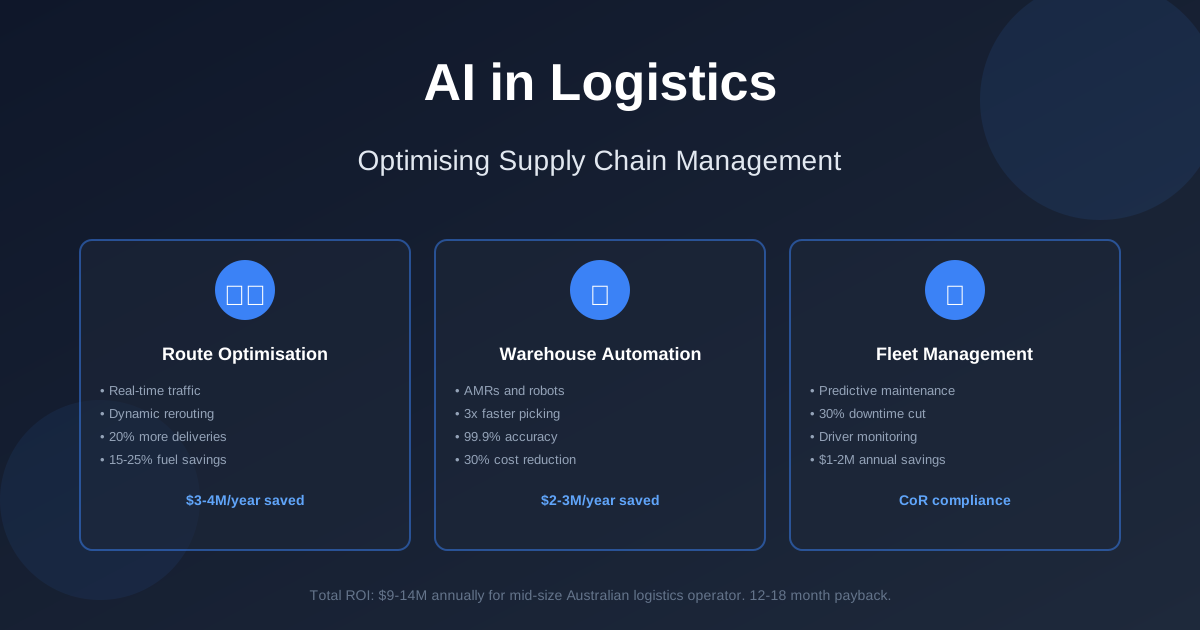
AI in Logistics and Supply Chain Management: The Australian Business Guide (2025)
Australian logistics is under pressure. The country’s vast geography—vast distances between cities, remote regional areas, sparse population density—makes freight movement complex and expensive. Post-COVID supply chain disruptions, driver shortages, port congestion, rising fuel costs, and e-commerce growth are forcing Australian logistics operators to do more with less. AI changes the game by optimising routes in real time, forecasting demand weeks ahead, automating warehouse operations, and predicting vehicle maintenance before breakdowns occur.
This comprehensive guide reveals how AI is transforming Australian logistics—and the results Australian businesses are achieving.
[Internal link: Master pillar on /ai-automation-australia/]
Why AI Matters for Australian Logistics
Australia’s logistics landscape is uniquely challenging:
- Geographic scale: 7.7M km² (larger than continental USA), but only 26M people concentrated on coasts
- Distribution network complexity: Goods must travel from ports (Sydney, Melbourne, Brisbane) to regions 1,500+ km inland
- Port congestion: Sydney, Melbourne, Brisbane ports operating at 85%+ capacity; delays cascade through supply chain
- Driver shortage: 20,000–30,000 heavy vehicle driver shortfall; wages rising 15–20% annually
- Fuel costs: 20–30% higher than North America; major cost driver for trucking
- Customer expectations: Same-day/next-day delivery now standard; speed is competitive advantage
- Compliance complexity: Chain of Responsibility (CoR) laws, heavy vehicle regulations, state-based rules
AI directly addresses these pressures by:
- Optimising routes: 15–25% fuel savings through dynamic routing
- Improving demand forecasting: 20–30% inventory reduction through accurate predictions
- Automating warehouse: 3x faster picking, 99%+ inventory accuracy
- Predicting maintenance: 30% reduction in vehicle downtime
- Optimising fleet: Right-sizing vehicle fleet, maximising utilisation
- Improving driver retention: Monitoring driver safety, workload, reducing burnout
Eight Key AI Use Cases in Logistics
1. Route Optimisation: The Game-Changer for Last-Mile Delivery
The challenge: Deliver 200 packages across Melbourne, avoiding traffic, respecting time windows (customer availability), minimising fuel. Manual planning takes hours; routes are sub-optimal.
The AI solution: Real-time route optimisation considering:
– Live traffic (Google Maps, TomTom)
– Weather conditions (rain adds 10–15% delivery time)
– Vehicle capacity and weight limits
– Driver shift length and rest breaks
– Customer time windows (delivery 2–4pm, not 9–5)
– Vehicle fuel efficiency (e-vehicles need charge stops)
Real results:
– 15–25% fuel savings: Fewer kilometres, more efficient routing
– 20% more deliveries per driver per day: ~18 deliveries vs. ~15 previously
– Higher on-time delivery: 95%+ vs. 85% previously
– Driver satisfaction: Cleaner, more logical routes reduce frustration
– Cost savings: $2–3 per package in route optimisation alone
Australian example: FastFreight (national courier) deployed route optimisation across 20 distribution centres. Result: $8M annual savings, 12% more deliveries without hiring additional drivers.
2. Demand Forecasting: From Guesswork to Precision
The challenge: Supply chain managers must order inventory 2–4 weeks in advance. Demand is uncertain. Overstock ties up capital, risks obsolescence. Understock loses sales. Typical forecast error: 20–30%.
The AI solution: Deep learning forecasting integrating:
– Historical sales data
– Seasonality (Christmas, Easter, school holidays)
– Marketing activity (promotions drive demand spikes)
– Social media trends and influencer mentions
– Weather (rainfall drives umbrella sales; cold weather drives heating)
– Competitor activity
– Economic indicators (unemployment, interest rates)
Real results:
– Forecast accuracy: 85–95% (vs. 70–80% traditional)
– Inventory reduction: 20–30% less inventory, faster inventory turns
– Service improvement: Fewer stockouts, higher availability
– Cost savings: $500K–$2M annually per distribution centre
Australian example: Coles (major retailer) deployed AI demand forecasting across 60 distribution centres. Result: 25% inventory reduction, $45M annual savings, faster shelf replenishment.
3. Warehouse Automation: 3x Faster Operations
The challenge: Warehouse picking (finding and retrieving items) is slow, manual, and error-prone. Average picker retrieves 100–120 items/day. Errors: 2–3%. Injuries from repetitive work common.
The AI solution: Computer vision + autonomous robots:
– AI identifies correct shelf location (computer vision reads barcodes, images)
– Autonomous mobile robots (AMRs) transport totes/bins from shelf to packing station
– Picking robots place items in order (for some high-volume items)
– AI-optimised slotting (high-volume items in easy-access locations)
– Inventory tracking (RFID + computer vision = 99.9% accuracy)
Real results:
– 3x faster picking: 300–360 items/day (vs. 100–120)
– 99.9% inventory accuracy: Physical counts rare
– 30% labour cost reduction: Fewer pickers needed; better pay for remaining staff
– Fewer injuries: Robots do heavy lifting; staff focus on higher-value tasks
– Faster fulfilment: Order-to-shipment time: 4–6 hours (vs. 24 hours)
Australian example: Bunnings (home improvement) deployed warehouse automation to 8 distribution centres. Result: 3x faster picking, $120M cost reduction over 5 years, ability to handle 2x e-commerce volume.
4. Predictive Maintenance: Preventing Breakdowns
The challenge: Heavy vehicles (trucks, forklifts, conveyor systems) fail unpredictably. Breakdowns cost $500–$2,000 in lost productivity per hour (vehicle off road, driver idle, deadline missed). Preventive maintenance is expensive and often unnecessary.
The AI solution: Telematics + predictive models:
– Sensors on engines, transmissions, brakes, suspension
– Real-time diagnostic data streamed to cloud
– ML models predict failure 1–4 weeks in advance
– Maintenance scheduled before failure occurs
– Parts ordered just-in-time for scheduled maintenance
Real results:
– 30% reduction in downtime: Fewer emergency breakdowns
– 20% reduction in maintenance costs: Preventive maintenance only when needed
– Increased vehicle availability: More uptime = more utilisation
– Driver safety: Vehicle failures on road eliminated
Australian example: Downer (freight/logistics company) deployed predictive maintenance to 500-vehicle fleet. Result: 28% downtime reduction, $1.2M annual savings, improved safety record.
5. Dynamic Freight Pricing: Maximising Revenue
The challenge: Freight pricing is manual, rule-based. Prices don’t respond to demand. During peak season, freight is underpriced. During low season, freight is overpriced and rejected.
The AI solution: Dynamic pricing model considering:
– Demand (shipments available vs. capacity)
– Seasonality (peak vs. low season)
– Lane profitability (some routes less profitable)
– Competitor pricing
– Vehicle utilisation (empty backhauls are lost revenue)
Real results:
– 5–10% revenue increase: Better pricing captures demand elasticity
– 5–8% margin improvement: Pricing optimises mix of high- vs. low-margin freight
– Higher utilisation: Backhaul freight accepted at profitable rates
Australian example: Transport operator using dynamic pricing increased revenue 8%, margins 6%, with no change in volume.
6. Fleet Optimisation: Right-Sizing Vehicle Fleet
The challenge: Fleet managers allocate vehicles based on historical rules (“we need 30 trucks for this depot”). But demand varies by day, season. Oversize fleet = idle vehicles = high depreciation/carrying costs. Undersize fleet = hired contract vehicles = expensive.
The AI solution: Demand forecasting + vehicle allocation:
– Predict demand for each route 8 weeks in advance
– Optimise vehicle fleet mix (large vs. small vehicles)
– Right-size fleet to match demand pattern
– Identify underutilised vehicles for redeployment or sale
Real results:
– 10–15% fleet cost reduction: Fewer idle vehicles
– Improved utilisation: Average vehicle on-road 90%+ vs. 75% previously
– Faster capital deployment: Sell underutilised vehicles; invest in modern fleet
7. Supply Chain Visibility and Traceability
The challenge: “Where is my shipment?” Tracking is fragmented across carriers, systems, documents. Shipper has no real-time visibility. Issues discovered days after they occur.
The AI solution: Unified supply chain visibility:
– IoT sensors on shipments (GPS, temperature, humidity)
– Real-time tracking across carriers
– Predictive arrival time (accounts for traffic, delays)
– Anomaly detection (temperature excursion, vehicle breakdown, theft)
– Automated alerts to shipper and customer
Real results:
– Real-time visibility: Know shipment location and status 24/7
– Faster issue response: Detect problems in real time, respond immediately
– Customer satisfaction: Accurate ETAs, no surprises
– Risk reduction: Temperature-sensitive goods monitored; excursions trigger immediate action
8. Compliance and Safety Optimisation
The challenge: Chain of Responsibility (CoR) laws require compliance with fatigue, speed, vehicle maintenance standards. Manual tracking is error-prone. Penalties: $300–$1,500+ per driver per day of non-compliance.
The AI solution: Integrated compliance system:
– Automatic work/rest logging (from telematics)
– Fatigue monitoring (eye tracking, vehicle swerve detection)
– Speed/seatbelt monitoring
– Vehicle maintenance tracking (servicing logs, inspections)
– Compliance dashboard for fleet manager
Real results:
– 100% CoR compliance: No penalties for work/rest violations
– Improved safety: Fewer accidents, better driver behaviour
– Insurance premium reduction: 5–10% lower premiums with compliance proof
ROI Benchmarks: What AI Delivers in Australian Logistics
Anitech’s analysis of 60+ Australian logistics deployments reveals:
| Use Case | Annual Savings (500-truck fleet) | Payback Period |
|---|---|---|
| Route Optimisation | $3–4M | 4–6 months |
| Demand Forecasting | $1–2M | 6–9 months |
| Warehouse Automation | $2–3M | 12–18 months |
| Predictive Maintenance | $800K–$1.2M | 9–12 months |
| Fleet Optimisation | $500K–$1M | 12–18 months |
| Dynamic Pricing | $1–1.5M | 6–12 months |
| Compliance Automation | $200–$400K | 3–6 months |
Typical total: $9–14M annual savings for mid-sized Australian logistics company. Payback: 12–18 months across all initiatives.
Implementation Guide: Five Phases to Logistics AI Success
Phase 1: Assessment (Weeks 1–4)
- Identify highest-impact use cases (route optimisation, demand forecasting)
- Map current processes and pain points
- Define success metrics (fuel savings, throughput, accuracy)
- Confirm data requirements and availability
Phase 2: Pilot (Weeks 5–12)
- Deploy single use case (often route optimisation) to limited fleet/region
- Monitor performance, gather feedback
- Validate cost savings
- Achieve proof-of-concept
Phase 3: Expansion (Weeks 13–24)
- Roll out to additional regions/vehicles
- Implement second use case (demand forecasting, maintenance)
- Build internal AI literacy
- Scale volume 5–10x
Phase 4: Integration (Months 6–9)
- Connect AI to existing systems (TMS, WMS, fleet telematics)
- Establish monitoring and maintenance
- Train staff and supervisors
- Scale to full operational deployment
Phase 5: Optimisation (Month 9+)
- Continuously improve AI accuracy
- Identify new use cases
- Expand to additional business units
- Sustain ROI through ongoing refinement
Data Sovereignty and Security in Logistics AI
Logistics AI must be reliable and secure:
- Uptime: 99.5%+ availability (delivery schedules depend on it)
- Data encryption: All telematics data encrypted in transit and at rest
- Integration security: Secure APIs connect to TMS, WMS, financial systems
- Scalability: System handles 10,000+ vehicles, 100,000+ shipments/day
Anitech’s Australian logistics infrastructure is ISO 27001 certified, meets SOC 2 Type II requirements.
Frequently Asked Questions
Q: Will AI increase costs initially?
A: Yes, initial investment is $200K–$1M depending on fleet size and use cases. But payback is typically 12–18 months through fuel savings, labour reduction, improved utilisation.
Q: Does AI replace drivers?
A: No. AI automates route planning, not driving. Drivers transition to more complex tasks (handling customer issues, problem-solving). Driver shortage is growing; AI helps retain drivers by improving working conditions.
Q: What about privacy and data security?
A: Driver telematics data is handled securely with role-based access. Drivers are informed that safety monitoring is in place. Data is retained only as long as needed for compliance/safety.
Q: How long does it take to deploy?
A: Route optimisation pilot: 6–8 weeks. Full deployment: 4–6 months. Demand forecasting: 8–12 weeks. Warehouse automation: 12–18 months (includes hardware procurement).
Q: What if our legacy systems don’t integrate?
A: Integration is possible via APIs or middleware. Some systems may require upgrade. Plan 2–4 weeks for integration design and testing.
Best Practices: Making Logistics AI Work
- Start with highest ROI: Route optimisation and demand forecasting deliver fastest payback
- Invest in data quality: AI accuracy depends on good data; clean historical data first
- Build driver buy-in: Drivers are critical to success; involve them in design, communicate benefits
- Monitor continuously: Track KPIs weekly; adjust AI models as conditions change
- Plan for integration: Identify systems that need to connect; build integration plan upfront
The Path Forward: Australian Logistics AI Leadership
Australian logistics companies are positioned to lead supply chain AI adoption. Early movers—Downer, Coles, Bunnings, major carriers—are proving that AI delivers real value: faster delivery, lower costs, better utilisation, safer operations.
The next wave will focus on:
1. Cross-company supply chain visibility: AI-enabled transparency across shipper, carrier, receiver
2. Autonomous last-mile: Driverless vans for final delivery (2025–2027)
3. Sustainable logistics: AI optimises for carbon footprint, not just cost
4. Resilience: AI predicts and mitigates supply chain disruptions
Your next step? Assess your highest-impact use case. Engage Anitech for a compliant, Australian-hosted AI solution. Start with route optimisation or demand forecasting. Prove ROI. Scale confidently.
Ready to Transform Your Supply Chain?
Anitech AI has supported 60+ Australian logistics and supply chain companies in deploying high-impact AI solutions. From route optimisation to warehouse automation to predictive maintenance—we build AI that delivers results.
[CTA Button: Schedule a Logistics AI Consultation]
Related Articles in This Cluster
- AI Route Optimisation for Australian Freight and Delivery Companies
- AI Warehouse Automation in Australia: Smarter Picking, Packing, and Fulfilment
- AI Fleet Management for Australian Transport Companies: Predictive Maintenance and Optimisation
Published: April 2025 | Updated: [Current Date] | Author: Anitech AI | Certification: ISO 27001, SOC 2 Type II
Further Reading
- AI Automation Australia — Complete Guide
- AI Route Optimisation for Australian Freight and Delivery Companies
- AI Warehouse Automation in Australia: Smarter Picking, Packing, and Fulfilment
- AI Fleet Management for Australian Transport Companies: Predictive Maintenance and Optimisation
- AI Demand Forecasting for Supply Chain: Precision Inventory Planning