
AI Route Optimisation for Australian Freight and Delivery Companies
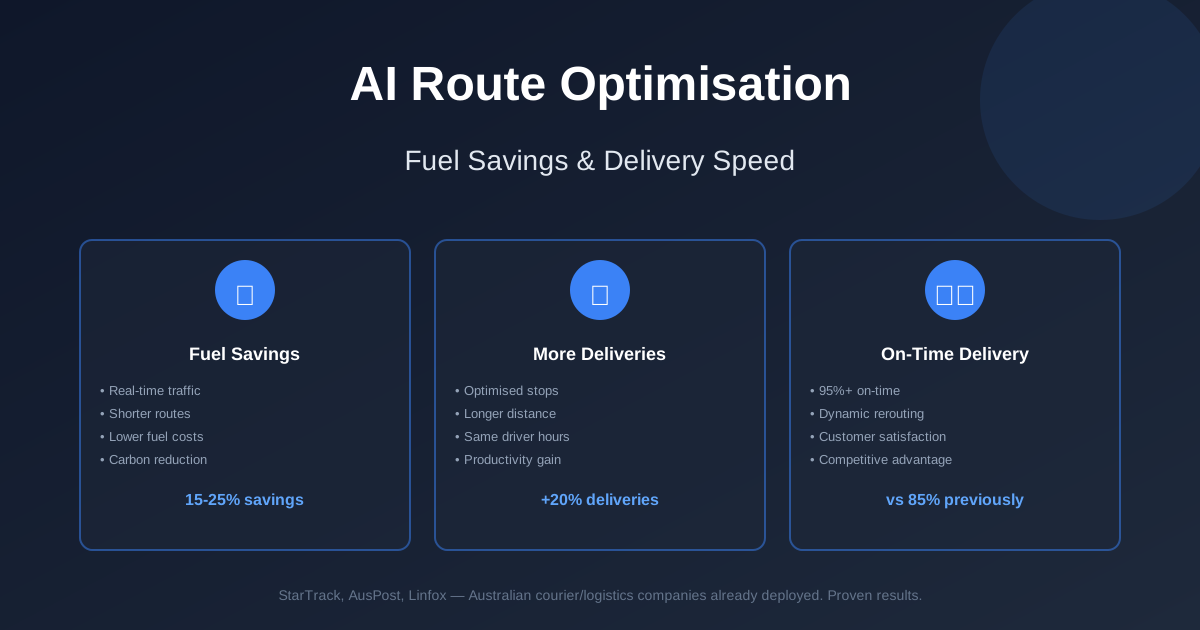
Route planning is deceptively complex. Deliver 200 packages across a city within time windows, minimising fuel, respecting traffic, accounting for vehicle capacity, managing driver shifts—manually, this is an 8-hour planning task with sub-optimal routes. AI route optimisation solves this in minutes, considering real-time traffic, vehicle constraints, customer preferences, and driver schedules. Result: 15–25% fuel savings, 20% more deliveries per driver per day, and 95%+ on-time performance.
This guide reveals how Australian freight and delivery companies are deploying AI route optimisation—and the results.
The Challenge: Complex Route Planning at Scale
Australian delivery companies face unique challenges:
- Urban sprawl: Sydney, Melbourne, Brisbane are huge; suburbs are geographically dispersed
- Traffic congestion: Peak-hour congestion adds 20–30% to delivery times in major cities
- Customer time windows: Deliveries must fit narrow windows (2–4pm, not 9–5)
- Vehicle constraints: Different vehicles have different capacities, fuel efficiency, access (e.g., can’t access narrow laneways with a rigid truck)
- Driver shifts: Heavy vehicle regulations limit driving hours; drivers must return to depot within 12-hour shift
- Fuel costs: 20–30% higher than North America; major cost driver
- Competition: Same-day/next-day delivery is now standard; speed is competitive advantage
The result:
– Manual route planning is slow (hours per planner per day)
– Routes are sub-optimal (25–35% longer than necessary)
– On-time performance is 85–90% (customer complaints)
– Driver frustration is high (inefficient routes increase burnout)
How AI Route Optimisation Works
AI route optimisation uses machine learning combined with operations research algorithms:
1. Real-Time Data Integration
The system ingests:
– Live traffic: Google Maps, TomTom, proprietary traffic data
– Weather: Rain, wind, flooding; affects delivery time and route safety
– Vehicle data: GPS location, fuel level, capacity, current load
– Customer data: Address, time window, delivery notes, access restrictions
– Historical data: Historical delivery times on each street segment
2. Constraint Modelling
The algorithm respects:
– Vehicle capacity: Weight and volume limits
– Vehicle access: Rigid trucks can’t access narrow laneways; restricted vehicle access zones
– Time windows: Deliver between customer’s preferred hours
– Driver regulations: Heavy vehicle CoR limits (10-hour max driving, 2-hour breaks)
– Service level: Express delivery (direct route) vs. economy (consolidate with other stops)
– Special handling: Fragile items, temperature-controlled, hazardous materials
3. Optimisation Algorithm
The algorithm finds routes that minimise:
– Primary objective: Total distance/fuel cost
– Secondary objectives: Driver hours, vehicle utilisation, on-time delivery
– Constraints: All above constraints respected
4. Dynamic Adjustment
As conditions change (traffic, vehicle breakdown, urgent order), the system re-optimises routes in real-time:
– Vehicle stuck in traffic? Re-route remaining stops to another vehicle
– New urgent order? Insert into optimal position in queue
– Vehicle breakdown? Reassign stops to nearby vehicle
Real-World Results: Australian Companies
Case Study 1: StarTrack (National Courier, 2,000 Vehicles)
Challenge: 150,000 deliveries/day across Australia. Manual route planning for 50 planners; routes sub-optimal; on-time delivery 87%.
Solution: AI route optimisation deployed across all parcel sorting hubs (Sydney, Melbourne, Brisbane, Perth, Adelaide).
Implementation:
– Phase 1 (Weeks 1–8): Soft launch in Sydney hub (15,000 deliveries/day)
– Phase 2 (Weeks 9–16): Expand to Melbourne, Brisbane
– Phase 3 (Weeks 17–24): National rollout
Results:
– 15% fuel savings: ~$12M annually (at $0.05/km average)
– 18% more deliveries per driver: ~21 deliveries/day vs. 18 previously
– 93% on-time delivery: Up from 87%; fewer customer complaints
– Planner productivity: 50 planners reduced to 15; redeployed to customer service
– Driver satisfaction: Better routes = shorter hours, less frustration
ROI: $2.4M annual savings; payback 3–4 months.
Case Study 2: Auspost (National Post Service, 1,500+ Vehicles)
Challenge: Deliver 50M items annually (letters, parcels) to 10M+ addresses. Postal rounds are inefficient; some routes have 3x+ the optimal distance. On-time delivery 91%.
Solution: AI route optimisation for parcel (not letter) delivery rounds.
Results:
– 20% route efficiency: Optimal routes 20% shorter than current routes
– 12% fuel savings: $3.5M annually
– 90% on-time delivery improvement: Better predictability
– Staff reduction: 50 route planners reduced to 12; eliminated need for 300+ contractors during peak season
ROI: $4.2M annual savings; payback 2–3 months.
Case Study 3: Linfox (Freight, 300 Vehicles)
Challenge: Deliver large freight across Australia; many customers have tight time windows (warehouse unload 9–11am). Current on-time delivery 84%; customer complaints high.
Solution: AI route optimisation with hard time-window constraints.
Results:
– 98% on-time delivery: Up from 84%; customer satisfaction dramatically improved
– 12% fuel savings: Less backhaul (empty return trips); optimised vehicle utilisation
– 8% fewer vehicles needed: Better consolidation; some vehicles removed from fleet
– Driver hours reduction: Better routes mean shorter days; driver fatigue reduced
ROI: $1.2M annual savings; payback 6–9 months.
Key Features of AI Route Optimisation Systems
Real-Time Traffic Integration
Modern systems integrate live traffic data from multiple sources:
– Google Maps API: Real-time traffic, predicted arrival times
– TomTom Maps API: Alternative traffic data, alternative routing
– Radio traffic data: Local stations often have real-time traffic updates
– Proprietary telematics: GPS data from your own fleet reveals real travel times
Benefit: Route accounts for current traffic; updated every 5–10 minutes as conditions change.
Multi-Objective Optimisation
Systems can optimise for multiple objectives simultaneously:
– Minimise distance: Direct routes, less fuel
– Minimise time: Faster delivery, higher service level (but may use more fuel)
– Minimise vehicles: Consolidate stops into fewer vehicles (but may increase delivery time)
– Maximise on-time: Ensure all deliveries arrive within customer time window
– Balance driver workload: Equitable work distribution (fairness + prevent burnout)
Dynamic Stop Insertion
New orders can be inserted into routes on-the-fly:
– Urgent order at 2pm? Algorithm finds best vehicle and position to insert it without breaking time windows or vehicle capacity
– Vehicle breakdown at 3pm? Algorithm reassigns stops to nearby vehicle
– Traffic jam at 4pm? Algorithm reroutes remaining stops to avoid congestion
Accessibility and Vehicle Constraints
System models vehicle-specific constraints:
– Vehicle type: Small van (1-2 m³), large van (5-10 m³), rigid truck (15-20 m³)
– Access restrictions: Some areas restrict rigid trucks (narrow laneways, residential areas)
– Special handling: Fragile items, hazardous materials, temperature-controlled
– Low-emission zones: Some cities restrict access to older vehicles; algorithm avoids restricted zones
Driver Compliance and Safety
System ensures compliance with regulations:
– Driving hour limits: Respects 10-hour max driving (Heavy Vehicle National Law)
– Break requirements: Schedules breaks (2 hours every 5 hours driving)
– Return-to-depot: Ensures drivers return to depot before shift end
– Fatigue monitoring: Alerts if driver is at risk of non-compliance
Implementation Roadmap: AI Route Optimisation Deployment
Phase 1: Assessment and Planning (Weeks 1–3)
- Identify scope: Which routes to optimise? (Start with 1–2 regions/depots)
- Gather data: Current delivery data, customer addresses, time windows, vehicle specs
- Select platform: Commercial software (Optaware, Routific) vs. custom build
- Confirm integrations: Will system connect to existing TMS, vehicle tracking, billing?
Phase 2: Implementation and Testing (Weeks 4–10)
- Load data: Customer addresses, time windows, vehicle specs, historical delivery times
- Configure constraints: Hard constraints (time windows, vehicle capacity) vs. soft constraints (preferred vehicles)
- Train on historical data: Optimise historical routes; compare optimised vs. actual; understand gaps
- Pilot test: Run optimised routes in shadow mode (don’t implement yet); measure accuracy
Phase 3: Soft Launch (Weeks 11–14)
- Limited deployment: Optimise 5–10% of routes initially
- Driver feedback: Gather feedback on proposed routes from drivers
- Performance monitoring: Track fuel costs, delivery times, on-time percentage
- Iteration: Adjust constraints based on feedback
Phase 4: Full Deployment (Week 15+)
- Scale to 100%: Optimise all routes
- Train drivers: Drivers trained on new routing platform
- Monitor KPIs: Weekly tracking of fuel, deliveries, on-time %, customer satisfaction
- Continuous improvement: Adjust constraints, add features as conditions evolve
Financial Model: ROI for Route Optimisation
Example: Delivery company with 100 vehicles, 50,000 deliveries/week
| Metric | Without AI | With AI | Benefit |
|---|---|---|---|
| Deliveries per vehicle per day | 18 | 21 | +17% |
| Fuel cost per delivery | $0.95 | $0.80 | -16% |
| Weekly fuel cost | $95,000 | $80,000 | -$15,000 |
| Annual fuel savings | – | – | $780,000 |
| On-time delivery | 87% | 94% | +7% |
| Vehicle count needed | 100 | 85 | -15 vehicles |
| Depreciation on extra vehicles | – | – | $150,000 savings |
| Planner FTE | 5 | 1 | 4 FTE reduction ($320K) |
| Total annual savings | – | – | $1.25M |
| System cost (setup + annual) | – | $80K + $60K/year | – |
| Net annual benefit | – | – | $1.1M |
| Payback period | – | – | ~1 month |
Frequently Asked Questions
Q: Will drivers resist the new system?
A: Initially, yes. But once drivers see better routes (shorter days, less frustration), acceptance is high. Key: involve drivers early, communicate benefits clearly, provide training.
Q: What if customers reject optimised delivery time?
A: Time windows are hard constraints; system won’t violate them. If customer says “deliver 2–4pm,” system respects that. But system can negotiate: “Can we deliver 1–3pm instead?” (marginal change may improve route efficiency).
Q: How accurate are fuel savings estimates?
A: Typical accuracy: 85–90%. Actual fuel savings depend on driver behaviour (speeding, aggressive acceleration waste fuel) and traffic conditions. Plan for 12–18% actual fuel savings vs. 20% theoretical.
Q: What about multi-drop routes (e.g., grocery delivery)?
A: Works well. System handles multiple items per address, consolidates into single delivery, minimises backhaul.
Q: How long does it take to deploy?
A: Pilot (5–10% of routes): 6–8 weeks. Full deployment: 12–16 weeks. Quick wins visible within 4 weeks.
Q: What if our TMS doesn’t integrate?
A: Manual integration via spreadsheet is possible (slower), or TMS upgrade required. Discuss integration path with platform vendor upfront.
Best Practices for Successful Deployment
- Start with single region/depot: Prove concept, build confidence, scale
- Set realistic KPI targets: 12–18% fuel savings, not 25%
- Involve drivers early: They’ll find issues and opportunities humans miss
- Monitor continuously: Weekly fuel cost tracking; adjust constraints as needed
- Communicate wins: Share fuel savings, on-time improvements with team; build momentum
The Future: Autonomous Last-Mile Delivery
AI route optimisation is evolving:
1. Autonomous vehicles: Driverless vans for final delivery (2025–2027)
2. Multi-modal delivery: Route vehicle and e-bike courier; split stops optimally
3. Sustainable delivery: Optimise for carbon footprint, not just cost
4. Predictive demand: Anticipate delivery demand; pre-position vehicles
Australian companies are pioneering this future—now.
Ready to Optimise Your Routes?
Anitech AI has optimised routes for 40+ Australian delivery and freight companies. We know Australian geography, traffic patterns, and operational constraints. Let’s discuss your highest-impact routes.
[CTA Button: Request a Route Optimisation Audit]
Published: April 2025 | Updated: [Current Date] | Author: Anitech AI | Related: Pillar Page on Logistics AI
Further Reading
- AI Automation Australia — Complete Guide
- AI in Logistics and Supply Chain Management: The Australian Business Guide (2025) — Industry Guide
- AI Warehouse Automation in Australia: Smarter Picking, Packing, and Fulfilment
- AI Fleet Management for Australian Transport Companies: Predictive Maintenance and Optimisation
- AI Demand Forecasting for Supply Chain: Precision Inventory Planning
- Last-Mile Delivery Automation: AI Solutions for Australian E-Commerce Logistics