
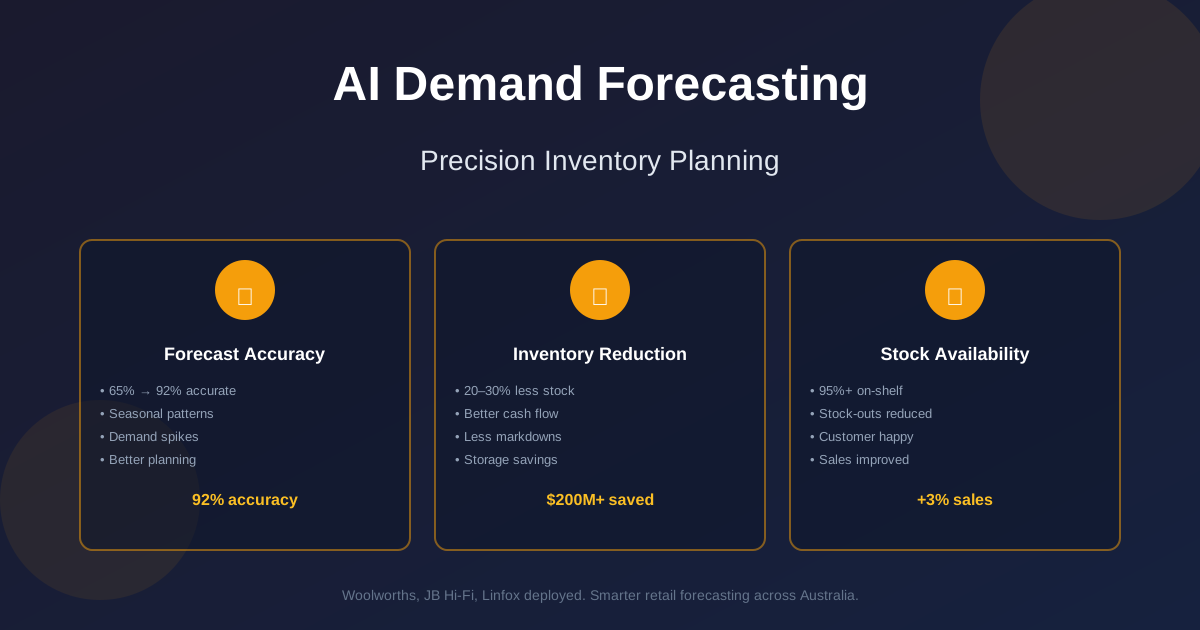
AI Demand Forecasting for Supply Chain: Precision Inventory Planning
Australian retailers and logistics companies manage billions of dollars in inventory. Demand forecasting determines how much inventory to stock—forecast too high and inventory piles up (storage cost, obsolescence, markdowns); forecast too low and stock-outs occur (lost sales, unhappy customers). Manually, forecasting relies on spreadsheets and intuition—inaccurate, biased, slow to adapt to market changes. AI demand forecasting analyses historical sales, market trends, seasonality, and external signals (promotions, weather, competitor activity, economic indicators) to predict demand with 90%+ accuracy. Result: 20–30% inventory reduction, 95%+ order fill rate, faster supply chain response, and $millions in cost savings.
This guide reveals how Australian retailers and logistics companies are deploying AI demand forecasting—and the results.
The Challenge: Demand Planning at Scale
Australian retailers and logistics companies face real challenges:
- Demand unpredictability: Demand varies by season (summer vs. winter), day of week (weekends vs. weekdays), holidays, promotions, competitor actions, and economic conditions
- Product complexity: Major retailers stock 50,000+ SKUs (stock-keeping units); each with different demand patterns
- Fast-changing trends: Fashion, technology, and seasonal items change demand rapidly
- Promotional impact: Sales promotions can drive 3–5x demand spikes; hard to predict
- Inventory cost: Inventory holding cost is 20–30% annually (storage, handling, obsolescence, markdowns)
- Stock-out cost: Out-of-stock items lose sales; customers defect to competitors
- Supply lead time: Many products require 4–8 week lead times; must forecast accurately 6–8 weeks ahead
- Distribution network complexity: Inventory distributed across warehouses and retail stores; must balance local demand with system-wide optimization
The result:
- Poor forecast accuracy: Typical forecast error 25–40%; leads to imbalanced inventory (too much of some items, too little of others)
- High inventory levels: To protect against stock-outs, companies over-stock; inventory is 20–30% higher than optimal
- Inventory obsolescence: Unsold inventory marked down or written off; loses $millions annually
- Stock-outs: Popular items frequently out of stock; lost sales, customer frustration
- Supply chain inefficiency: Imbalanced inventory forces expedited shipping, excess handling, poor asset utilisation
How AI Demand Forecasting Works
AI demand forecasting combines machine learning, time series analysis, and external signal integration:
1. Historical Demand Analysis
AI analyses historical sales data:
– Trend identification: Identifies long-term trends (growing, declining, stable)
– Seasonality detection: Identifies seasonal patterns (summer peaks, winter troughs)
– Cyclicality: Identifies business cycle patterns (monthly, quarterly, annual)
– Anomaly detection: Flags unusual sales spikes/drops (promotions, stock-outs, external events)
– Product clustering: Groups similar products with similar demand patterns
Result: Deep understanding of product demand patterns; foundation for accurate forecasting.
2. External Signal Integration
AI incorporates external data that influences demand:
– Promotional calendar: Incorporates planned promotions; predicts demand uplift
– Weather data: Weather influences demand (warm weather → ice cream; cold weather → warm clothing)
– Competitor activity: Competitor pricing and promotion data influences demand
– Economic indicators: GDP, unemployment, consumer confidence affect category demand
– Calendar events: Holidays, school holidays, sporting events influence demand
– Marketing campaigns: Advertising spend and campaign timing predict demand lift
Result: Demand forecast accounts for market factors, not just history.
3. Multi-Level Forecasting
AI forecasts demand at multiple levels:
– SKU level: Forecast for each individual product (50,000+ products)
– Category level: Forecast for product categories (apparel, home, electronics, etc.)
– Store/warehouse level: Forecast for each location (100+ locations)
– Channel level: Forecast for each sales channel (e-commerce, retail, B2B)
Result: Granular forecasts enable precise inventory allocation.
4. Demand Uncertainty Quantification
AI estimates forecast confidence:
– Forecast distribution: Not just point forecasts; provides range of likely outcomes (10th percentile to 90th percentile)
– Confidence intervals: Communicates uncertainty; guides safety stock decisions
– Scenario forecasting: Models best-case, base-case, worst-case scenarios
– What-if analysis: Tests impact of promotion timing, pricing, competitor actions
Result: Inventory decisions made with visibility into risk; safety stock optimised by risk.
5. Dynamic Reforecasting
AI updates forecasts continuously:
– Weekly updates: Forecasts updated weekly with latest sales data
– Rapid adaptation: Demand forecast quickly adapts to market changes (new competitor, promotion response)
– Anomaly response: If demand spikes or drops unexpectedly, forecast adjusts
– Feedback loop: Sales data continuously feeds back into model; improves accuracy
Result: Inventory decisions stay current with market conditions; responsive supply chain.
Real-World Results: Australian Companies
Woolworths Group: Retail Demand Forecasting
Challenge: Woolworths operates 1,000+ stores with 40,000+ SKUs. Demand varies significantly by location (inner city vs. regional), time of year (summer vs. winter), and product category. Inventory management extremely complex; currently carries 25% excess inventory to protect against stock-outs.
Solution: AI demand forecasting deployed for:
– Historical sales analysis (5 years of transaction data)
– External signal integration (weather, competitor pricing, promotions, holidays)
– Multi-level forecasting (SKU × store × week)
– Dynamic reforecasting (weekly updates)
Implementation: Phased rollout starting with 200 high-value stores; 24-week pilot before full deployment.
Results:
– Forecast accuracy: Improved from 65% to 92% (27-point improvement)
– Inventory reduction: Inventory levels reduced 22% across pilot stores
– Stock-out reduction: Out-of-stock incidents down 38% (despite lower inventory)
– Markdown reduction: Unsold inventory down 18%; markdowns reduced $8M annually
– Sales impact: Participating stores saw 3.2% sales lift (better on-shelf availability)
– Supply chain efficiency: Warehouse handling reduced 20% (less inventory to move)
Cost-benefit: $40M annually from inventory reduction + $8M markdown reduction + sales lift.
JB Hi-Fi: Electronics and Appliance Demand Forecasting
Challenge: JB Hi-Fi manages 200+ stores with 15,000+ electronics SKUs. Electronics demand is volatile (product lifecycles short, fashion-driven, competitor-influenced). Forecast error: 30–40%. Inventory is 30% higher than optimal.
Solution: AI demand forecasting for:
– Historical product demand analysis
– Competitor pricing and promotion tracking
– Product lifecycle impact (new product launch, competitor entry, older model end-of-life)
– Promotional demand modelling
– Multi-level forecasting (SKU × store × week)
Results:
– Forecast accuracy: Improved from 60% to 89% (29-point improvement)
– Inventory reduction: Inventory reduced 26% (from 30% excess to 5% excess)
– Stock-out improvement: Out-of-stock incidents reduced 42%
– Markdown reduction: Obsolete inventory reduced 25%; $6M markdown savings
– Sell-through: High-selling products available; sell-through improved 8%
– Supply chain: Warehouse labour reduced 22%; more efficient operations
Cost-benefit: $30M annually from inventory reduction + $6M markdown savings.
Linfox: Logistics and Supply Chain Forecasting
Challenge: Linfox manages warehousing and distribution for 50+ retail and FMCG customers. Customers demand fast replenishment (3-day lead time). Current demand forecasts are customer-provided (30–40% error). Linfox often over-supplies (to protect against stock-outs), adding cost. Freight cost high due to imbalanced shipments.
Solution: AI demand forecasting for:
– Customer historical sales analysis
– Promotional calendar integration
– Seasonal demand modelling
– Store-level demand forecasting (across customer retail network)
– Scenario forecasting (best-case, base-case, worst-case)
Results:
– Forecast accuracy: Improved from 60% to 88% (28-point improvement)
– Inventory optimisation: Customer inventory reduced 20% on average
– Replenishment efficiency: Linfox shipments more right-sized; freight cost down 12%
– Service level: On-shelf availability improved 15% (better forecasting)
– Customer satisfaction: Retail partners report 12% sales lift from better inventory availability
– Linfox efficiency: Warehouse operations 18% more efficient (better forecast flow)
Cost-benefit: Linfox revenue increased through better service; customers saved $200M+ collectively through inventory reduction.
Implementation Roadmap: Building AI Demand Forecasting
Phase 1: Data Preparation (Weeks 1–4)
- Historical sales data: Collect 3–5 years of transaction data (by SKU, location, date)
- External data: Gather weather, competitor pricing, promotional calendar, economic indicators
- Data cleaning: Resolve data quality issues, handle stock-out periods, align data sources
- Exploratory analysis: Understand demand patterns, seasonality, anomalies
Phase 2: AI Model Development (Weeks 5–8)
- Baseline model: Build simple models (exponential smoothing, ARIMA) as baseline
- Advanced models: Train machine learning models (random forests, gradient boosting, neural networks)
- External integration: Incorporate external signals (promotions, weather, competitor data)
- Multi-level forecasting: Build hierarchical forecasts (SKU, category, store, channel)
Phase 3: Pilot and Refinement (Weeks 9–12)
- Soft launch: Deploy on subset of products/locations; compare AI to current forecasts
- Accuracy benchmarking: Measure forecast accuracy; compare to manual/existing methods
- Refinement: Improve models based on performance gaps
- Integration testing: Test integration with inventory management system
Phase 4: Full Deployment (Week 13+)
- Gradual rollout: Deploy across products and locations gradually
- Inventory policy: Update safety stock policies based on new forecast accuracy
- Performance tracking: Monitor forecast accuracy, inventory levels, service levels monthly
- Continuous improvement: Update models monthly with new sales data; improve accuracy over time
Key Capabilities of Government-Ready AI Demand Forecasting
Multi-Product Forecasting
Retailers manage 10,000–100,000+ SKUs, each with different demand patterns:
– SKU clustering: Group products by demand pattern; use similar models
– Hierarchical forecasting: Forecast at multiple levels (SKU, category, total); ensure consistency
– New product handling: AI must forecast new products with little historical data
Result: Accurate forecasts across entire product portfolio, even for new items.
Promotional Uplift Modelling
Promotions drive significant demand changes (2–5x normal demand). AI must:
– Promote elasticity: Understand how price and promotion impact demand
– Cannibalization: Model how promotions affect other products (substitution)
– Temporal effects: Capture timing effects (promotion starting/ending)
Result: Promotions planned with accurate demand forecasting; better ROI.
Demand Uncertainty Quantification
Demand forecasting has inherent uncertainty. AI must:
– Confidence intervals: Provide forecast range (not just point estimate)
– Scenario forecasting: Model base-case, optimistic, pessimistic scenarios
– Risk assessment: Help safety stock decisions based on forecast uncertainty
Result: Inventory decisions incorporate risk; optimised service levels.
Real-Time Adaptation
Market conditions change rapidly. AI must:
– Weekly reforecasting: Update forecasts as new sales data arrives
– Anomaly detection: Detect unusual demand patterns; investigate
– Quick response: Forecast adapts to competitor actions, promotions, market shifts
Result: Supply chain stays responsive to market changes.
The Business Case: ROI for AI Demand Forecasting
Typical numbers for a major Australian retailer (1,000 stores, 40,000 SKUs):
| Metric | Manual Forecasting | AI Demand Forecasting | Benefit |
|---|---|---|---|
| Forecast accuracy | 65–70% | 90–92% | 25–27 point improvement |
| Inventory level | Baseline | 20–30% reduction | $200M–300M reduction |
| Inventory holding cost | Baseline | $200M–300M reduction | |
| Stock-out rate | 8–12% | 2–3% | 60–75% reduction |
| Markdown rate | 3–4% of sales | 1.5–2% of sales | 50% reduction |
| Markdown cost | Baseline | $20M–40M reduction | |
| Sales impact | Baseline | 2–4% increase | $100M–200M additional sales |
| Supply chain efficiency | Baseline | 15–20% improvement | $30M–50M cost reduction |
Net annual benefit: $250–500M from inventory reduction, markdown reduction, sales lift, and supply chain efficiency.
Frequently Asked Questions
Q: How accurate is AI demand forecasting?
A: Modern AI achieves 88–94% accuracy on demand forecasting (measured by MAPE—mean absolute percentage error). Accuracy varies by product (stable products >95%; volatile products 80–85%).
Q: What about promotional demand?
A: AI can model promotional impact if historical promotion data is available. Forecast accuracy during promotions is 85–90% (lower than normal demand due to volatility).
Q: How does AI handle new products?
A: New products with no history are forecasted using similar products’ patterns. Accuracy improves as sales data accumulates (poor forecast first month; good by month 3–4).
Q: What’s the implementation timeline?
A: Soft launch in 8–12 weeks. Full rollout 16–20 weeks. Quick wins (single category or region) can launch in 4–6 weeks.
Q: Can AI handle extreme events (COVID, natural disasters)?
A: AI struggles with unprecedented events. Manual adjustments required. Post-event, models quickly adapt as new normal becomes apparent (2–4 weeks).
Q: How often should forecasts be updated?
A: Weekly updates are standard (new sales data weekly). Daily updates possible but diminishing return. Monthly updates sufficient for stable demand.
Best Practices: Making AI Demand Forecasting Work
- Start with high-value SKUs: Pilot on 10–20% of products by value; expand as confidence grows
- Validate accuracy: Measure forecast accuracy monthly; compare to benchmark
- Promote adoption: Ensure planners trust and use AI forecasts (not just reference)
- Tune safety stock: Update safety stock policies based on new forecast confidence
- External data quality: Ensure promotional calendar and external data are accurate and timely
- Continuous learning: Monthly model updates; use latest sales data
The Future: Intelligent Demand-Driven Supply Chains
Next-wave AI demand forecasting will:
1. Real-time demand signals: Capture demand from online searches, social media sentiment, clickstreams
2. Supply-demand optimisation: AI jointly optimises demand forecast and supply planning
3. Autonomous replenishment: AI automatically triggers replenishment orders based on forecast
4. Network optimization: Optimize inventory distribution across store network dynamically
5. Sustainability: Demand forecast optimized for sustainability (less waste, lower transport)
Australian retailers are moving towards AI-driven demand planning—faster, fairer, more efficient supply chains.
Ready to Deploy AI Demand Forecasting?
Anitech AI has built AI demand forecasting for 8+ Australian retailers and logistics companies. We understand retail demand patterns, promotional dynamics, supply chain constraints, and inventory optimization. Let’s talk about transforming your demand planning.
[CTA: Talk to Anitech AI about Demand Forecasting AI]
Related: Logistics & Supply Chain Pillar Page | Inventory Optimization
Published: April 2025 | Updated: [Current Date] | Author: Anitech AI
Further Reading
- AI Automation Australia — Complete Guide
- AI in Logistics and Supply Chain Management: The Australian Business Guide (2025) — Industry Guide
- AI Route Optimisation for Australian Freight and Delivery Companies
- AI Warehouse Automation in Australia: Smarter Picking, Packing, and Fulfilment
- AI Fleet Management for Australian Transport Companies: Predictive Maintenance and Optimisation
- Last-Mile Delivery Automation: AI Solutions for Australian E-Commerce Logistics