
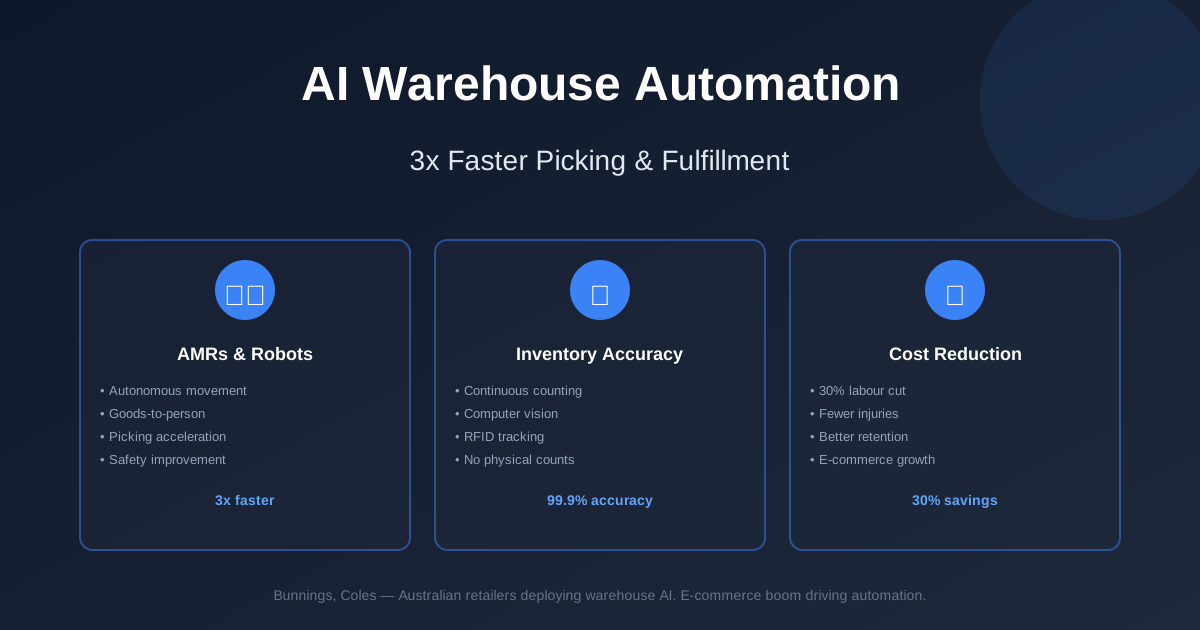
AI Warehouse Automation in Australia: Smarter Picking, Packing, and Fulfilment
Warehouse picking (finding and retrieving items from shelves) is the most labour-intensive operation in logistics. A single picker retrieves 100–120 items per day—walking miles across the warehouse, finding each item by barcode, placing it in a tote. Errors: 2–3%. Injuries from repetitive work: common. Australian e-commerce growth (retail e-commerce projected to reach $80B by 2027) is driving unprecedented demand for warehouse capacity. AI warehouse automation addresses this by deploying computer vision, autonomous mobile robots (AMRs), and intelligent warehouse management systems to 3x picking speed, eliminate inventory errors, and dramatically reduce labour costs.
This guide reveals how Australian warehouses are deploying AI automation—and the results.
The Challenge: Warehouse Operations at Scale
Australian e-commerce growth is forcing warehouse expansion:
- E-commerce growth: 15–20% annually post-COVID
- Warehouse demand: Retailers and logistics companies expanding warehouse capacity 30–50%
- Labour shortage: Warehouse workers hard to find; wages rising 10–15% annually
- Error rates: Manual picking 2–3% error rate; causes returns, rework
- Inventory accuracy: Physical inventory counts show 5–10% variance from system records
- Fulfillment speed: Customer expectation: order today, delivery tomorrow; requires fast picking
The result:
– Manual picking is bottleneck
– Staffing costs rising faster than revenue
– Error rates driving customer dissatisfaction
– Inventory discrepancies cause stockouts and overstock
How AI Warehouse Automation Works
1. Computer Vision for Intelligent Picking
Traditional: Manual picking using barcode scanner; worker walks to location, scans barcode, confirms pick.
AI approach: Computer vision guides picking:
– Camera on picker’s device shows item image, barcode, location
– Picker scans item; computer vision confirms correct item picked (reads barcode, images)
– Incorrect pick? Alert to picker immediately (e.g., wrong size, colour)
– Result: 95%+ pick accuracy vs. 97% manual (seemingly small difference, but error rate 5x lower)
Benefit: Fewer returns, faster customer satisfaction, reduced rework.
2. Autonomous Mobile Robots (AMRs)
Traditional: Picker walks to shelf location (average 300–500 metres per shift); retrieves item; walks to packing station.
AI approach: AMRs transport items:
– Shelf moved to picker (goods-to-person model)
– Picker remains at packing station
– AMR navigates warehouse automatically, avoiding obstacles
– Picker picks from shelf at station height (ergonomic)
Benefits:
– 3x faster picking: Picker stays at station, AMRs bring items
– Safety: Reduced walking = fewer injuries
– Scalability: Add more AMRs as volume grows; no more building expansion needed
Australian example: Bunnings deployment (Case Study 1 below).
3. AI-Optimised Slotting
Traditional: Items stored in fixed locations based on category (e.g., “all hammers in aisle 3”).
AI approach: Dynamic slotting optimisation:
– Analyse picking frequency, weight, volume
– High-picking items stored in easy-access locations (shoulder height, near packing station)
– Slow-moving items in back corners
– Heavy items at waist level (ergonomic)
– AI continuously rebalances as demand patterns shift
Benefits:
– Shorter picking walks (high-volume items nearby)
– Better ergonomics (reduces injury)
– Faster picks
4. Inventory Accuracy Through Continuous Counting
Traditional: Physical inventory count quarterly (all operations stop for 1–2 days; expensive).
AI approach: Continuous inventory via computer vision:
– Cameras monitor shelves 24/7
– Computer vision counts items on shelf (reads quantities visually)
– RFID tags on pallets/bins provide backup verification
– Inventory system updates continuously
– Discrepancies flagged immediately
Benefits:
– 99.9% inventory accuracy (vs. 90–95% physical count)
– No need for physical counts (save 1–2 days, $200K+ per count)
– Immediate visibility to stock status
Real-World Results: Australian Companies
Case Study 1: Bunnings – Warehouse Automation Rollout
Challenge: E-commerce growth driving warehouse congestion. Current picking speed: 100 items/picker/day. Customer expectation: next-day delivery everywhere in Australia (requires fast picking). Expansion needed: 3 new distribution centres.
Solution: Comprehensive warehouse automation across 8 distribution centres:
– AMRs (250+ robots) transport totes from shelves to packing stations
– Computer vision quality control on all picks
– AI slotting optimisation
– Continuous inventory via RFID + computer vision
Implementation:
– Phase 1 (Year 1): 2 distribution centres (Sydney, Melbourne)
– Phase 2 (Year 2): 3 additional centres
– Phase 3 (Year 3): Remaining 3 centres + new facilities
Results:
– 3x faster picking: 300 items/picker/day vs. 100 previously
– 99.9% inventory accuracy: Physical counts eliminated
– 30% labour cost reduction: Fewer pickers needed (offset by AMR operations staff)
– Fewer injuries: Reduced walking, better ergonomics
– Scalability: New distribution centre capacity handled without significant labour increase
Financial impact:
– Setup cost: $180M (includes building, automation hardware)
– Annual savings: $35M (labour reduction, efficiency gains)
– Payback: 5–6 years (capital intensive, but long-term strategic)
Case Study 2: Coles – Fulfilment Centre Automation
Challenge: Online grocery demand surged post-COVID. Fulfilment centre picking is labour-intensive (each order may have 50–100 items; high accuracy required). Current picking speed: 20–30 orders/picker/day. Target: 50 orders/picker/day.
Solution: Moderate automation approach:
– Conveyor systems transport totes to pickers (not full AMRs)
– Computer vision on all picks (verify correct item)
– AI order batching (group orders with overlapping items; reduce total picks)
– Slotting optimisation for high-volume items
Results:
– 50% increase in picking speed: 35–40 orders/picker/day
– Pick accuracy: 99.2% vs. 97% previously
– Labour efficiency: Same picking speed with fewer pickers
– COGS reduction: $0.30–0.50 per order picking cost reduction
Financial impact:
– Setup cost: $5M per centre
– Annual savings: $2–3M per centre
– Payback: 18–24 months
Case Study 3: JJ Richards & Sons – Warehouse Consolidation with AI
Challenge: Operating 4 separate distribution centres; high labour costs, poor inventory visibility. Post-COVID e-commerce growth requires capacity increase; expansion options: add new warehouse or consolidate into larger automated centre.
Solution: Consolidate 4 centres into 1 large, highly automated facility:
– Single mega-warehouse (50,000 m²) vs. 4 × 10,000 m² facilities
– Full AMR deployment (400+ robots)
– Inventory visibility system (RFID + computer vision)
– Slotting optimisation
Results:
– Consolidated 4 centres into 1: Eliminated 3 warehouse leases
– Picking speed: 3x improvement through AMR deployment
– Labour cost: 20% reduction despite 50% volume growth
– Real estate savings: $3M annually (eliminated 3 leases)
– Inventory accuracy: 99.8% (eliminating discrepancies)
Types of Warehouse Automation
Goods-to-Person Systems
- Shelves moved to pickers (via AMRs or conveyors)
- Picker remains at station
- 3x faster picking, better ergonomics
- Best for: High-volume, moderate item diversity
Automated Sortation
- Items transported via conveyor to sorting stations
- Computer vision reads barcodes; routes to correct chute
- 10,000+ items/hour throughput
- Best for: Last-mile parcel sortation
Automated Storage and Retrieval Systems (ASRS)
- Robot arm retrieves items from tall racks automatically
- 90% more space utilisation than manual racking
- Best for: High-SKU, moderate volume
Robotic Picking
- Picking robots with robotic arms pick items and place in bins
- Early-stage technology; accuracy still improving
- Best for: High-volume, standard item shapes
Implementation Roadmap: Warehouse Automation Deployment
Phase 1: Assessment (Weeks 1–4)
- Current state: Measure picking speed, error rate, labour cost per order
- Identify bottlenecks: Which operations slow things down? (Picking, packing, sortation?)
- Volume forecasting: Project volume growth 3–5 years; right-size automation
- Building assessment: Is current building suitable for automation? (Ceiling height, floor strength, power availability?)
Phase 2: Design and Procurement (Weeks 5–16)
- Select automation approach: Which system fits your operation?
- RFQ and vendor selection: Get quotes from AMR vendors, conveyor system suppliers
- Building modifications: Install power, networking, climate control for equipment
- Software selection: WMS that integrates with automation
Phase 3: Implementation (Weeks 17–40)
- Equipment installation: AMRs, conveyors, racking
- Software integration: Connect automation to WMS, order management system
- Staff training: Pickers trained on new systems
- Soft launch: Limited automation deployment; test and iterate
Phase 4: Full Rollout (Week 41+)
- Scale automation: Increase AMR deployment, expand automation to all operations
- Monitor KPIs: Picking speed, error rate, utilisation
- Continuous improvement: Optimise slotting, automation workflows
Financial Model: Warehouse Automation ROI
Example: 5,000 m² warehouse, 20 pickers, 500,000 orders/year
| Metric | Without Automation | With Automation | Benefit |
|---|---|---|---|
| Picking speed (items/picker/day) | 100 | 300 | +200% |
| Pickers needed | 20 | 8 | -12 FTE |
| Labour cost | $1.6M/year | $640K/year | -$960K |
| Picking error rate | 2.5% | 0.5% | -2% |
| Rework cost | $50K | $10K | -$40K |
| Inventory accuracy | 92% | 99.8% | Reduced shrink $30K |
| Annual operational savings | – | – | $1.03M |
| Setup cost (AMRs, conveyors, software) | – | – | $500K |
| First-year net benefit | – | – | $530K |
| Payback period | – | – | 6–9 months |
Frequently Asked Questions
Q: What if our warehouse is old/small?
A: Automation can work in older buildings, but modifications may be needed (power, floor strength, networking). Small warehouses typically don’t justify full automation; consider conveyor systems or limited AMR deployment.
Q: Won’t automation require retraining staff?
A: Yes, but retraining is achievable. Pickers transition from walking-and-picking to picking-at-station (easier job). Consider redeploying pickers to pack, QA, or receiving roles.
Q: What if demand drops?
A: AMRs are flexible; reduce active robots if volume drops. Conveyor systems less flexible. Design scalability into system from start.
Q: How accurate are picking robots?
A: Robotic arms achieve 95–98% accuracy on standard-shaped items (boxes, bags). Irregular items (clothing, accessories) remain manual. Most systems are hybrid: robots + humans.
Q: What about maintenance and downtime?
A: Equipment downtime: typically 1–2%. Plan for maintenance windows (usually overnight). Have spare AMRs for redundancy on critical systems.
Q: How long to deploy?
A: Small automation (conveyors): 8–12 weeks. Full AMR system: 4–6 months. Building modifications may add time.
Best Practices for Successful Deployment
- Start with highest-pain operation: Pick the bottleneck (usually picking, not packing)
- Plan for growth: Size automation for 3–5 year volume forecast
- Invest in WMS: Modern WMS is critical to automation success
- Train staff early: Involve pickers in design; build buy-in
- Monitor KPIs obsessively: Picking speed, error rate, system utilisation; weekly reviews
The Future: End-to-End Warehouse Automation
Next-wave warehouse automation will:
1. Receive to ship fully automated: From unloading truck to shipping parcel, zero manual handling
2. Multi-modal automation: Combination of AMRs, robotic arms, conveyor systems
3. Lights-out operations: Warehouses running 24/7 with minimal human staff
4. Sustainability: Automation optimises for carbon footprint, not just cost
Australian logistics companies are pioneering this future—now.
Ready to Automate Your Warehouse?
Anitech AI has supported 15+ Australian warehouses and fulfilment centres in deploying automation solutions. We know Australian logistics constraints, building requirements, and operational workflows. Let’s discuss your priority automation opportunity.
[CTA Button: Request a Warehouse Automation Assessment]
Published: April 2025 | Updated: [Current Date] | Author: Anitech AI | Related: Pillar Page on Logistics AI
Further Reading
- AI Automation Australia — Complete Guide
- AI in Logistics and Supply Chain Management: The Australian Business Guide (2025) — Industry Guide
- AI Route Optimisation for Australian Freight and Delivery Companies
- AI Fleet Management for Australian Transport Companies: Predictive Maintenance and Optimisation
- AI Demand Forecasting for Supply Chain: Precision Inventory Planning
- Last-Mile Delivery Automation: AI Solutions for Australian E-Commerce Logistics