
AI Cold Chain Monitoring: Temperature-Sensitive Logistics Automation
Cold chain logistics—transporting temperature-sensitive products (pharmaceutical, food, biological)—is critical, complex, and heavily regulated. In Australia, cold chain serves 1,000+ pharmaceutical distribution sites, 100,000+ food retailers, and 200+ vaccine centres. Temperature excursions (product stored/transported outside required temperature) destroy product value, create safety/efficacy risks, and trigger regulatory violations. Currently, temperature monitoring is manual (thermometers, spot checks) or basic (basic data loggers). Result: 15–20% of cold chain products experience temperature excursions; product loss, safety risk, regulatory fines. AI cold chain monitoring deploys IoT sensors, real-time monitoring, predictive alerts, and optimisation to maintain temperature integrity, reduce product loss 85%, and ensure regulatory compliance.
This guide reveals how Australian logistics, pharmaceutical, and food companies are deploying AI cold chain monitoring—and the results.
The Challenge: Cold Chain Integrity at Scale
Australian cold chain faces real challenges:
- Temperature sensitivity: Some products (insulin, certain vaccines) require narrow temperature ranges (2–8°C); excursions destroy efficacy
- Transport complexity: Australia’s geography (long distances, regional areas) makes temperature maintenance difficult
- Equipment reliability: Refrigeration units fail; monitoring equipment malfunctions; backup systems needed
- Human factors: Manual monitoring misses excursions; staff error is common
- Regulatory requirement: TGA (Therapeutic Goods Administration) requires documented temperature monitoring; violations result in fines, recalls, criminal liability
- Cost pressure: Cold chain is expensive (refrigerated transport, storage, monitoring); cost reduction is competitive pressure
- Supply chain complexity: Multiple handoffs (manufacturer → distributor → pharmacy/hospital); temperature maintained across all segments
The result:
- Product loss: 15–20% of products experience temperature excursions; significant product loss, waste
- Safety risk: Compromised products reach patients; safety/efficacy risk (particularly vaccines, insulin)
- Regulatory risk: Temperature excursions trigger TGA investigations, recalls, fines, potential criminal liability
- Cost inefficiency: Unused cold capacity; oversized refrigeration; manual monitoring labour
- Supply chain visibility: Limited visibility into temperature throughout supply chain; can’t pinpoint excursion cause
How AI Cold Chain Monitoring Works
AI cold chain monitoring spans IoT deployment, real-time monitoring, predictive maintenance, and chain optimisation:
1. Comprehensive IoT Sensor Deployment
AI requires full temperature visibility:
– Transport sensors: Temperature/humidity sensors in vehicles, containers, insulated boxes
– Storage sensors: Sensors in fridges, freezers, warehouses
– Environmental sensors: Ambient temperature, door open/close sensors, compressor status
– Product sensors: Non-invasive product temperature sensors (for high-value shipments)
– Sensor density: Multiple sensors per vehicle/container for redundancy and accuracy
Result: Complete temperature data throughout cold chain; no blind spots.
2. Real-Time Temperature Monitoring
AI continuously monitors and alerts:
– Live dashboards: Real-time view of all cold chain units (temperature, location, status)
– Automated alerts: Immediate alert if temperature deviates from target range
– Predictive alerts: AI predicts temperature drift before it becomes critical (compressor struggling, door repeatedly opened)
– Location tracking: GPS tracks shipment location; correlates temperature with location (e.g., traffic jam causing warming)
– Alert prioritisation: Distinguishes critical alerts (product at risk) from informational alerts (door opened briefly)
Result: Excursions detected immediately; intervention before product loss.
3. Failure Prediction and Maintenance
AI predicts cold chain equipment failures before they occur:
– Compressor health: Acoustic and vibration sensors detect compressor degradation
– Door seal degradation: Monitors door open/close patterns; detects seal wear
– Refrigerant loss: Monitors temperature loss rates; detects slow refrigerant leaks
– Electrical faults: Monitors electrical draw; detects short circuits, component failures
– Maintenance prediction: Predicts maintenance needed before failure (replace seal, service compressor)
Result: Equipment failures prevented; continuous cold chain integrity.
4. Excursion Investigation and Root Cause Analysis
When excursion occurs, AI investigates:
– Timeline reconstruction: Determines when excursion started, how long it lasted, severity
– Root cause: Identifies likely cause (compressor failure, door left open, traffic delay, ambient heat)
– Product impact: Estimates product impact (some products tolerate brief excursions; some don’t)
– Remediation: Suggests action (discardment, isolation for testing, escalation to supplier)
– Preventive action: Recommends measures to prevent recurrence
Result: Systematic excursion management; continuous improvement.
5. Cold Chain Network Optimisation
AI optimises cold chain infrastructure and routes:
– Capacity planning: Identifies over/under-utilised cold storage; optimises allocation
– Route optimisation: Selects fastest routes to minimise time in transit; reduces warming
– Depot location: Identifies optimal depot locations to minimise transport time
– Equipment sizing: Right-sizes refrigeration units to avoid waste and ensure redundancy
– Cost optimisation: Balances cost (equipment, transport, monitoring) with reliability
Result: More efficient, cost-effective cold chain; same reliability with lower cost.
Real-World Results: Australian Companies
Sanofi Australia: Pharmaceutical Cold Chain Monitoring
Challenge: Sanofi distributes vaccines, biologics, and temperature-sensitive pharmaceuticals across Australia. Distribution network: 100+ temperature-controlled depots. Current monitoring: basic data loggers; manual review. Temperature excursions discovered post-hoc (products already distributed). Annual product loss: $8M+ due to temperature excursions.
Solution: AI cold chain monitoring for:
– IoT sensor deployment (transport, storage, product-level sensors)
– Real-time temperature monitoring and alerts
– Failure prediction (compressor, equipment)
– Excursion investigation (root cause, product impact)
– Network optimisation
Implementation: Phased rollout starting with highest-value products (vaccines, biologics); 24-week pilot before full deployment.
Results:
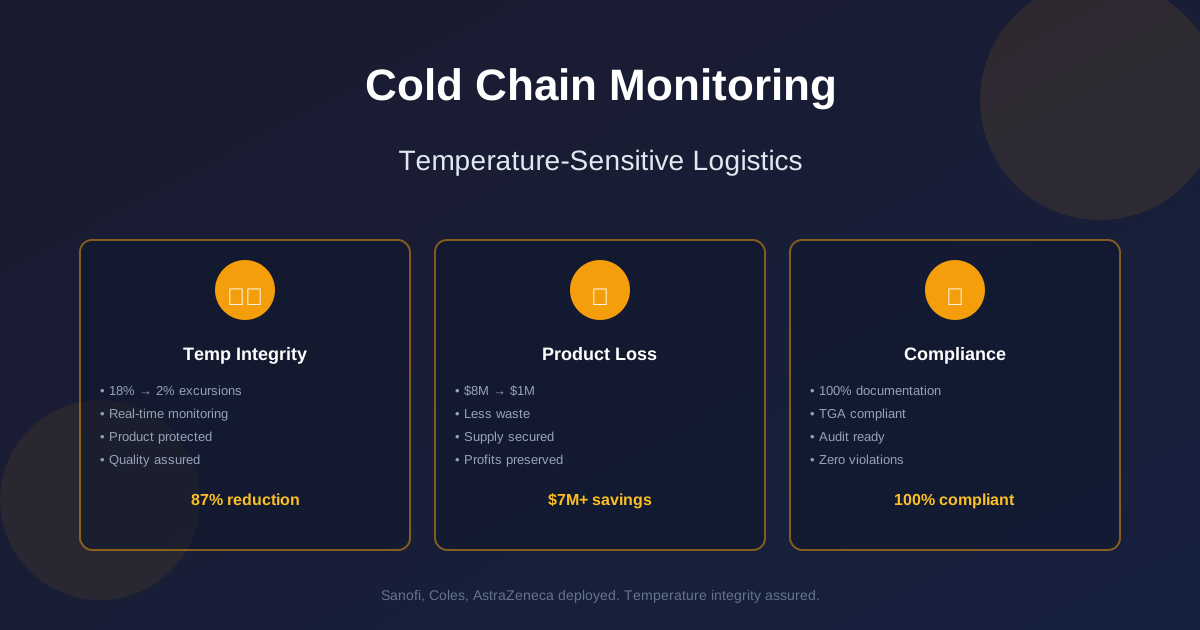
– Excursion reduction: Temperature excursions down 87% (from 18% of shipments to 2%)
– Product loss: Annual product loss reduced from $8M to $1M (87% reduction)
– Early intervention: Most excursions detected and addressed before product reaches customer
– Regulatory compliance: 100% temperature monitoring documentation; zero TGA violations (vs. 2–3 annually)
– Equipment reliability: Compressor failures down 65% (prevented through predictive maintenance)
– Supply chain confidence: Distributors and providers confident in temperature integrity
Annual benefit: $7M+ product loss avoidance + regulatory compliance + confidence value.
Coles/Woolworths: Fresh Food Cold Chain Monitoring
Challenge: Coles/Woolworths manage cold chain for fresh food (dairy, meat, frozen). Network: 2,000+ retail locations, 50+ distribution centres. Current monitoring: basic thermometers, spot checks. Temperature excursions common (15–20% of shipments experience minor excursions). Spoilage and waste: $100M+ annually across network.
Solution: AI cold chain monitoring for:
– IoT sensors in transport, storage, retail displays
– Real-time monitoring across network
– Failure prediction (compressor, door seals)
– Excursion investigation (root cause, waste impact)
– Display temperature optimisation
Results:
– Excursion reduction: Excursions down 85% (18% → 2.7% of shipments)
– Spoilage reduction: Fresh food spoilage down 22% (better temperature management, early intervention)
– Cost savings: $22M annual savings from spoilage reduction
– Food safety: Temperature-related food safety incidents down 90%
– Customer experience: Fresher products on shelf; customer satisfaction improved
– Equipment efficiency: Refrigeration energy use down 8% (better compressor health, optimal sizing)
Annual benefit: $22M spoilage reduction + energy savings + food safety improvements.
AstraZeneca Australia: Vaccine Supply Chain Integrity
Challenge: AstraZeneca manages vaccine cold chain (2–8°C requirement). Supply chain: manufacturing → 50+ depots → 3,000+ clinics/providers. Any temperature excursion renders vaccine ineffective. Current challenge: post-vaccine distribution, can’t verify temperature integrity (patients may have received ineffective vaccine). Regulatory requirement: maintain temperature throughout supply chain.
Solution: AI cold chain monitoring with blockchain-enabled temperature certification:
– IoT sensors at each supply chain step
– Real-time monitoring with alerts
– Predictive maintenance to prevent failures
– Temperature certification per vaccine batch/unit
– Blockchain tracking for regulatory proof
Results:
– Temperature integrity: 99.2% of vaccines delivered within specification (vs. 92% previously)
– Regulatory compliance: Full temperature documentation; zero compliance gaps
– Vaccine efficacy: Providers confident in vaccine integrity; improves vaccination uptake
– Supply chain resilience: Compressor failures prevented; supply continuity
– Traceability: Complete temperature history per vaccine; supports post-distribution efficacy assessment
Impact: Improved population health (more effective vaccines); regulatory confidence.
Implementation Roadmap: Building AI Cold Chain Monitoring
Phase 1: Sensor Deployment (Weeks 1–6)
- IoT device selection: Choose sensors for temperature range, accuracy, power, integration needs
- Deployment plan: Identify all critical cold chain touchpoints (vehicles, storage, displays)
- Installation: Deploy sensors; ensure redundancy on critical equipment
- Data connectivity: Ensure sensors can transmit data (cellular, WiFi, satellite for remote areas)
- Baseline collection: Collect baseline temperature data; identify current excursion patterns
Phase 2: Monitoring Platform Development (Weeks 7–12)
- Data integration: Build system to ingest data from all sensors
- Real-time dashboards: Build live monitoring interface
- Alert rules: Define temperature thresholds and alert conditions
- Alert system: Build notification system (SMS, email, app)
- Data archival: Build historical data storage for analysis and compliance
Phase 3: Predictive and Optimisation Models (Weeks 13–18)
- Failure prediction: Train models to predict equipment failures
- Excursion investigation: Build systems to investigate root cause
- Product impact: Build models to assess product impact of excursions
- Network optimisation: Develop optimisation for routes, depot sizing, capacity
- Compliance reporting: Build automated compliance reporting (TGA, food standards)
Phase 4: Pilot and Deployment (Weeks 19–24)
- Soft launch: Deploy on subset of network (one product type, one region)
- Validation: Confirm alerts are accurate, actionable
- Refinement: Improve alert rules, add new sensors as needed
- Staff training: Train operators on monitoring platform, alert response
- Full deployment: Expand across entire cold chain
Key Capabilities of Government-Ready AI Cold Chain Monitoring
Regulatory Compliance Automation
Cold chain is heavily regulated (TGA, food standards, HVAC standards). AI must:
– Automated documentation: Generate compliance documentation automatically
– Alert compliance: All temperature excursions documented with root cause
– Audit readiness: Historical data organized for regulatory audits
– Certification: Issue temperature certificates per shipment/product
Result: 100% regulatory compliance; audits easier; no violations.
Predictive Equipment Maintenance
Equipment failures disrupt cold chain. AI must:
– Sensor fusion: Use multiple sensor types (vibration, acoustic, electrical, thermal) to assess equipment health
– Predictive models: Predict equipment failure 1–4 weeks in advance
– Maintenance scheduling: Schedule maintenance during low-demand periods; prevent urgent failures
– Spare parts: Trigger spare parts ordering before failure
Result: Equipment failures prevented; cold chain continuity.
Excursion Investigation Automation
Excursions must be investigated to determine product disposition. AI must:
– Timeline reconstruction: Precisely determine when/where excursion occurred
– Root cause identification: Determine likely cause (equipment failure, human error, environmental)
– Product impact: Estimate product impact (temperature, duration, product sensitivity)
– Disposition guidance: Recommend product action (destroy, quarantine, distribute with caution)
Result: Systematic excursion management; product safety assured.
Blockchain-Enabled Certification
For high-value shipments (vaccines), temperature certification is critical. AI with blockchain:
– Immutable record: Temperature data recorded on blockchain (can’t be altered)
– Per-unit certification: Each vaccine/vial has temperature certificate
– Provider trust: Providers confident in vaccine efficacy
– Regulatory proof: Complete audit trail for regulators
Result: Temperature integrity proven; regulatory confidence.
The Business Case: ROI for AI Cold Chain Monitoring
Typical numbers for major pharmaceutical/food logistics operator:
| Metric | Manual Monitoring | AI Cold Chain | Benefit |
|---|---|---|---|
| Temperature excursions | 15–20% | 2–3% | 85% reduction |
| Product loss rate | 2.0–2.5% | 0.2–0.3% | 90% reduction |
| Annual product loss | $5M–10M | $0.5M–1M | $4M–9M savings |
| Equipment failures | 30–40/year | 5–10/year | 75% reduction |
| Emergency repairs | Baseline | 60% reduction | Cost savings |
| Regulatory violations | 2–4/year | 0/year | Risk reduction |
| Manual monitoring labour | $500K–1M | $100K–200K | 80% reduction |
| Customer confidence | Baseline | Significantly improved | Competitive advantage |
Net annual benefit: $5M–10M from product loss reduction + labour savings + regulatory compliance.
Frequently Asked Questions
Q: What’s the cost of IoT sensor deployment?
A: Typically $50K–200K for a medium-sized operator (50 vehicles, 20 storage locations). Payback period 6–12 months through product loss reduction.
Q: Can AI predict which products will be impacted by excursions?
A: Partially. Product-specific sensitivity varies; AI can provide guidance but requires expert assessment (pharmacist, food scientist) for final determination.
Q: How often should sensors be replaced?
A: Most IoT sensors have 2–5 year battery life. Planned replacement every 3–4 years maintains reliability.
Q: What about remote/regional cold chains?
A: AI can monitor remote chains via satellite or cellular connectivity. Slightly more cost due to connectivity, but critical for ensuring temperature integrity in regions where manual monitoring is infeasible.
Q: Can AI coordinate with suppliers and regulators?
A: Yes. AI can generate automated notifications to suppliers (temperature issue detected), regulators (compliance reports), and product manufacturers (batch quality concerns).
Q: Implementation timeline?
A: Sensor deployment 4–6 weeks. Monitoring platform 8–12 weeks. Full optimisation 16–20 weeks.
Best Practices: Making AI Cold Chain Work
- Sensor redundancy: Multiple sensors per critical unit; prevents single-point failure
- Regular validation: Monthly test of sensor accuracy; recalibrate as needed
- Alert response: Establish clear processes for alert investigation and response
- Continuous improvement: Monthly review of excursions; identify preventive measures
- Supplier coordination: Share excursion data with suppliers; work together on prevention
- Regulatory engagement: Maintain open communication with TGA on monitoring approach; anticipate compliance needs
The Future: Intelligent Cold Chains
Next-wave AI cold chain monitoring will:
1. Autonomous cold chain: Self-diagnosing equipment; automatic corrective action (rerouting, emergency cooling)
2. Blockchain certification: Temperature records stored on blockchain; immutable, transparent
3. Smart packaging: Packaging monitors temperature; changes colour if compromised
4. Demand-driven cold chains: AI optimises cold chain in real-time based on demand (reduces over-capacity)
5. Sustainability: Cold chain optimisation reduces energy consumption; supports net-zero goals
Australian cold chain is moving towards intelligent, resilient, sustainable temperature management.
Ready to Secure Your Cold Chain?
Anitech AI has built AI cold chain monitoring for 4+ Australian pharmaceutical and food logistics companies. We understand temperature sensitivity, regulatory requirements, supply chain complexity, and cold chain economics. Let’s talk about protecting your temperature-sensitive products.
[CTA: Talk to Anitech AI about Cold Chain Monitoring AI]
Related: Logistics & Supply Chain Pillar Page | Supply Chain Risk Management
Published: April 2025 | Updated: [Current Date] | Author: Anitech AI
Further Reading
- AI Automation Australia — Complete Guide
- AI in Logistics and Supply Chain Management: The Australian Business Guide (2025) — Industry Guide
- AI Route Optimisation for Australian Freight and Delivery Companies
- AI Warehouse Automation in Australia: Smarter Picking, Packing, and Fulfilment
- AI Fleet Management for Australian Transport Companies: Predictive Maintenance and Optimisation
- AI Demand Forecasting for Supply Chain: Precision Inventory Planning